

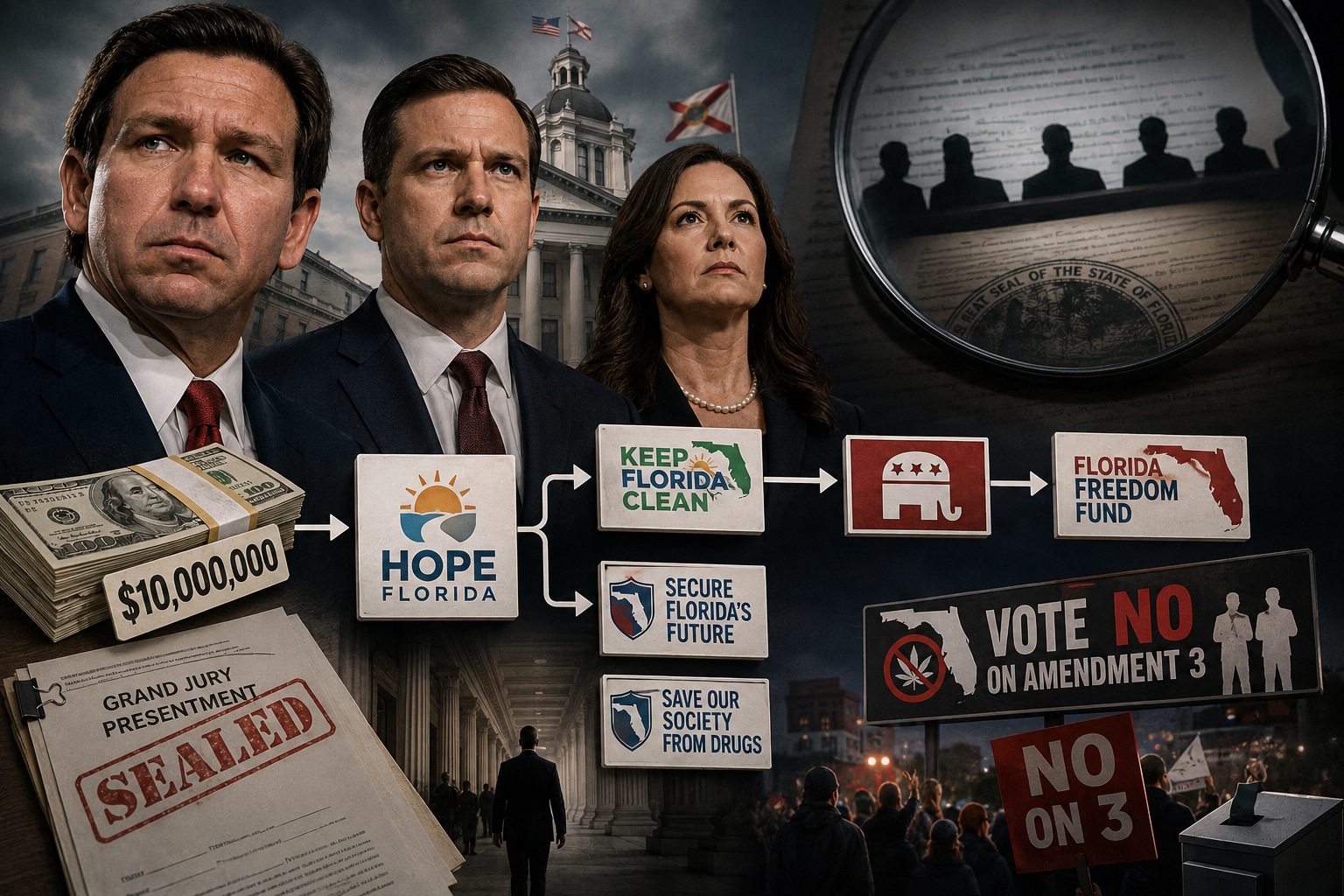
After the sealed Hope Florida presentment leaked this week to CBS News Miami, Gov. Ron DeSantis’s primary focus was not the $10 million from a settlement with Medicaid contractor Centene for overbilling Florida’s Healthy Kids program, which insures low-income children. It was publicly labeling the grand jury’s findings a “hoax” and a lie.
That is not the response of a governor absorbing a report about taxpayer money. It is the response of a man protecting the people he promoted.
The money moved. Then they were appointed to higher office.
There was, he said, no diversion of Medicaid funds. The only crime “was whoever leaked the grand jury report,” and there would be “consequences.”
Attorney General James Uthmeier called the coverage a politically motivated attack and said leaking grand-jury material is a crime under Florida law. He warned reporters asking about the sealed report that they might themselves be breaking the law.
The misconduct is out in the open now. The people who moved the money got promoted. DeSantis, Uthmeier, and Moody are no longer protected behind a sealed report. What they treated as a leak problem is now a public record of who signed, who rose, and who looked away.
Three things are no longer sealed:
The $10 million was taxpayer money, misappropriated for politics.
Uthmeier had the authority to move it, and he was promoted.
Moody had the authority to stop the signature. She authorized it anyway.
Jurors wrote that the money was “misappropriated as part of a sophisticated scheme to fund political activities,” that intermediaries “mischaracterized” the intended use, and that senior officials tried to “circumvent” laws requiring the funds be returned.
The $10 million belonged to taxpayers. DeSantis once called it a “cherry on top.” The presentment rejected that. It was not extra. It was part of the settlement. DeSantis and Uthmeier can call the report a hoax. The jurors did not.
The panel pinned Uthmeier as the man with authority over the settlement team. As chief of staff he oversaw the officials who negotiated the Centene deal and the $10 million sent to Hope Florida.
Testimony and messages identified Uthmeier as telling an intermediary nonprofit to seek money from Hope Florida. He controlled Keep Florida Clean, which received most of what came next.
DeSantis then named him attorney general.
He had never been elected. He is on the ballot now.
The Leon County grand jury finished the report in January. It sat sealed for seven months until CBS Miami made the leak public.
“Nobody will take responsibility for deciding the $10 million of taxpayer money would go to Hope Florida,” the grand jury wrote. “This decision was the original misappropriation, and no witness would take responsibility for making the decision or had any memory of who made it.”
Keep Florida Clean, the panel wrote, “was the prime recipient of the majority of the $10 million taxpayer funds.” From there the money did not stop. Keep Florida Clean sent millions to the Republican Party of Florida and to the Florida Freedom Fund, a DeSantis-tied committee.
The funds helped finance the campaign that defeated Amendment 3, Florida’s 2024 recreational marijuana measure.
Money also moved into committees active in the 2024 fights. Amendment 3 won a majority of the vote and still failed the 60 percent threshold required to amend the Florida Constitution.
Those later transfers were already on the public books. The presentment is what named them as taxpayer money.
The $10 million came from a $67 million settlement with Centene for overbilling Healthy Kids. Florida had the overbilling on the books since 2021.
The settlement sat until September 2024, weeks before voters decided Amendment 3. Officials rewrote it: $57 million to the state, $10 million to Hope Florida.
From there it moved fast: two $5 million grants to Secure Florida’s Future and Save Our Society From Drugs, two 501(c)(4) groups that do not have to disclose their donors in the same way a PAC does, then $8.5 million to Keep Florida Clean.
The state later reimbursed the federal government for the $10 million “in an abundance of caution.”
They called it a cherry on top. They repaid it as Medicaid.
Jurors flagged the speed. The settlement took seven days to fund. They wrote that they believed the rush was “due to the impending election which was just 45 days away.” Once the $10 million reached Hope Florida, it was gone within 25 days.
Virtually everyone involved, the grand jury noted, was a lawyer acting on other lawyers’ advice. “We recognize that this would be an impediment to criminal prosecution,” the panel wrote.
Neither Ashley Moody nor Uthmeier nor the governor were called to testify. Some legal observers told the Miami Herald that the absence of Uthmeier’s testimony could mean he was treated as a target of the investigation.
The report said then-Attorney General Ashley Moody was aware of the plan to send $10 million from the Centene settlement to Hope Florida.
Then-Chief Deputy Attorney General John Guard raised objections with her. The deal was rewritten so the Agency for Health Care Administration, not the attorney general’s office, directed the funds. Moody then authorized Guard to sign that final version.
The Attorney General’s Office was one of four state agencies required to sign the original settlement. The four signatories were Guard, then-AHCA Secretary Jason Weida, Insurance Commissioner Mike Yaworsky, and then–Department of Health Chief of Staff Cassandra Pasley.
John Guard signed it for the office. He told the grand jury he signed only after raising it with Moody and getting her approval. Guard also testified that he “esoterically” agreed the $10 million belonged to the state and that he had “political concerns” about spending it without legislative approval, concerns he shared with Moody, who authorized the signature anyway.
Moody could have stopped this. That was the line of authority.
She authorized the signature. Then she was sent to the Senate.
Other officials said they relied on her office. Insurance Commissioner Mike Yaworsky noted the “atypical nature” of the $10 million earmark and signed after being told by counsel and by Guard there was nothing contrary to law.
Andrew Sheeran, then AHCA general counsel, said he conferred with multiple AG lawyers and an outside firm and believed the deal complied with Florida law.
No witness admitted who first decided that Hope Florida — the foundation tied to the governor’s wife, Casey DeSantis, whose public brand the charity was built to support — would receive the $10 million.
The gaps were not small. Witnesses contradicted one another. Asked who ordered the $10 million to Hope Florida, their memories drew blanks.
The chairman of the Hope Florida board testified that the foundation’s lawyer called to say a $10 million donation was coming.
That lawyer, Jeff Aaron, who has personal and professional ties to DeSantis and Uthmeier, told the grand jury he did not learn of the donation until the affair exploded months later. The panel called the contradiction “curious” and found the board chair “transparent and credible.”
Katie Strickland, a deputy chief of staff whose portfolio included AHCA, said the idea came from then-AHCA Secretary Jason Weida. Sheeran said the same. Weida said he could not recall whose idea it was. DeSantis later promoted Weida to chief of staff after naming Uthmeier attorney general.
The man who could not recall whose idea it was runs the governor’s office.
In January 2025, after DeSantis appointed Moody to the U.S. Senate, the seat that opened when Donald Trump made Marco Rubio secretary of state, the governor named Uthmeier attorney general. He was sworn in February 2025.
The attorney general named in that leak is James Uthmeier, now on the November ballot against Jose Javier Rodriguez. Moody faces state Rep. Angie Nixon.
The grand jury also asked the Legislature to close the hole: require settlement money to go into the General Fund, and put real rules and consequences on how entities like Hope Florida may use taxpayer dollars.
Sen. Rick Scott called the findings “deeply concerning.” “Money designated to help poor kids was diverted to political ads. Florida families deserve accountability, not more finger pointing in Tallahassee.”
DeSantis is term-limited. Uthmeier and Moody are not.
The jurors could not name who pulled the lever. They named who had the authority, who signed, who got the money, and who got promoted. DeSantis and Uthmeier can call that a hoax. The presentment is now public. The ballot is in November.

