

By Thomas Fazi, CompactMag
“The Russian invasion of Ukraine was a rational response to Western encroachment.”
As the war in Ukraine stretches into its second year, we continue to be told that Russia’s invasion was an irrational, unprovoked act animated by a paranoid dictator’s Hitlerian thirst for annexing territory. This claim undergirds the entire Western narrative on Ukraine. Indeed, it’s hard to find a statement by Western leaders on the subject that doesn’t include the word “unprovoked.”
It’s easy to see why. If this narrative is correct, then so must be the West’s strategy in Ukraine. If we are dealing with a “new Hitler” in Vladimir Putin, there is no room for diplomatic negotiations, which require a rational interlocutor. Moreover, there is no alternative to total military victory. Confronting Putin entails risks, of course, including that of a direct NATO-Russia confrontation, but the alternative would be to appease his maniacal drive for Lebensraum. Next in line would be the Baltic States, and after that—who knows?
The problem is that this narrative is not only incorrect, but the opposite of the truth. Viewed from the standpoint of Russian national self-interest, the invasion of Ukraine was a rational response to the Western encirclement of Russia’s borders that began during the dissolution of the Soviet Union and continued to the eve of the war. By that point, events in Ukraine had reached a tipping point, and were plausibly understood by Russia’s leadership to represent an existential threat to its survival—leading Moscow to take pre-emptive action.
It all began in 1990, when Western and Russian leaders laid the groundwork for new post-Cold War security arrangements in Europe. As is well known, these included an assurance by the West that NATO wouldn’t expand eastward. No official treaty ever codified such a promise, a fact often trotted out by those who claim the assurance is a myth or an outright fabrication of the Russian propaganda machine.
But such denials ignore the fact that interstate relations, like interpersonal relations, rely on informal exchanges much more than they do on explicit contractual obligations. In any case, there is no doubt that “a cascade of assurances about Soviet security [were] given by Western leaders to Gorbachev and other Soviet officials throughout the process of German unification in 1990 and on into 1991,” according to an analysis by the National Security Archive of George Washington University, based on declassified documents.
As early as January 1990, the West telegraphed to Moscow that the dissolution of the Soviet Bloc wouldn’t be followed by NATO expansionism, with then-West German Foreign Minister Hans-Dietrich Genscher declaring in a speech in Bavaria that month that German reunification should not be accompanied by an “expansion of its territory towards the east, i.e. moving it closer to the Soviet borders.”
The following month, Genscher told his British counterpart, Douglas Hurd, that “the Russians must have some assurance that if, for example, the Polish government left the Warsaw Pact one day, they would not join NATO the next.” Then US Secretary of State James Baker “repeated exactly the Genscher formulation in his meeting with [Soviet] Foreign Minister Eduard Shevardnadze … and even more importantly, face to face with Gorbachev,” according to the George Washington University researchers (again, citing declassified documents). Time and again, the likes of Baker, Hurd, and Genscher reassured Soviet authorities at the highest level that “our policies are not aimed at separating Eastern Europe from the Soviet Union,” as Baker told Gorbachev. “We had that policy before. But today we are interested in building a stable Europe, and doing it together with you.”
In addition to assurances about Western expansion, Western leaders, not least US President George H.W. Bush and Prime Minister Margaret Thatcher of Britain vowed a shift in the structure and function of the Western Alliance, away from a military bloc and toward a political one that would include Russia as a partner “into discussion about the future of Europe,” as the Iron Lady told Gorbachev in June 1990. Her successor, John Major, personally reiterated to Gorbachev the following year that “we are not talking about the strengthening of NATO.” There were many more such reassurances where that came from, leading the George Washington University researchers to conclude that subsequent Soviet and Russian complaints about being misled about NATO expansion “were founded in written contemporaneous” memos.
Or as former CIA Director Robert Gates put it, the West blindsided Moscow by “pressing ahead with expansion of NATO eastward [in the 1990s], when Gorbachev and others were led to believe that wouldn’t happen.”
“Moscow considered the entry of Ukraine and Georgia into NATO an absolute red line.”
Within a few years, NATO began to expand toward Russia’s border. Although the trajectory of NATO expansion became clear in the mid-1990s, the first decisive step occurred in 1999, when the Western Alliance formally admitted three new states from Central and Eastern Europe: Hungary, the Czech Republic, and, most important, Poland, a country with a long history of hostility to Russia. Even though this didn’t violate any formal treaty obligation, it flagrantly contradicted the assurances previously offered by the West.
Then, in 2001, President George W. Bush announced America’s unilateral withdrawal from the Antiballistic Missile Treaty. Just a few years later, in 2004, NATO admitted an additional seven Eastern European countries, including Romania and Estonia, the latter of which borders on Russia. By this point, most members of the former Warsaw Pact had joined NATO, which had expanded nearly 1,000 miles toward Russia.
Americans should understand better than anyone why these actions were legitimate cause for concern in Moscow. It’s been unofficial US policy for more than a century that potentially hostile foreign powers are forbidden from placing military forces close to the American border—or indeed, anywhere in the Western hemisphere. “US policy thus reveals a conviction about the strategic importance of geographic proximity in military deployments, irrespective of stated intentions,” as Benjamin Abelow writes in his important 2022 book, How the West Brought War to Ukraine. If Russia had taken equivalent actions with respect to the US territory—say, placing its military forces in Canada or Mexico—Washington would undoubtedly have interpreted such a move as a threat to its national security, and would likely have gone to war over it, even if Russia had stated that its intentions were purely defensive.
So it’s hardly a surprise that verbal assurances from the West that NATO’s enlargement wasn’t offensive in nature did little to assuage Russia’s concerns—especially given that the West had already broken its promises on several occasions. Subsequent events would only lend further credence to Moscow’s fears. At a 2008 summit in Bucharest, NATO announced that it intended to admit Ukraine and Georgia as members. Both countries border on Russia. Even though no formal action to admit those countries was taken at the time, the statement nonetheless represented a brazen provocation. Moscow had always been very clear that it viewed the possible admission of Ukraine and Georgia to NATO as an existential threat. Ukraine shares a 1,200-mile land border with Russia, and is a mere 400 miles from Moscow.
The Bucharest announcement didn’t happen out of the blue; it came on the heels of years of US provocations. American officials had been openly talking about “integrating Ukraine into the Euro-Atlantic community” for several years. As an analysis from 2004 put it, “for a long time, the aim of American foreign policy has been to drive a wedge between Russia and Ukraine and draw the latter into NATO,” for example by funding pro-Western opposition parties.
Following the NATO Bucharest summit, William J. Burns, then America’s envoy to Moscow and currently the director of the CIA, sent a cable to Washington in which he described his meeting with the Russian foreign minister. Burns noted that Moscow considered the entry of Ukraine and Georgia into NATO an absolute red line. In August of the same year, four months after NATO’s announcement of the plan to admit Ukraine and Georgia, Russian forces invaded Georgian territory. This was a reaction against an assault by the Georgian military—funded, armed, and trained by the United States—on a semi-autonomous Georgian district, South Ossetia, that borders Russia. The Georgian attack took place days after the United States led a 2,000-man military exercise inside Georgia.
The United States also began to conduct military exercises near Russia’s borders. For example, in 2020, NATO conducted a live-fire training exercise inside Estonia, 70 miles from Russia. Meanwhile, the United States and other Western countries, acting outside of NATO, armed, trained, and coordinated with the Ukrainian military, and reaffirmed the commitment that Kiev would join the Western Alliance. In July 2021, Ukraine and America co-hosted a major naval exercise in the Black Sea involving navies from 32 countries.
In other words, between 2017 and 2021, there was a flurry of Western military activity near Russia’s borders, including simulated attacks on Russian targets, as well as Ukraine’s de facto integration into NATO structures.
“Between 2017 and 2021, there was a flurry of Western military activity near Russia’s borders.”
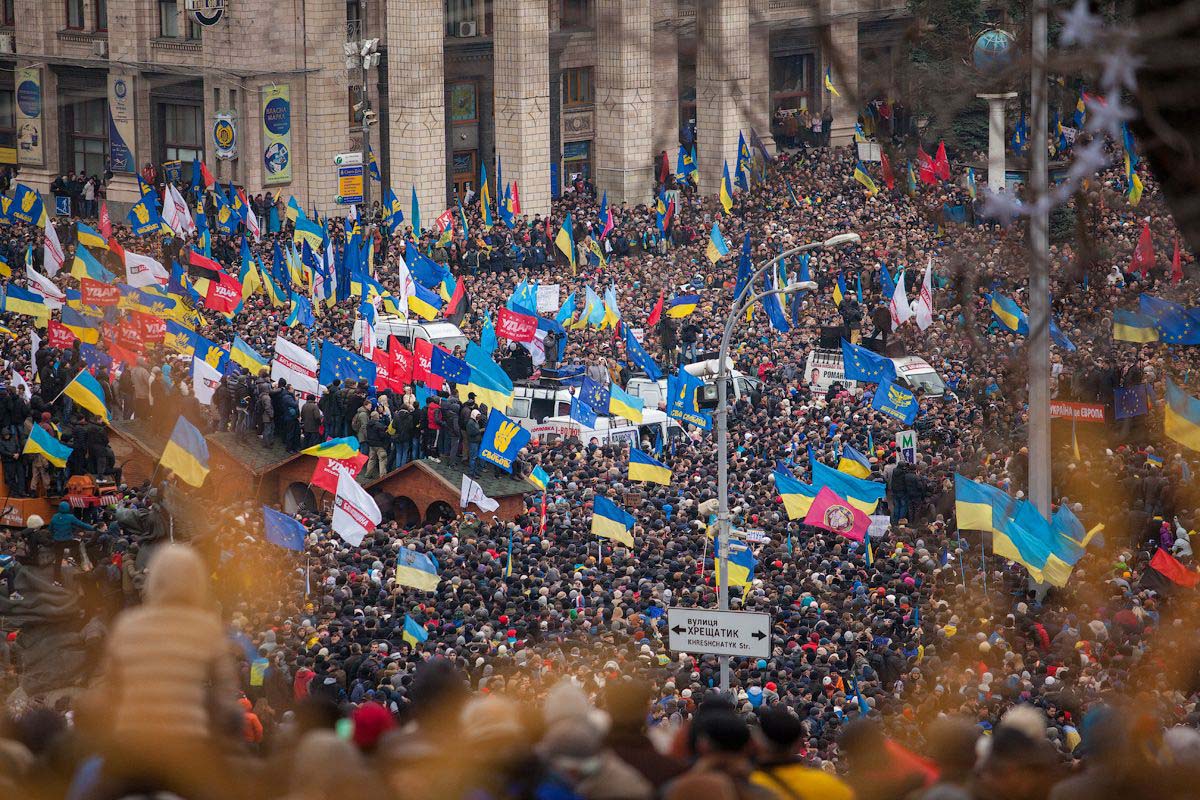
The final chapter in the prehistory of Russia’s invasion of Ukraine began in late 2013, with the so-called Euromaidan uprising against the pro-Russian Ukrainian government of Viktor Yanukovych—elected in 2010 in a vote judged free and fair by international observers. (The name “Euromaidan” references the pro-European sentiments of the demonstrators and the square in central Kiev—Maidan Nezalezhnosti—where the protests occurred.) The protests began peacefully but turned violent, culminating in three days of deadly clashes between security forces and protesters, many of whom were armed. All told, nearly 100 protesters and 13 police died, mostly as a result of shots fired by snipers. The bloodshed triggered an avalanche of international outrage and forced Yanukovych to flee the country.
The events of those days remain hotly debated. Even though Western governments and media organs immediately blamed the deaths of the protesters on security forces, there is evidence that many of the shots—aimed at protesters as well as at police—were in fact fired from protester-controlled buildings by shooters tied to far-right ultra-nationalist groups.
Ivan Katchanovski, a political scientist at the University of Ottawa and author of several peer-reviewed studies on the topic, has come to the conclusion that the Maidan massacre “was a successful false-flag operation organized and conducted by elements of the Maidan leadership and concealed groups of snipers in order to overthrow the government and seize power in Ukraine”—in other words, a coup against a democratically elected government by armed, far-right Ukrainian ultra-nationalists.
It’s unclear exactly what role Washington played in the events of those days. What we know for sure is that the United States was crucially involved in the events that led up to the Euromaidan protests, and then actively supported and promoted the demonstrations, in an obvious attempt to bring about regime change in Ukraine. In November 2013, days before the uprising broke out, a Ukrainian lawmaker stated in Parliament that the United States was preparing a civil war in Ukraine, and that NGOs were being used to carry out a coup from inside the US Embassy in Kiev. A leaked phone call between then-Assistant Secretary of State Victoria Nuland and then-US Ambassador to Ukraine Geoffrey Pyat also revealed that in late January 2014, a month before the massacre, Washington was already handpicking who would replace Yanukovych.
In response to the coup, and partly out of “well-founded concern,” writes Abelow, that the post-coup government or its Western partners might try to block Russia’s use of its vital naval base in Sevastopol, Crimea—access to which Russia had previously negotiated—Russia annexed Crimea. The 2014 events plunged Ukraine into a bloody civil war between the government and pro-Russian separatists in the Donbas region, which borders Russia. Much has been said about Russian support for the Donbas separatists. Less known is the fact that, immediately following the coup, the United States began a massive program of military aid to Ukraine, though at first this was limited to non-lethal items. One objective of this funding was to “improve interoperability with NATO”—signaling that Washington would begin treating Ukraine as a de facto NATO member regardless of its formal status.
The provocations didn’t end there. In 2016, acting on the prior American abrogation of the ABM Treaty, the United States put into operation a missile site in Romania (scheduled to be followed by Poland in 2022), designed to accommodate nuclear-tipped offensive weapons like Tomahawk cruise missiles, capable of striking deep inside Russia. A year later, the Trump administration began to sell lethal weapons to Ukraine. In 2019, the administration also unilaterally withdrew from the 1987 Intermediate-Range Nuclear Forces Treaty. Fearing that this boosted the risk of a US first strike, Moscow sought new, mutual restrictions and moratoria on missile deployments; Washington dismissed the Russian proposals.
The United States also began to conduct military exercises near Russia’s borders. For example, in 2020, NATO conducted a live-fire training exercise inside Estonia, 70 miles from Russia. Meanwhile, the United States and other Western countries, acting outside of NATO, armed, trained, and coordinated with the Ukrainian military, and reaffirmed the commitment that Kiev would join the Western Alliance. In July 2021, Ukraine and America co-hosted a major naval exercise in the Black Sea involving navies from 32 countries.
In other words, between 2017 and 2021, there was a flurry of Western military activity near Russia’s borders, including simulated attacks on Russian targets, as well as Ukraine’s de facto integration into NATO structures.
“The provocations against Russia only became more pronounced.”
Ukrainian President Volodymyr Zelensky was elected in 2019 with the promise of bringing peace to Donbas by implementing the Minsk agreements, a series of French- and German-brokered deals aimed at bringing the conflict in eastern Ukraine to an end, including constitutional reforms in Ukraine granting a measure of self-government to certain areas of Donbas. There is evidence that Zelensky took his mandate seriously. However, from the start, far-right nationalists expressed their violent opposition to the implementation of Minsk, even going as far as threatening to kill Zelensky and his family.
There was one powerful actor that could have reined in the extremists: the US government. Yet no substantial American support was ever given to the peace agenda. The result was the violation of the Minsk agreement, the continuation of the fighting, and Zelensky’s adoption of an increasingly intransigent anti-Russian position. This included reiterating Ukraine’s intention to join NATO. “Unsurprisingly, Moscow found this evolving situation intolerable and began mobilizing its army on Ukraine’s border to signal its resolve to Washington,” as John Mearsheimer notes. “But it had no effect, as the Biden administration continued to move closer to Ukraine. This led Russia to precipitate a full-blown diplomatic stand-off in December 2021.”
That same month, writing in the journal Foreign Policy, the Russian ambassador to the United States wrote a dramatic appeal to his American and Western counterparts, warning that “the situation is extremely dangerous” and presenting a series of concrete proposals to create conditions for de-escalation in Europe and restoration of trust, including the withdrawal of military activities from Russia-NATO contact lines and a new moratorium on the deployment of ground-based intermediate-range missiles. He also warned that, if the West chose to escalate, Moscow would not back down:
No one should doubt our determination to defend our security. Everything has its limits. If our partners keep constructing military-strategic realities imperiling the existence of our country, we will be forced to create similar vulnerabilities for them. We have come to the point when we have no room to retreat. Military exploration of Ukraine by NATO member states is an existential threat for Russia.
Moscow’s offer as well as its warning were ignored by the United States. Indeed, the provocations against Russia only became more pronounced. On Feb. 19, 2022, Zelensky, in a speech at the Munich Security Conference, questioned whether Ukraine was obligated to retain its non-nuclear status.
Five days later, Russia launched its invasion. One may very well consider that action morally reprehensible, but in light of the events that led to that decision, it can’t be considered unprovoked. On the contrary, it was a rational reaction to what Russians plausibly saw as an existential threat—and the same course of action Americans would have taken if they had been put in a similar position.
To be clear, what may be justifiable from a realist national-security perspective isn’t necessarily justified from a moral standpoint. But the Western narrative on Ukraine, aside from being incorrect, represents an insurmountable obstacle to any diplomatic solution insofar as it depicts Russia, and its leader, as agents of evil who can’t be reasoned with. This narrative empowers the military-industrial complex and the most jingoistic factions in the West, which evidently want the proxy war against Russia to go on for as long as possible. Understanding how we got into this mess is the only way of getting out of it. That means grasping the motivations that drove Russia to invade, and acknowledging the responsibility of all the parties involved, including the West. These are basic preconditions for putting an end to the humanitarian disaster in Ukraine.

