

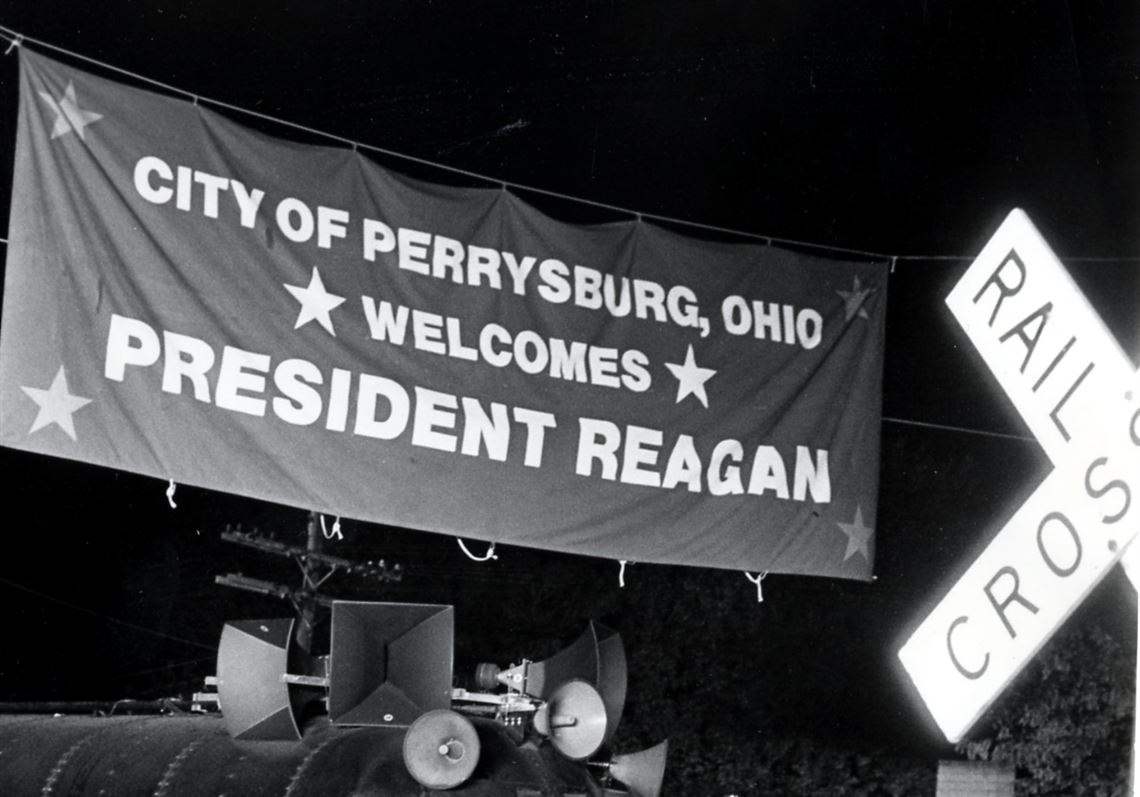
“Off to Dayton, Ohio for ‘Whistle Stop’ tour across Ohio,” President Ronald Reagan wrote in his diary 40 years ago.
Reminiscent of Harry Truman’s whistlestop in 1948, on Oct. 12, 1984, the 40th President traveled northbound from Dayton to Sidney, Lima, Ottawa, and Deshler, ending the trip in Perrysburg.
I was 7 years old at the time, in the crowd as “the Heartland Express” slowed to the final stop in its itinerary at the Louisiana Avenue crossing.
“The tally showed more than 100,000 people at those five stops and no counting of the crowds at all the small towns we passed through,” Reagan wrote.
The purpose was to see average Americans and their communities up close while playing up nostalgia and romance for train travel — a late 20th century version of the front porch campaign popularized by the likes of Ohioans James Garfield and William McKinley. Four decades later, it’s worth reflecting on what that trip meant for these communities and how much the nature of American politics — and ourselves — have changed since.
The whistlestop of 1984 was the most complex presidential advance and Secret Service undertaking of the Reagan-Bush re-election campaign.
The train, consisting of 12 cars and three engines, included the historic Ferdinand Magellan presidential car, a Chessie Executive Officer Car, three diner cars, two baggage cars, and five coach cars. It not only provided protection for the president, but facilities needed to be a traveling White House, a Secret Service command and control center, and a press office. With the cooperation of CSX, Chessie, and Amtrak, the train was assembled at Union Station in Washington so it could be inspected and modified as needed before being moved to Dayton for the start of its unique journey.
Designated “U.S. Car One,” the Ferdinand Magellan was used by Presidents Franklin D. Roosevelt, Harry Truman, and Dwight Eisenhower before it was retired in 1958 to the Gold Coast Railroad Museum in Fort Lauderdale, Fla. It included a wood-paneled dining room, a sitting area, and a staff work area between cabins for the president and first lady.
The heaviest passenger railcar ever built in the United States, with six axles and a gross weight of 286,000 pounds, its girth limited it to a top speed just over 40 mph. Much of the added weight was the result of features such as 5/8-inch armor plate covering the entire car, three-inch bulletproof glass, and two escape hatches.
The train’s original door weighed 900 pounds, before the Secret Service found it too unwieldly and demanded a replacement. While Roosevelt liked leisurely trips in it, as it was outfitted with a special railroad wheelchair, Truman would yell if it was going too slow. He was even known to go forward and drive the train. The Ferdinand Magellan was always the last car in the train, and in 1984 it was decorated with presidential memorabilia, especially from Truman’s 1948 re-election campaign. These were also the voters Reagan was targeting — mostly blue-collar, rural Americans from the heartland.
Reagan flew into Wright Patterson Air Force Base in Dayton at 11 a.m., where the presidential traveling party was met by first-term Republican Congressman Michael DeWine before continuing to Old Montgomery County Courthouse Mall for the first rally. Reagan then switched to the train departing Dayton Union Station.
Other Republican members of Congress joined for the portions of the trip that traversed their Congressional districts, including Reps. Tom Kindness, Michael Oxley, and Delbert Latta of Bowling Green. Former Gov. James Rhodes introduced Reagan in Dayton. The stops in Sidney, Lima, Ottawa, and Deshler followed a similar script — a boisterous marching band, the playing of “Hail to the Chief,” and a simplified version of Reagan’s stump speech in which he argued that his rival, former Vice President Walter Mondale, was too liberal for America while also calling for Mondale to release his health records in response to news that he was on medication for high blood pressure and had an enlarged prostate.
Reagan, then 73 and the oldest presidential candidate at the time, was eager to rebuff critics who said he was too old to run again.
The stop in Perrysburg was the final one, before Reagan transferred to motorcade to Toledo Express Airport where Air Force One returned him to Andrews Air Force Base outside Washington.
I was too young to process the event or what Reagan said, but thanks to the marvels of the internet Ohioans in these communities can watch each of Reagan’s stops on YouTube. According to his official schedule, Reagan arrived in Perrysburg at 7:40 p.m. “It was a great day,” Reagan wrote in his diary, and a long one too. He spoke from the rear platform itself at the Louisiana Avenue crossing as opposed to stepping on to a nearby dais. The rear platform was open but covered, with brass-rails and a built-in speaking podium with Truman-era microphones and speakers, adorned by the presidential seal.
“Well, now we’re 3½ weeks from election day,” Reagan said, “and the American people are getting the full flavor of the very clear choice that is facing them.” Indeed we are, even in 2024. “It’s a choice between two fundamentally different ways of governing and two distinct ways of looking at America,” he added.
Perhaps the more things change, the more they stay the same in politics — if only we wait long enough. Will we ever see another “Heartland Express” in our neighborhoods? I don’t think we will. If presidential candidates can reach tens of millions in a televised debate, or through the mobile devices we carry everywhere, why spend a whole day to reach perhaps 100,000 in a part of the nation that has become known as “flyover country”?
Reagan’s trip through northwest Ohio 40 years ago is a reminder of when citizens were people and not just props for huge campaign rallies. However, if I’m wrong, and I hope I am, I know where to find a presidential train.

