

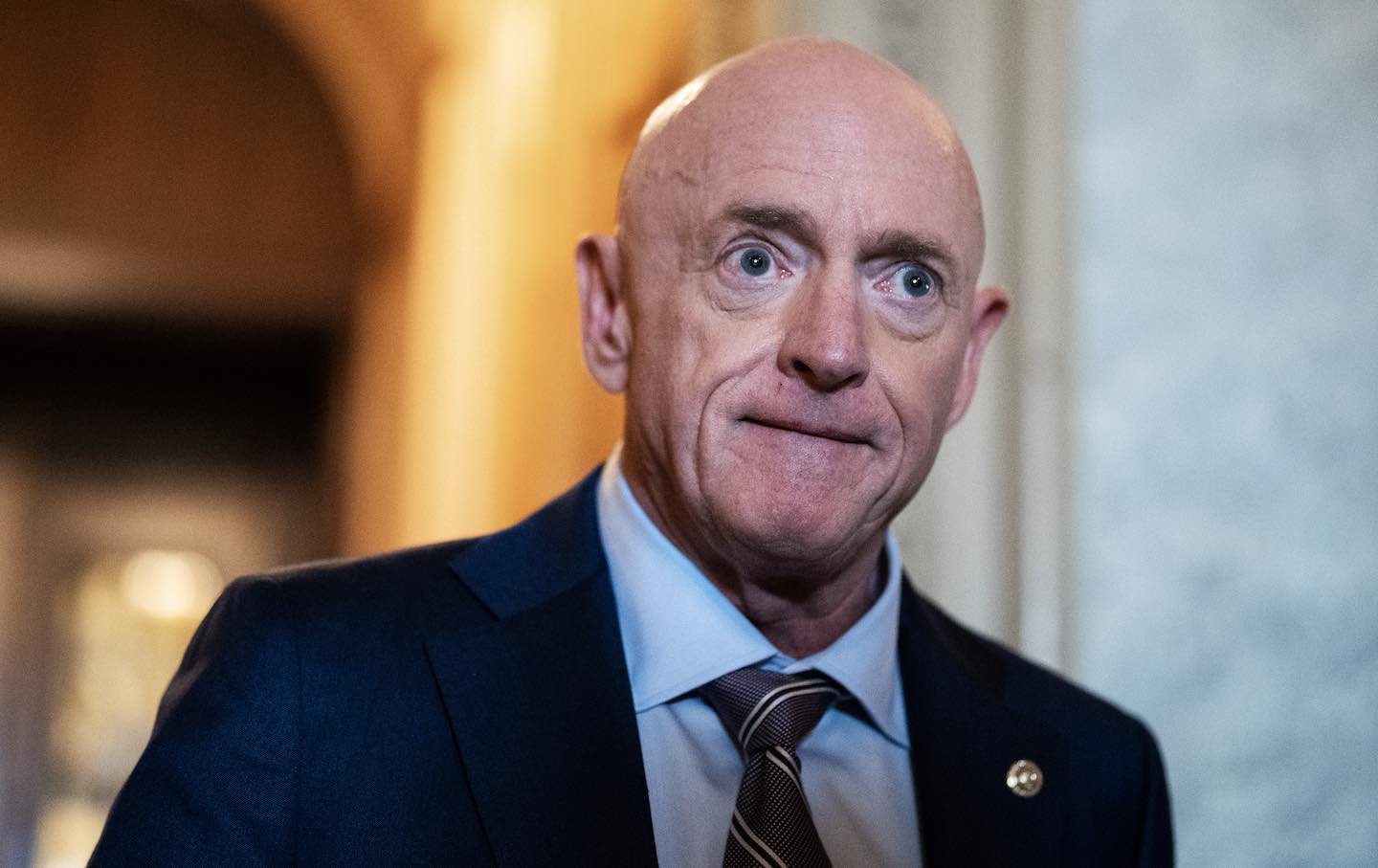
Mark Kelly is not some back bench unknown. He is a United States Senator from Arizona, a retired Navy captain, and a former astronaut who has worn the uniform in combat and ridden a rocket into orbit.
That is precisely why what he has done, and what has unfolded around him since, cannot be brushed aside as another routine Washington shouting match. This is not noise. It is a live wire running straight through the relationship between the military, the Constitution, and civilian authority. The importance of this moment truly cannot be overstated.
On November 18, 2025 Senator Kelly joined five other Democratic lawmakers – Sen. Elissa Slotkin (D-MI, former CIA analyst), Rep. Jason Crow (D-CO), Rep. Chris Deluzio (D-PA, Rep. Maggie Goodlander (D-NH), Rep. Chrissy Houlahan (D-PA) – with military or intelligence backgrounds in a slickly produced video addressed directly to service members and the intelligence community. In that video they urged troops to “refuse illegal orders” and presented themselves as veteran guardians of the Constitution who would show the ranks where the line of legality truly lies.
Ordinarily a stunt like that would earn a cycle or two of cable outrage before dissolving into the digital ether. This time it did not. This time the institution which rightly insists on now calling itself The Department of War responded with language so stark that even the most jaded Pentagon reporters took notice.
On November 24, 2025 The Department of War announced on X it had received “serious allegations of misconduct” against Captain Mark Kelly, United States Navy retired, and that it had launched a review into his conduct related to the “illegal orders” video.
On December 16, 2025 Secretary Pete Hegseth escalated that review into an official Command Investigation, a formal military probe carried out in part by the Pentagon general counsel’s office which is an unprecedented use of military justice scrutiny against a sitting elected official.
According to the Pentagon, the inquiry will assess whether Kelly’s participation in the video warrants anything from administrative measures to recalling him to active duty for court-martial proceedings.
Think about that for a moment; a sitting United States Senator targeted by his former chain of command with the explicit possibility of being dragged back into uniform and tried under the Uniform Code of Military Justice (UCMJ) for statements made in a political message.
That is not business as usual. That is a constitutional tripwire. In plain English, it means this: It describes a moment when the government goes so far beyond its constitutional limits that it sets off alarm bells. It is the point where an action or decision is so clearly unconstitutional that people are justified in pushing back strongly, refusing to go along with it, or taking serious steps to stop it in order to protect the Constitution and the system of government. Put even more simply: It is the line you cross when something is so wrong under the Constitution that doing nothing is no longer acceptable.
The content of the video is not subtle. Kelly and his colleagues tell troops and intelligence officers they have a duty to reject unlawful orders, and they present those orders not as abstract hypotheticals from a classroom ethics seminar, but as a present danger to the Republic. The idea that service members must refuse unlawful commands is not controversial in itself. Nuremberg settled that. United States military law reaffirms it. That is not the point.
The point is where the message came from and when it was delivered. This guidance did not come from a judge advocate general, a military chaplain, or a base-level civics program. It came from partisan politicians beaming directly into the barracks through social media, in the middle of an escalating political conflict with President Donald J. Trump over his military authority and use of force abroad and at home.
Once elected politicians begin telling riflemen, pilots, and intelligence analysts which orders may be illegal in the context of ongoing policy battles, they are no longer explaining the rule of law. They are inviting individual service members to substitute partisan interpretation for the chain of command. That is combustible.
The Department of War knows it. In its announcement, the department reminded the country that federal law forbids actions intended to interfere with “the loyalty, morale, or good order and discipline of the armed forces,” and warned that violations would be handled through “appropriate legal channels.”
Those are not casual phrases. “Serious allegations of misconduct” is language typically reserved for espionage, corruption, or grave breaches of military law. “Recall to active duty for court-martial” is a nuclear instrument. It exists on the books. It has been used only in rare and exceptional cases. It has almost never been publicly floated against a sitting member of the United States Senate.
Then came the public confrontations. Secretary of War Pete Hegseth blasted the video on social media as reckless and argued it could create confusion among troops and encourage insubordination. In a closed-door Senate briefing, Hegseth confronted Kelly during discussions about controversial military strikes, chastising him and other Democrats for posting the video when Kelly raised questions about those strikes’ legality.
Strip away the formality and the punctuation and the meaning is unmistakable. The Secretary of War is accusing a sitting senator of using his retired rank and war record in a way that endangers American troops and discredits the service.
Into this already volatile landscape stepped Donald J. Trump, who has never pretended to speak in the cautious tones of a law review footnote. After the video’s release, Trump described the conduct of Kelly and his fellow lawmakers on Truth Social as “seditious behavior, punishable by DEATH.”
The media predictably fixated on the typography and the temperature of the rhetoric. What they ignored is that the President was pointing directly at existing American law where sedition and related offenses have historically carried maximum penalties in extreme cases.
You may loathe his rhetoric. You may recoil at his style. But you cannot pretend the stakes are small when the commander in chief, the Department of War, and a sitting senator are all invoking words like sedition, illegal orders, and court martial in the same news cycle.
This is not a food fight. It is a test of whether constitutional government can restrain military power, and whether military power can resist being drawn into partisan warfare.
Mark Kelly did not hide. In a statement on X and at public appearances he has condemned the Pentagon investigation, calling it an attempt to intimidate him and silence dissent within the military. He said the probe was “very performative” and asserted that it was about sending a message to retired service members and active duty personnel not to criticize the president. His attorneys have warned that any attempt to proceed with actions against him would be unconstitutional and an extraordinary abuse of power, and have pledged legal action to halt any such effort.
From a purely political perspective, Kelly’s framing is effective. He casts himself as the victim of executive intimidation and cloaks himself in constitutional language. Much of the legacy press has noted that narrative. But his own words underscore just how extraordinary this confrontation has become.
Kelly no longer speaks only as a senator. The Secretary of War himself has emphasized that Kelly addressed “all troops” while explicitly invoking his rank and service history, lending what the department describes as the “appearance of authority” to his message and thereby bringing discredit upon the armed forces. Kelly wants to have it both ways. He wants his retired captain rank and astronaut prestige to amplify his moral authority in the eyes of young service members, then the absolute shield of legislative immunity the moment the institution he once served responds.
That unresolved tension is precisely why this episode matters.
I know something about what happens when powerful institutions turn legal mechanisms into political weapons. I lived through an improperly motivated political prosecution. I watched the full machinery of the federal state deployed in service of a narrative. I also know what happens when the boundary between civilian politics and military obedience begins to blur.
Here is what Americans must understand:
First, if the Department of War succeeds in establishing that it can haul a senator back under the UCMJ for political speech that allegedly affects troop morale, then every retired officer in public life will feel the chill. The message will be unmistakable: step out of line and the old chain of command can reach across time and office to pull you back into uniform.
Second, even if that power is never exercised, the public threat itself is corrosive. An official declaration of “serious allegations of misconduct” coupled with talk of recall is not a neutral act. It is a warning flare. It tells veterans who question deployments, war powers, or military policy that dissent may carry personal risk.
Third, Kelly and his allies are playing with fire by filming themselves offering guidance to the ranks about what constitutes an illegal order in the present political environment. That invites the politicization of the junior officer corps and the enlisted force. You cannot maintain a cohesive military if every platoon becomes its own constitutional court guided by whichever senator appeared in their feed that week.
Fourth, the obsession with surface rhetoric allows the press to evade the central question. Does using retired rank to influence troops against a sitting president’s orders cross the line into prohibited interference with good order and discipline? Refusing to confront that question deepens cynicism and leaves the most serious issues to unelected lawyers and generals.
This is not about liking Mark Kelly or Donald Trump. It is not even primarily about the policies that led to the video. It is about whether the American system can preserve a bright line between political advocacy and military obedience. It is about whether retired officers who enter politics can continue to trade on their rank while claiming immunity from the code that still technically governs them.
If the Department of War quietly shelves this matter, the damage will still linger. The threat of recall will linger. The spectacle of senators rallying troops against “illegal orders” of a sitting president will linger. If they proceed further we enter wholly uncharted territory. A court-martial of a United States Senator for political speech would trigger an earthquake of litigation over jurisdiction, separation of powers, and the First Amendment. Either way, the country loses if this is dismissed as another cable news spectacle.
This is a constitutional moment. The American people must demand clarity. Clarity on whether retired officers in federal office remain subject to military discipline for political speech. Clarity on whether partisan appeals to the ranks are compatible with responsible statesmanship. Clarity on whether the Department of War remains subordinate to civilian oversight or drifts toward ideological arbitration. Until that clarity exists, every veteran in public life, every young recruit scrolling in the barracks, and every citizen who values republican government should understand this plainly. The Mark Kelly saga is not a sideshow. It is the main event.

