

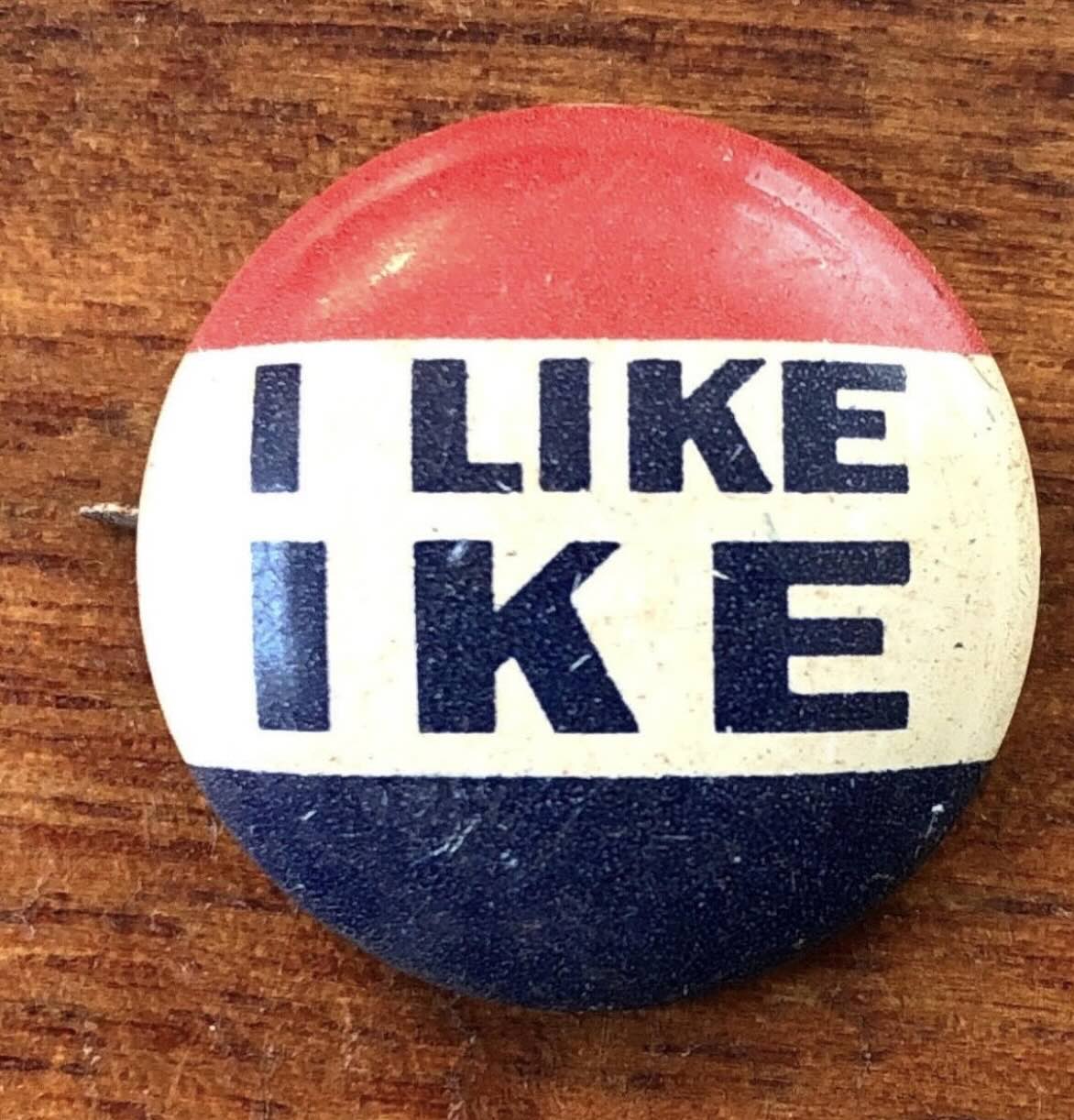
A widely admired war hero known to millions simply as “Ike,” Dwight D. Eisenhower, the 34th president (1953–1961), entered the White House in 1953 promising to end one war and prevent others. He more than kept that promise, delivering on it with calm persistence and earning the sincere appreciation of a nation weary of conflict.
He ended the Korean War, gave America eight years of peace and booming prosperity, guided the nation safely through the Cold War, and closed his presidency with a powerful farewell warning against the dangers of the military-industrial complex.
Many historians now rank him among the most effective leaders in U.S. history—precisely because his steady hand helped create what millions of Americans still remember fondly as the golden years of peace, opportunity, and national confidence.
Born in 1890 in Denison, Texas, and raised in Abilene, Kansas, Dwight D. Eisenhower began his career as an American soldier and one of the greatest military leaders of his generation. His command of Allied forces during World War II made him a beloved national hero.
In 1952, both parties courted him, and he chose the Republicans, defeated Adlai Stevenson in a landslide, he won re-election in 1956 by an even larger margin. He governed as a pragmatic moderate who valued balance, fiscal responsibility, and restraint.
His military experience gave him rare wisdom. Unlike most politicians, he understood the true cost of war, not just in lives lost and treasure spent, but in the toll it took on America’s national character.
When Eisenhower took office in January 1953, America was locked in a brutal, seemingly endless war in Korea, with over 50,000 American deaths already recorded.
Campaigning on a pledge “to go to Korea,” he visited the front lines weeks before his inauguration. He quickly negotiated an armistice, signed on July 27, 1953, which halted the fighting and created a demilitarized zone that still exists today.
The fighting stopped. For the remainder of his presidency, the United States avoided major new combat involvement—an extraordinary achievement at the height of the Cold War.
Eisenhower had quietly faced the risk of escalation, including private consideration of nuclear options, yet chose firm de-escalation. This became the first step in what he called his “crusade for peace.”
The 1950s brought remarkable prosperity under his leadership. The American economy expanded robustly, with strong GDP growth, low inflation (often below 2 percent), and low unemployment. Mild recessions occurred, but overall price stability and opportunity allowed the middle class to grow dramatically, supported the baby boom, and reshaped suburban America.
Eisenhower’s signature domestic achievement was the Federal-Aid Highway Act of 1956, which launched the Interstate Highway System—the largest public-works project in American history. It transformed commerce, defense mobility, and daily life, created hundreds of thousands of jobs, and fueled explosive suburban growth.
He also strengthened Social Security, created NASA in response to Sputnik, launched the Department of Health, Education, and Welfare, and advanced civil rights by desegregating the District of Columbia and federal workforce, enforcing Brown v. Board with troops in Little Rock, and signing the Civil Rights Acts of 1957 and 1960—the first such laws in nearly a century.
He balanced the federal budget three times and kept deficits in check, viewing a strong economy as a vital national-security asset. In foreign policy, his “New Look” strategy emphasized nuclear deterrence, strong alliances like NATO, and “more bang for the buck,” helping deter major conflict while skillfully managing crises in Suez, the Taiwan Strait, and Berlin without escalation. No new wars broke out.
On January 17, 1961, just days before leaving office, Eisenhower delivered one of the most memorable farewell addresses in American history. From the Oval Office, the old soldier warned the nation against the growing influence of the military-industrial complex: “In the councils of government, we must guard against the acquisition of unwarranted influence, whether sought or unsought, by the military-industrial complex. The potential for the disastrous rise of misplaced power exists and will persist.”
It was a remarkably honest warning from a man who had spent his life in uniform and understood both the necessity and the risks of a large permanent arms industry.
Outwardly calm and stoic, Eisenhower often appeared as a grandfatherly figure. In truth, as political scientist Fred I. Greenstein demonstrated in his groundbreaking study The Hidden-Hand Presidency, he was a far more sophisticated and effective leader than his contemporaries realized.
Drawing on declassified diaries and memoranda, Greenstein showed how Eisenhower consciously practiced a “hidden-hand” style: working diligently behind the scenes, delegating credit to others, using language strategically to build consensus or obscure his own role, and applying his exceptional organizational skill and emotional intelligence to achieve results with minimal public friction. “Gently in manner, strong in deed” could have served as his unspoken motto.
This approach not only allowed him to navigate the treacherous politics of the 1950s with remarkable success but also explains why his steady hand produced eight years of peace and prosperity that felt almost effortless to the American people.
Time has revealed Eisenhower’s genuine greatness. Scholars increasingly place him in the top tier of American presidents for his crisis management, economic stewardship, and moral restraint.
He ended a war, built the Interstate Highway System, balanced the budget, kept the country strong and morally grounded, and—speaking with the quiet authority of a soldier-statesman—warned America to guard against the very military-industrial forces he had helped create. That is precisely why Dwight D. Eisenhower may be the most underrated president in modern American history.
A five-star general who had personally witnessed war, he gave America eight years of peace with no new major conflicts, a growing economy that expanded the middle class, a sense of stability and national confidence the country had not known in decades. With the calm wisdom and hard-earned authority of a soldier-statesman, he also left a timeless warning to guard our democracy against the dangers of the military-industrial complex. In the end, he delivered exactly what Americans needed most—peace, prosperity, and the foresight to help protect it for future generations.

