

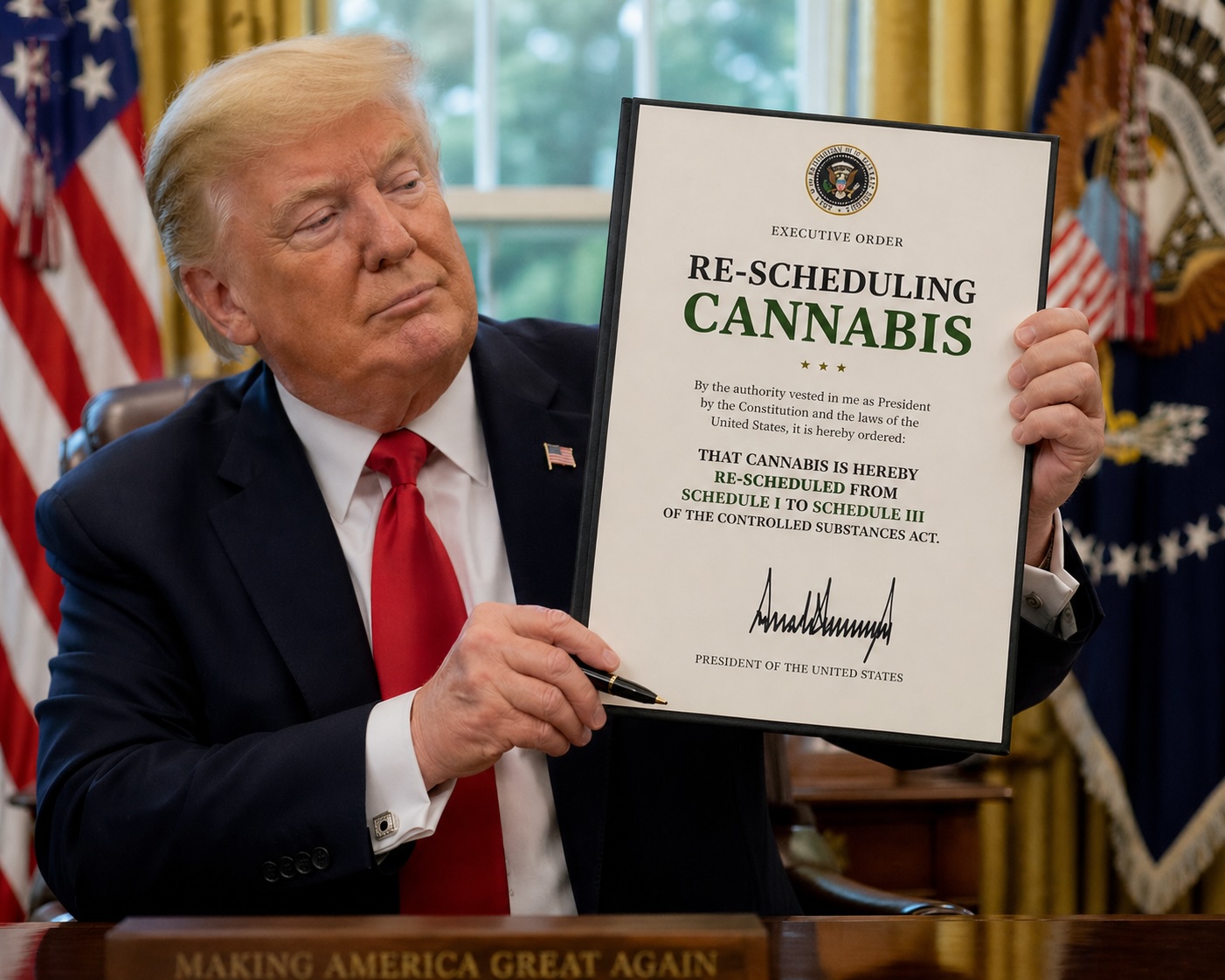
Washington didn’t legalize marijuana—but what it did may prove far more important. By rescheduling certain cannabis activities into Schedule III, the federal government has quietly created something the industry has lacked for decades: a legitimate, structured pathway forward. This isn’t the end of prohibition, but it is the beginning of integration. And for those paying attention, it opens the door to a new kind of market—one that blends state medical programs, federal oversight, and emerging pharmaceutical potential into a hybrid system unlike anything we’ve seen before. President Trump must the credit for this vital policy change. I have advocated for this decision since he was elelcted in 2016 when I formed the United States Cannabis Coalition.
At its core, this decision recognizes a reality that has existed for years: cannabis already operates as a medical system in dozens of states. By allowing state-licensed operators to pursue DEA registration, the federal government is no longer standing entirely outside that system—it is beginning to interface with it. That shift alone is transformative. It gives compliant operators a path to legitimacy, access to standard business deductions, and the ability to participate in a federally recognized supply chain. For an industry long constrained by legal uncertainty and punitive tax treatment, this is a foundational upgrade.
There will, of course, be winners and losers. The winners are those prepared to operate within a structured, compliant framework: state-licensed medical cannabis companies, research-driven operators, and organizations capable of meeting DEA standards. They now have a pathway to evolve beyond the limitations of state-only markets. The losers are those who remain outside that framework—particularly segments of the hemp-derived cannabinoid market that have thrived in regulatory gray zones. As federal policy becomes more defined, ambiguity becomes risk, and informality becomes harder to sustain.
But focusing only on winners and losers misses the larger point. What this order really creates is opportunity—specifically, the opportunity to build a new category of regulated cannabis products that sits somewhere between traditional state dispensary models and fully FDA-approved pharmaceuticals. For the first time, a cannabis operator could, in theory, obtain DEA registration, produce standardized products, and distribute them within a controlled medical framework. These products may not carry FDA-approved indications, but they exist within a federally recognized scheduling system and can be prescribed, tracked, and dispensed under Schedule III rules.
This is where the real inflection point lies. The President Trump is effectively allowing the emergence of a hybrid system—one that does not replace the FDA, but operates alongside it. FDA-approved cannabis drugs will continue to represent the highest standard for national pharmaceutical distribution, with full clinical validation and broad market access. But beneath that layer, a secondary system can develop: one grounded in state medical programs, enabled by DEA registration, and governed by controlled substance rules rather than full FDA drug approval. It is a model that resembles compounded pharmaceuticals or other physician-directed therapies, where medical judgment and regulatory oversight coexist without requiring full premarket approval for every formulation.
For state medical programs, this is a profound shift in power. They are no longer isolated experiments operating in tension with federal law. Instead, they become the foundation of a federally recognized supply chain. States with robust licensing systems, established operators, and research capabilities are now positioned to lead—not just locally, but nationally. They can become centers of production, research, and clinical development, feeding into a broader ecosystem that includes both traditional healthcare and emerging cannabis therapeutics.
International obligations and compliance requirements will ensure that this system is tightly controlled. DEA registration, quota systems, anti-diversion measures, and reporting requirements will shape how the market develops. But those controls should not be mistaken for limitations alone—they are also what enable legitimacy. They provide the structure necessary for capital formation, institutional participation, and long-term stability. In short, they transform cannabis from a fragmented industry into a regulated sector capable of scaling responsibly.
The strategic implications are significant. Cannabis is no longer confined to a binary choice between prohibition and full FDA pharmaceutical approval. Instead, it now occupies a middle ground—a regulated, medically oriented category with room for innovation, physician involvement, and product development. This hybrid model could accelerate research, expand patient access, and allow operators to develop therapies in a more iterative, real-world environment.
The cannabis industry hasn’t just been rescheduled—it has been repositioned. The federal government has moved from opposition to engagement, from exclusion to structured participation. For operators willing to meet the moment, this is more than a regulatory change. It is the beginning of a new phase—one defined not by uncertainty, but by the opportunity to build something durable, credible, and deeply integrated into the future of American healthcare.

