

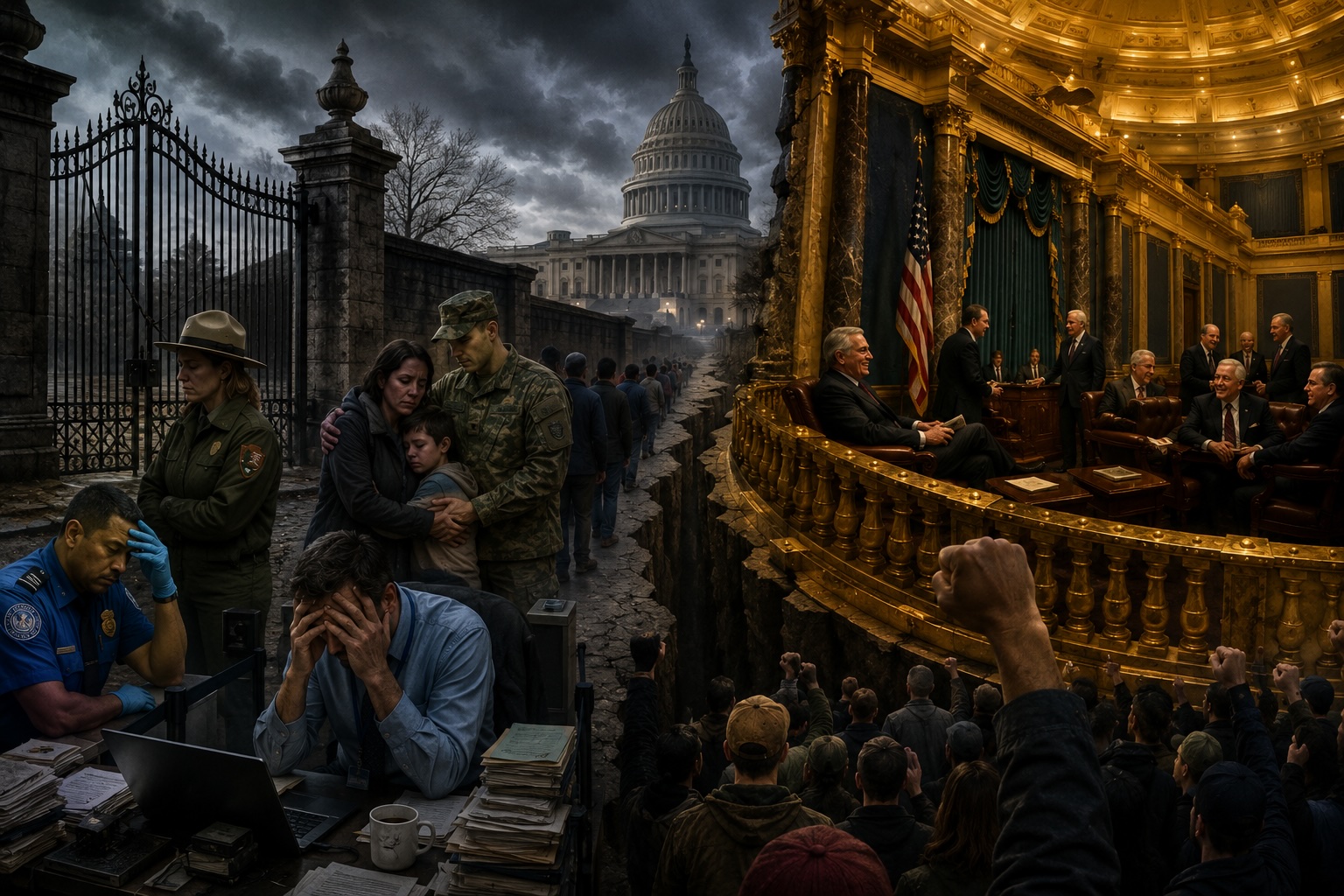
There are few spectacles in American politics more noxious than watching the federal government descend into paralysis while the permanent political class in Washington continues cashing taxpayer funded paychecks as though nothing has happened.
During government shutdowns, national parks close their gates like abandoned fortresses, airport security officers work without immediate compensation, military families brace for uncertainty, and federal workers stare into the abyss of financial instability. Yet for decades Congress itself remained cocooned inside a gilded citadel of constitutional protection, insulated from the economic agony imposed upon the very citizens whose labor finances the Republic. That outrageous asymmetry finally collided with mounting public rage in the Spring of 2026 when the United States Senate unanimously approved a measure intended to withhold Senators’ pay during future government shutdowns. The resolution was presented to the American people as an act of accountability, shared sacrifice, and moral reciprocity. Whether it ultimately becomes meaningful reform or merely another theatrical flourish in the endless carnival of Washington symbolism remains a far more complicated question.
The measure at the center of this controversy is Senate Resolution 526, introduced by Senator John Kennedy of Louisiana. Kennedy, whose populist rhetoric often combines Southern plainspokenness with prosecutorial severity, argued that members of Congress should not continue receiving uninterrupted compensation while ordinary Americans and federal employees suffer through appropriations stalemates created by political dysfunction. The resolution emerged after repeated shutdown crises, including the sprawling 43 day federal shutdown in late 2025 and the subsequent Department of Homeland Security (DHS) funding standoff earlier in 2026. Those confrontations exposed once again the grotesque contradiction embedded within the machinery of government. Transportation Security Administration (TSA) officers continued reporting to airports without timely pay. Federal contractors faced financial devastation. Agencies froze operations like locomotives stranded on a frozen rail line. Meanwhile senators continued receiving their salaries under constitutional protections established more than two centuries ago.
Kennedy framed the resolution as an instrument of “shared sacrifice,” insisting that lawmakers should “put our money where our mouth is.” In a city addicted to rhetorical pageantry, that phrase resonated with a furious electorate that has grown increasingly contemptuous of congressional privilege. The Senate agreed. The procedural cloture vote to end debate passed by an astonishing 99 to 0 margin. Not a single senator voted against it. Following cloture the resolution passed by voice vote without recorded opposition. In practical terms, every senator who participated supported the measure. There were no recorded “Nay” votes because none were cast.
That unanimity is politically revealing. In modern Washington, where partisan hostility resembles trench warfare conducted through television cameras and social media volleys, a 99 to 0 vote is almost biblical in its rarity. Republicans supported it. Democrats supported it. Institutional conservatives supported it. Progressive populists supported it. Even senators who privately understood the constitutional minefield surrounding congressional compensation chose not to oppose a measure so politically radioactive to resist. Voting against it would have been portrayed as an open defense of congressional entitlement during national dysfunction.
Yet beneath the applause and moral posturing lies a critical reality that much of the public does not fully understand. Senate Resolution 526 is not a law. It is not legislation requiring House passage. It does not go to the President’s desk for signature. It is an internal Senate resolution governing Senate procedures. That distinction matters enormously. The resolution applies only to senators, not members of the House of Representatives. It also does not immediately take effect. In order to comply with constitutional restrictions involving congressional compensation, implementation is delayed until after the November 2026 midterm elections and the beginning of the next Congress.
Even more important is the fact that senators are not permanently losing their pay under the resolution. Their compensation would merely be withheld temporarily during a shutdown and then restored afterward through back pay once appropriations are enacted. In essence, the measure functions more like delayed compensation than true forfeiture. Critics argue this transforms the proposal into a symbolic gesture rather than genuine punishment. Supporters counter that delayed pay still creates pressure and aligns senators more closely with the federal workforce that suffers during shutdowns.
The constitutional architecture surrounding congressional compensation is one of the primary reasons reform efforts have repeatedly collided with legal obstacles for decades. The framers of the Constitution intentionally insulated Congress from financial coercion. Article I, Section 6 declares that senators and representatives “shall receive a Compensation for their Services.” That language was designed to preserve legislative independence from the executive branch and from state governments. The framers feared that political adversaries might weaponize congressional compensation to intimidate lawmakers or manipulate legislative behavior. In the aftermath of the Articles of Confederation, they sought to create a federal legislature immune from economic extortion.
The 27th Amendment complicates matters even further. Ratified in 1992 after originating as part of James Madison’s original Bill of Rights proposals, the amendment prohibits laws varying congressional compensation from taking effect until after an intervening election for the House of Representatives. That is precisely why Kennedy’s resolution postpones implementation until the next Congress. Immediate enforcement would almost certainly trigger constitutional litigation.
These constitutional barriers have forced lawmakers to devise increasingly elaborate workarounds resembling legal labyrinths worthy of Byzantine imperial bureaucracies. Some proposals place salaries into escrow accounts during shutdowns. Others withhold compensation temporarily but restore it later through mandatory back pay. Some apply only prospectively to future Congresses. Others attempt partial deductions rather than outright forfeiture. Each mechanism reflects an effort to navigate the constitutional reef without capsizing upon judicial review.
Kennedy’s resolution is merely the latest chapter in a long saga of congressional pay reform efforts. Numerous lawmakers from both parties have introduced related measures over the years. Representative Bryan Steil of Wisconsin introduced the “Withhold Member Pay During Shutdowns Act,” designated H.R. 5891. Earlier bipartisan proposals included versions championed by Representative Abigail Spanberger of Virginia, Representative Eugene Vindman, and Representative Brian Fitzpatrick of Pennsylvania. Senator Rick Scott of Florida repeatedly advanced “No Budget, No Pay” legislation requiring Congress to pass budgets and appropriations before receiving compensation. Some versions sought permanent forfeiture without back pay. Others used escrow systems or delayed compensation mechanisms.
Many of these efforts gained bipartisan rhetorical support but died quietly within committees or procedural choke points. Washington possesses a remarkable talent for converting public outrage into symbolic gestures that evaporate before meaningful implementation. The congressional cemetery is littered with reform proposals that generated thunderous headlines before vanishing into legislative oblivion.
The voting history on these broader measures reveals the complicated politics beneath the surface. Some earlier “No Budget, No Pay” efforts in prior Congresses passed the House with large bipartisan margins, including one notable vote exceeding 285 members in support. Yet Senate resistance, procedural barriers, constitutional concerns, and institutional self preservation repeatedly prevented final enactment. In other instances, measures were blocked through objections during unanimous consent requests. Senator Ed Markey of Massachusetts, for example, previously objected to certain proposals advanced by Senator Rick Scott.
Supporters of stronger reforms argue that temporary withholding with guaranteed back pay amounts to little more than performative contrition. They contend that permanent forfeiture during shutdowns would create real incentives for Congress to avoid fiscal brinkmanship. Opponents counter that allowing compensation to be weaponized could undermine legislative independence and create dangerous constitutional precedents. Some constitutional scholars insist that only a formal constitutional amendment could permanently authorize no pay or no back pay policies without serious legal vulnerability.
Senator Lindsey Graham himself acknowledged that a constitutional amendment may represent the most legally durable solution. Yet constitutional amendments in modern America are rarer than eclipses. Achieving two thirds support in both chambers and ratification by three fourths of the states is an almost Herculean political undertaking in an era of relentless polarization.
The broader public frustration driving these reforms is understandable. Government shutdowns have evolved into recurring rituals of political nihilism. They resemble ancient sieges in which rival factions barricade themselves inside fortified camps while ordinary citizens suffer the consequences. Essential workers are transformed into collateral damage within appropriations warfare. Federal agencies stagger through uncertainty like wounded leviathans drifting through storm battered seas. Public confidence in Congress, already languishing near historic lows, deteriorates even further with every fiscal confrontation.
For many Americans the notion that Congress continues receiving uninterrupted salaries during these crises symbolizes everything rotten within the modern federal apparatus. The image is politically toxic because it reinforces perceptions of an insulated ruling class divorced from the hardships imposed upon ordinary citizens. That perception explains why even senators with constitutional reservations overwhelmingly supported Kennedy’s resolution. The political optics of opposing it would have been catastrophic.
Still, Americans should understand clearly what has and has not happened. Congress has not abolished its own pay during shutdowns. The Senate has not enacted binding federal law applicable to the entire legislative branch. There is no imminent statute awaiting presidential signature. The House remains untouched by Kennedy’s resolution. Permanent forfeiture without back pay remains constitutionally dubious absent an amendment. What the Senate approved was a narrowly tailored procedural measure crafted carefully to survive constitutional scrutiny through delayed implementation and eventual reimbursement.
Whether this marks the beginning of serious congressional accountability or merely another ceremonial flourish in Washington’s theater of controlled outrage remains uncertain. The Capitol has always excelled at staging symbolic acts while preserving the underlying architecture of institutional privilege. Ancient Rome perfected bread and circuses. Modern Washington perfects resolutions and headlines.
Yet the fury driving this issue is real. Americans are exhausted by shutdown politics. They are exhausted by performative brinkmanship masquerading as governance. They are exhausted by watching the political aristocracy shield itself from the consequences of its own dysfunction. Senate Resolution 526 represents an acknowledgment, however limited, that public patience has reached a breaking point.
In the end, this battle is not merely about congressional salaries. It is about legitimacy itself. A Republic cannot endure indefinitely when its citizens believe their governing class inhabits a separate moral universe insulated from the burdens imposed upon the nation. The Framers created constitutional protections for congressional compensation to preserve independence from tyranny. They never intended those protections to become armor plating for political irresponsibility.

