

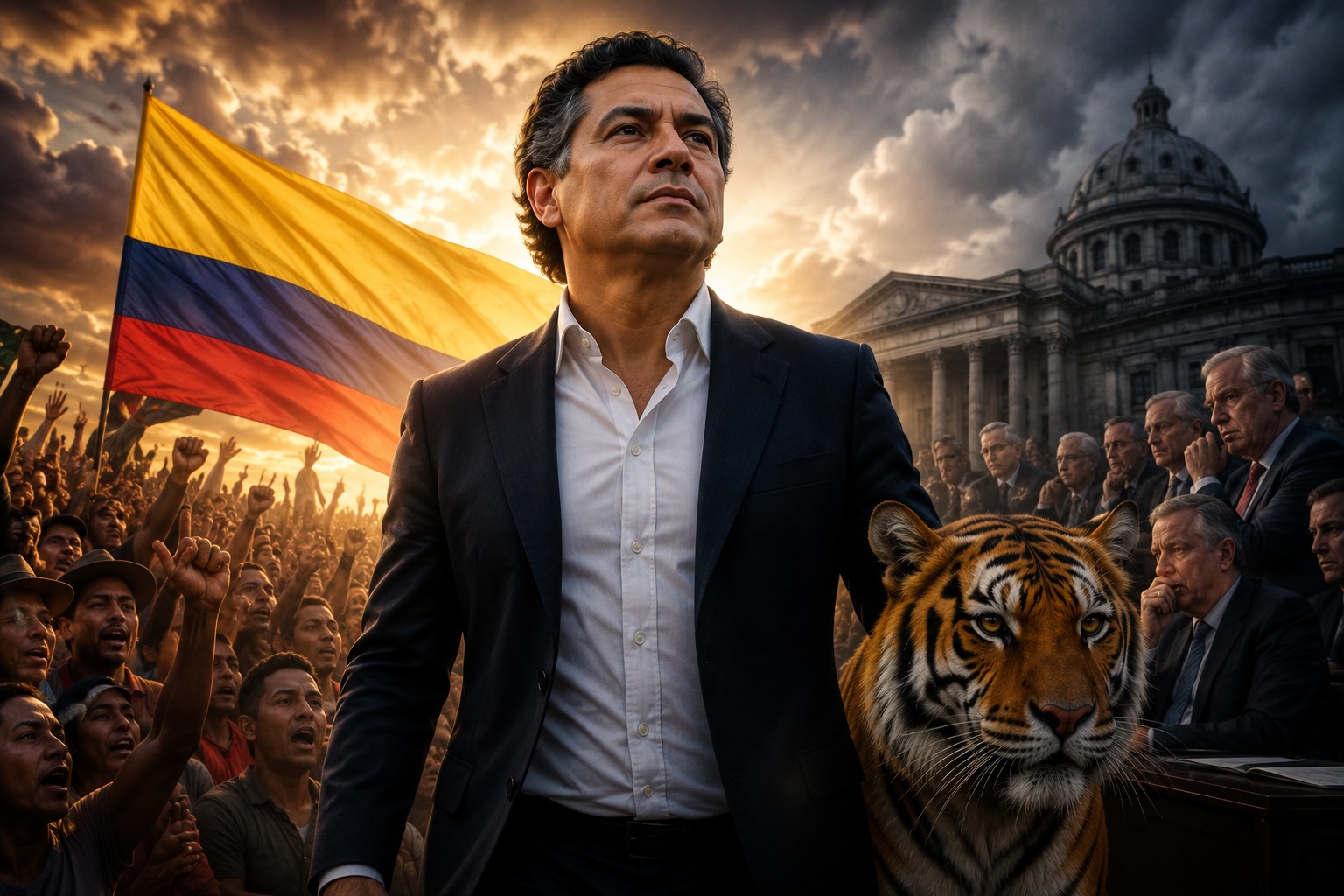
As Colombians prepare to cast their votes on Sunday, one figure towers over the campaign trail like a force of nature: Abelardo de la Espriella, the combative lawyer and businessman known throughout his nation as “El Tigre.” Surging in the final polls to within striking distance of the leftist frontrunner, the outsider candidate is drawing massive crowds that roar his slogan “¡Firme por la patria!” while men in tiger costumes chant and fireworks explode behind bulletproof glass. He is the candidate the left and the entrenched conservatives fear most because he refuses to play by the rules of the political establishment. A self-funded movement leader who skipped the old party primaries, de la Espriella offers something rarer in Colombian politics: an unapologetic repudiation of the failed status quo.
This election is far larger than Colombia alone. It is a hemispheric test of whether Latin America will continue its drift toward ideological experiments that weaken sovereignty and empower criminal empires, or finally reject them by electing a leader with the force of personality to stop them dead in their tracks. Voters are faced with three options: institutionalization of Gustavo Petro’s left-wing project in Iván Cepeda, the restoration of a stale political class with Paloma Valencia, or the genuine anti-establishment renaissance that de la Espriella represents. It is a moment of truth for the Colombian people. Will they accept genuine transformation or instead choose the same old failures wearing fresh slogans and slicker advertising.
The conditions for this populist explosion were created by Petro himself. Colombia’s first leftist president arrived promising “Total Peace,” treating armed groups as political actors with legitimate grievances rather than mortal enemies of the State. In practice, the policy granted narco-terrorist networks precious time, legitimacy, and breathing room to expand. Groups such as the ELN, FARC dissidents (FARC-EP and Segunda Marquetalia), Clan del Golfo, Tren de Aragua, and the transnational empires of the Sinaloa Cartel and CJNG—all designated by the United States as terrorist organizations—exploited the opening. As a direct result of Petro’s malfeasance, ordinary Colombians lived with extortion, displacement, and the grinding erosion of safety on a daily basis. Petro may not have invented these criminal ecosystems, but his doctrine of craven appeasement functionally empowered them.
The damage has not stayed within Colombia’s borders. A fragile Colombia strengthens the cartels, accelerates migration northward, and hands strategic advantages to Venezuela and the Cuban regime. It weakens a historic U.S. security partner at the very moment when counter-narcotics cooperation, border security, and regional stability matter most. Petro’s open hostility toward Washington has only hastened the drift. The next president will determine whether Colombia remains a frontline bulwark or remains as a vector of instability.
Into this vacuum steps Iván Cepeda, Petro’s chosen successor from the Historic Pact. A senator, human rights activist, and son of a Communist Party leader, Cepeda is more disciplined and ideologically consistent than his mentor. He pledges to deepen social reforms, pursue further negotiations with armed groups, advance progressive taxation, and possibly rewrite the constitution through a constituent assembly. To those who value order, sovereignty, and strong alliances, Cepeda represents something more dangerous than mere continuity. He is the full institutionalization of Petroism. Through the coddling of narcotraffickers, the full-scale expansion of cultural progressivism, hostility to markets, and further alienation from Washington, Cepeda would serve the interests of Maduro, Havana, and the narco-left while undermining U.S. objectives on drugs, migration, and hemispheric security.
On the center-right stands Senator Paloma Valencia of the Democratic Center, positioned as the respectable, establishment-approved conservative option. A philosopher, lawyer, and political heir with deep ties to the legacy of controversial former President Álvaro Uribe, Valencia promises to end Total Peace, strengthen security forces, resume coca fumigation, and revive investment in hydrocarbons. Yet Valencia is the very embodiment of the system many Colombians now reject: conventional, focus-grouped, donor-influenced, and bound by her ties to the political elite. She offers competent stewardship of decline within the bounds the globalist elite find acceptable. Like a Colombian Nikki Haley, she can rally traditional conservative votes and obtain high-level endorsements, but Valencia lacks the dynamism to spark the broader popular revolt against an exhausted, self-protective political class widely viewed as corrupt and incapable of delivering structural change.
That is precisely why de la Espriella has become the lightning rod. Operating through his Defenders of the Homeland movement, the 47-year-old has crafted an insurgent crusade instead of a conventional candidacy. His platform puts security first as the indispensable foundation for everything else: ten new mega-prisons modeled that would outdo Salvadoran President Nayik Bukele, military offensives against groups that refuse to submit, aerial fumigation of coca crops, drastic cuts to government bureaucracy, tax reductions, and a complete revival of the hydrocarbons sector. Criminals who reject peace will face decisive action under the law—no more treating narco-terrorist armies as negotiating partners. Just days ago, he met virtually with Brazil’s Bolsonaro brothers to begin forging a regional conservative alliance centered on ironclad security, smaller government, and economic freedom.
De la Espriella’s leadership ability lies in the characteristics she shares with the most influential leaders throughout the Americas. He wields Trump’s nationalist directness, contempt for elite gatekeeping and fearless naming of enemies—whether it is leftist ideologues, criminal networks, or the incestuous political class. He channels Bukele’s uncompromising insistence that public order is the precondition for liberty: the simple freedom to leave home, run a business, send children to school, and return home with your family safe and sound at the end of the day. And he carries Milei’s ferocious attack on socialist bureaucracy and market-hostile policies that punish productive citizens. For de la Espriella, security, sovereignty, and economic stagnation are not separate issues but one interconnected crisis manufactured by decades of elite failure.
His coalition reflects that understanding. It draws conservatives, working-class voters, entrepreneurs, national-security realists, anti-corruption voices, and independents who are exhausted by both Petro’s experiments and the old right’s timidity. These Colombians feel unsafe in their own neighborhoods, cheated by a self-serving system, and abandoned by conventional conservatism. They are not looking for the politics of respectability. They do not yearn for some kind of bipartisan facade. They are looking for a leader who owes no favors to a political class that has besieged their country. Colombia’s populist moment has arrived.
Abelardo de la Espriella is the candidate who captures the fury, the fear, and the hope of millions of Colombians who want safety restored, national sovereignty reclaimed, and prosperity to finally be unleashed. The left fears him because he rejects their ideologies and pays them no lip service otherwise. The right fears him because he rejects their good ol’ boys club. The comparison to Donald Trump is obvious. If Colombians choose la Espriella’s bold path toward national renaissance, they may not only rescue their own country but help chart a stronger, freer path for the entire hemisphere—one grounded in unity, strength, nationalism and an unyielding will to achieve absolute victory for the people.

