

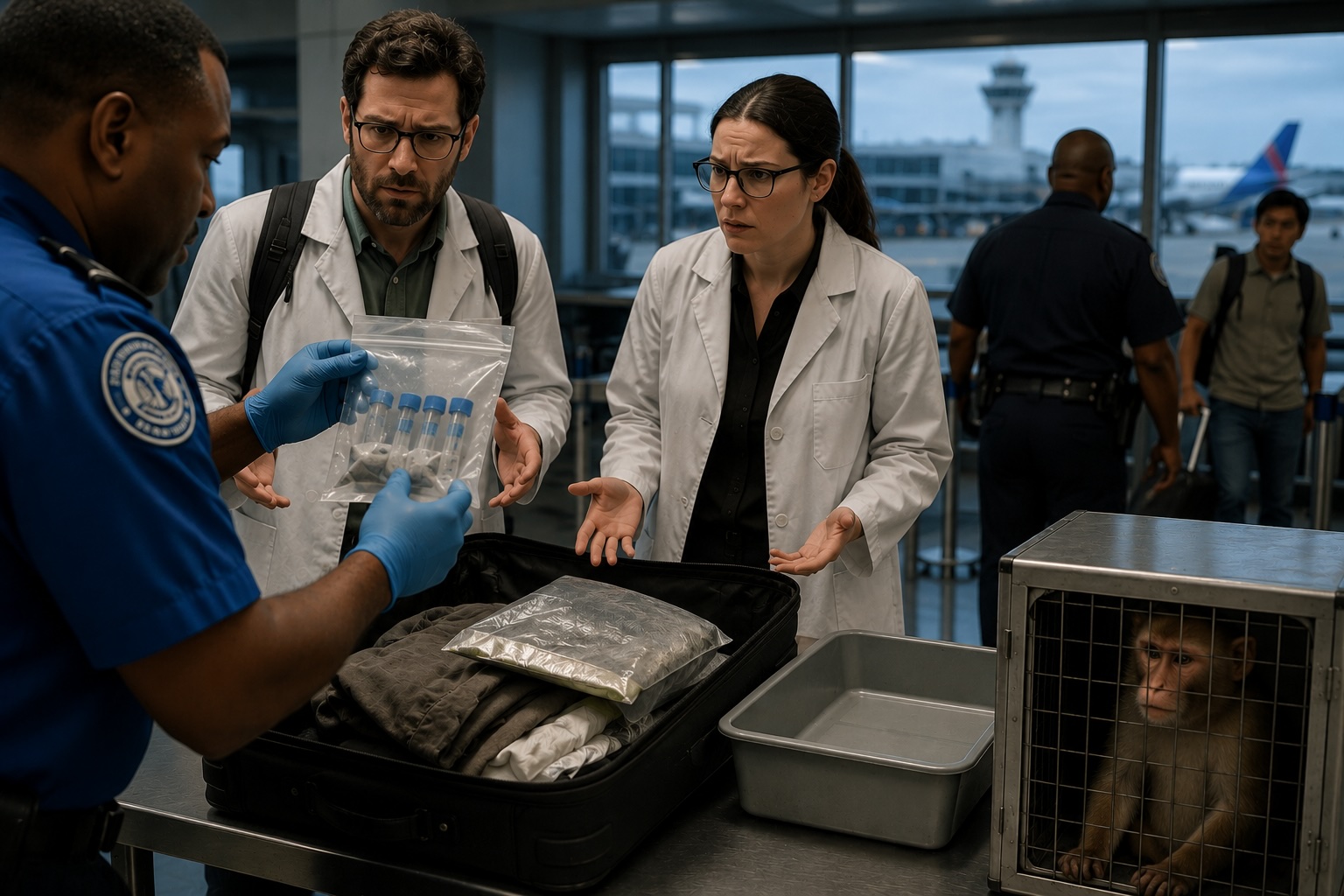
The U.S. Department of Justice has charged two foreign nationals working at the National Institutes of Health’s Rocky Mountain Laboratory in Montana with illegally smuggling deactivated monkeypox virus samples into the United States and with lying to federal agents.
Vincent Munster, a 53-year-old Dutch citizen and Chief of the Virus Ecology Section at NIH’s Rocky Mountain Laboratory, and Claude Kwe, a 38-year-old research fellow from Cameroon, were indicted following their arrival at Detroit Metropolitan Airport on January 25, 2026.
The pair had flown in from Brazzaville, Republic of the Congo, where a monkeypox outbreak was ongoing, carrying a large black plastic case. They told Customs and Border Protection officers that it contained only “diagnostics and testing equipment.”
FBI and CBP searches revealed 113 vials stored inside Styrofoam coolers. Of the 20 vials tested so far, 17 contained deactivated monkeypox virus, one held chickenpox virus, and two contained only human DNA.
Both researchers work in the high-containment BSL-4 laboratory at Rocky Mountain Laboratories, where they study emerging viral pathogens and species crossover.
They now face federal charges of conspiracy to smuggle goods and making false statements to authorities, each carrying a maximum penalty of up to five years in prison. Officials have emphasized that the samples were deactivated and posed no immediate public health risk. Nevertheless, the case highlights serious gaps in compliance with U.S. biological import protocols.
This is not an isolated incident. A troubling pattern has emerged in which foreign researchers have repeatedly attempted to circumvent U.S. biosecurity regulations, with multiple cases funneled through Detroit Metropolitan Airport, roughly 1,226 miles from NIH’s Rocky Mountain Laboratories in Hamilton, Montana.
In 2025, Chinese nationals Yunqing Jian, a postdoctoral researcher at the University of Michigan, and her boyfriend Zunyong Liu were charged after attempting to smuggle the crop pathogen Fusarium graminearum into the United States through Detroit Metropolitan Airport.
This fungus causes head blight (scab) in wheat, barley, and other cereals, leading to major crop losses and producing harmful mycotoxins. It is sometimes viewed as a potential agroterrorism agent.
Jian pleaded guilty to smuggling and making false statements. She attempted to flee before sentencing and was caught at JFK International Airport. She was ultimately sentenced in November 2025 to time served (approximately five months) before being deported. Liu returned to China earlier and remains at large.
Similarly, Chengxuan Han, a Chinese PhD student from Wuhan, faced charges for concealing biological materials, including roundworms and parasites, shipped to a University of Michigan lab. She pleaded no contest and was sentenced in September 2025 to time served (roughly three months) before deportation.
These cases have often resulted in lenient outcomes. Yunqing Jian was sentenced to time served plus deportation, despite attempting to flee the country before her sentencing.
In all of these incidents, the biological materials were seized and destroyed. Fortunately, no public health or agricultural incidents were reported as a result.
These prosecutions expose persistent challenges in biosecurity enforcement within the justice system. Foreign researchers on temporary visas often receive light penalties even as U.S. authorities have tightened biological import rules in the years since COVID.
The latest NIH monkeypox case involving Munster and Kwe is still in its early stages. As of June 2, 2026, no pleas have been entered and no sentencing has occurred.
This incident raises serious questions about NIH vetting procedures, the oversight of foreign nationals in sensitive BSL-4 positions, and compliance with pathogen transport protocols, particularly for researchers granted access to dual-use viruses such as monkeypox.
Had U.S. Customs and Border Protection not thoroughly inspected the materials, the outcome could have been far more serious.
Stronger oversight is urgently needed. Enhanced audits of NIH foreign hiring practices, stricter dual-use research review, and more robust biosecurity enforcement are essential. In an era of global outbreaks and heightened geopolitical tensions, these measures are critical to restoring public trust and protecting against potential insider threats.

