

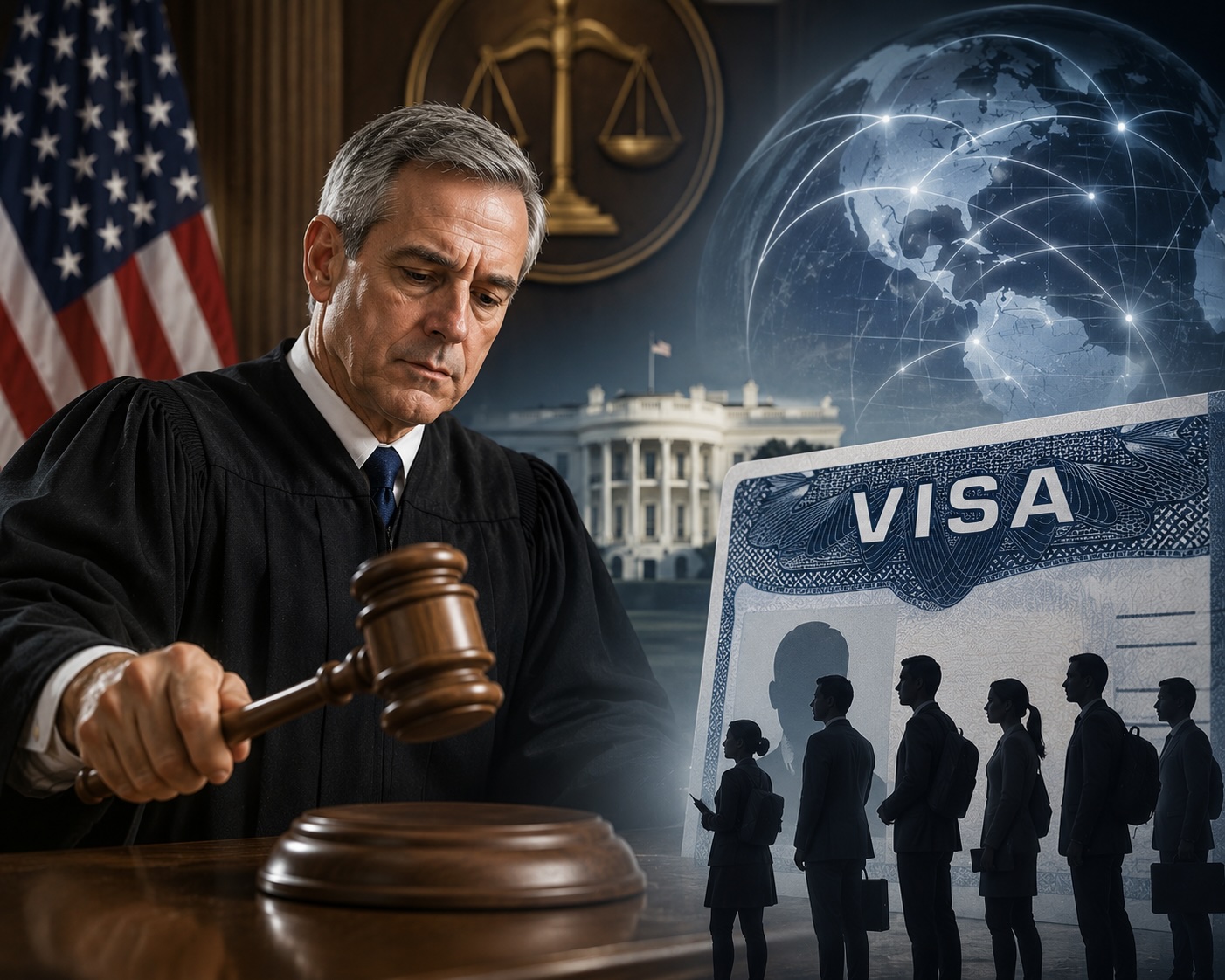
Judge Leo Sorokin, an Obama appointee, sided with a coalition of 20 Democratic-led states that challenged the Trump Administration’s $100,000 H-1B visa fee and struck it down.
Presidential Proclamation 10973, was signed by President Donald J. Trump on September 19, 2025, titled Restriction on Entry of Certain Nonimmigrant Workers, introduced a $100,000 fee, along with associated entry restrictions on new H-1B specialty occupation visa petitions
The implementation of this charge was part of an even more expansive effort in Trump’s second term to overhaul immigration by prioritizing American workers.
Trump argued that the program, which allows U.S. companies to hire foreign professionals in specialty occupations like technology, engineering, and medicine, was being abused and undercut American wages.
States involved in the lawsuit, led by California and others, argued that the fee would harm their economies, which depend heavily on tech and innovation hubs.
The ruling held that the policy exceeded executive authority and effectively functioned as an unauthorized tax or revenue measure, violating the separation of powers outlined in the U.S. Constitution.
The administration’s attorneys argued this was not a tax because it was not intended to raise revenue but to regulate entry and deter program misuse.
The judge issued a 42-page decision vacating the policy nationwide, concluding that the executive branch overstepped by imposing what amounted to a tax without congressional approval.
This ruling directly contradicts an earlier decision by U.S. District Judge Beryl Howell (also an Obama appointee) in Washington, D.C. In December 2025, Howell upheld the fee in a lawsuit brought by the U.S. Chamber of Commerce and others, ruling that the president had broad authority under the Immigration and Nationality Act to impose the measure as a valid restriction on entry to protect U.S. workers.
According to Pew Research Center analysis, nearly 400,000 H-1B visa applications were approved in fiscal year 2024, with about 141,207 for new/initial employment and the rest 258,196 for renewals/extensions of existing workers.
Pew also notes that broader U.S. immigration inflows remained high in recent years, with more than 11 million immigrants arriving between 2020 and 2025 (including over 3 million in 2023 alone), though the foreign-born population peaked at 53.3 million in early 2025 before declining somewhat due to departures and policy shifts.
These visas are capped annually at 85,000 for new cap-subject petitions (65,000 regular cap plus 20,000 for advanced-degree holders) and are critical for the U.S. tech industry, with major companies relying on them to fill specialized roles. The existing base fees include a $500 fraud prevention fee and a $1,500 ACWIA training fee for larger employers.
Economists have long contended that the program supports innovation and economic growth by enabling firms to access global talent, ultimately creating more jobs for Americans. Many have pointed to cases of large-scale layoffs alongside heavy H-1B hiring as evidence of misuse.
The administration defended the fee as a legitimate use of presidential powers under immigration law, specifically sections of the Immigration and Nationality Act allowing restrictions on entry when deemed detrimental to U.S. interests.
However, Sorokin rejected this, emphasizing that Congress alone holds the power to levy taxes and set such significant changes to visa policy. He noted the fee’s implementation also violated the Administrative Procedure Act.
This ruling comes amid ongoing debates over U.S. immigration reform. Proponents of tighter controls argue that programs like H-1B displace American workers, particularly in STEM fields, and depress wages. Others highlight labor shortages in high-tech sectors and the contributions of skilled immigrants to GDP and entrepreneurship.
The decision is expected to be appealed by the Justice Department.
Legal experts note the case reveals tensions between executive action and legislative authority in immigration matters. A previous Trump-era attempt to restrict these visas during the COVID-19 pandemic was also blocked by courts on procedural grounds.
The H-1B program will continue to remain a focal point in American politics. While the fee is now blocked, the underlying debates over visa caps, wage protections, and labor market impacts that are likely to persist in Congress and future litigation.
For now, the ruling preserves access to the program at standard fees, allowing companies to continue sponsoring skilled foreign talent without the dramatic cost increase.
This ruling comes amid ongoing debates over U.S. immigration reform. Proponents of tighter controls argue that programs like H-1B displace American workers, particularly in STEM fields, and depress wages.
The Trump administration is set to appeal the decision. As appeals proceed, it will test the boundaries of presidential authority in an area where Congress has granted broad discretion but drawn firm lines on fiscal matters. Legal observers expect the issue to reach higher courts, potentially shaping U.S. immigration policy for years to come.

