

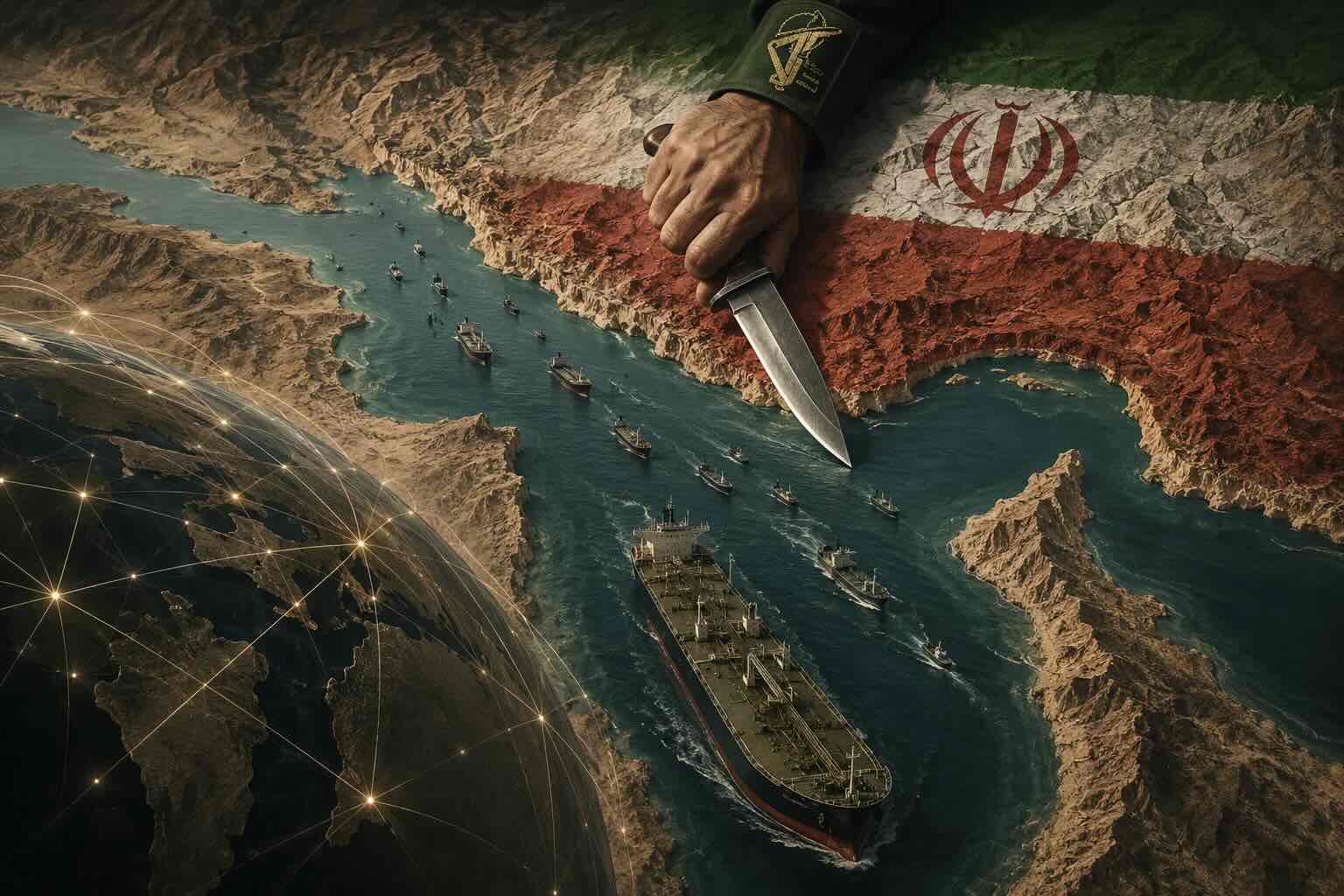
History reminds us that civilization often hinges on narrow passages; the Bosporus, the Panama Canal, the Suez Canal. At the top of that list sits the Strait of Hormuz, a 21-mile-wide chokepoint through which roughly one fifth of the world’s seaborne oil and vast quantities of liquefied natural gas flow. This is not just another shipping lane; it is the global economy’s jugular.
That is precisely why Iran’s latest drone strike against a Singapore-flagged cargo vessel should concern every American, whether they follow foreign policy or not. According to U.S. officials, the attack was carried out by Iran’s Islamic Revolutionary Guard Corps (IRGC) as the vessel exited the Strait of Hormuz near Oman. The drone damaged the ship’s bridge, fortunately causing no reported injuries or loss of life. The absence of casualties, however, should not obscure the gravity of what occurred. A commercial vessel engaged in lawful international commerce became the target of an armed attack in one of the world’s most strategically significant waterways.
President Donald Trump correctly described the incident as a “foolish violation” of the recently negotiated ceasefire and maritime agreement that had been painstakingly assembled to reduce tensions, reopen shipping lanes, and restore stability after months of conflict. Those negotiations were never simply about diplomacy. They were about restoring confidence that international commerce could once again flow freely through a vital maritime choke point. Iran’s actions now place that fragile understanding in jeopardy.
The significance of this event extends far beyond the region. Stability in Hormuz directly influences energy prices and, by extension, inflation, transportation costs, and the price of everyday goods. Even with increased domestic production, the United States remains tied to global energy markets, meaning disruptions or even perceived threats can quickly ripple through supply chains, financial markets, and household budgets.
That is why financial markets watch the Strait of Hormuz with extraordinary intensity. Even the threat of disruption can drive up shipping insurance, alter trade routes, and trigger volatility that ultimately raises costs for consumers.
Iran understands this dynamic perfectly. For decades, the leadership in Tehran has recognized that while it cannot compete conventionally with the United States Navy, it possesses one uniquely powerful form of leverage: geography. Iran occupies much of the northern coastline overlooking the Strait of Hormuz. From missile batteries, drones, naval mines, fast attack craft, submarines, and proxy forces, the Islamic Revolutionary Guard Corps has built an asymmetric strategy designed not necessarily to defeat superior military forces outright, but to create enough uncertainty that global commerce slows, insurance rates soar, and political pressure mounts on Western governments.
This strategy has evolved over decades. Rather than confronting American naval superiority head-on, Iran has consistently invested in capabilities intended to impose economic pain disproportionate to the cost of the attack itself. A relatively inexpensive drone capable of damaging a commercial vessel can trigger billions of dollars in market volatility. That is strategic leverage of the highest order.
The Islamic Revolutionary Guard Corps deserves special attention because it is not simply another branch of Iran’s military establishment. It functions simultaneously as a military organization, intelligence service, economic empire, ideological enforcement arm, and exporter of revolutionary influence throughout the Middle East. Its fingerprints have appeared repeatedly across regional conflicts through support for proxy organizations, maritime harassment, missile development, cyber operations, and unconventional warfare. The IRGC exists not merely to defend Iran’s borders but to project the revolutionary ideology born in 1979 far beyond them.
That ideology is fundamentally different from traditional statecraft. Most governments seek stability because stability encourages prosperity. Revolutionary regimes often perceive instability itself as a strategic asset. Chaos weakens adversaries, raises the costs of resistance, and creates opportunities to expand influence. That difference explains why seemingly irrational actions often make perfect sense when viewed through the ideological lens of revolutionary governments.
The latest attack also reveals something else that policymakers should not ignore. Agreements reached on paper remain only as durable as the willingness of both parties to honor them. Diplomacy has value, but diplomacy unsupported by credible deterrence eventually becomes little more than hopeful rhetoric. International commerce depends upon confidence that agreements will be enforced and violations will carry meaningful consequences.
President Trump’s criticism reflects precisely this concern. The administration’s objective has been to reopen commercial navigation while preventing the region from descending into another prolonged military confrontation. That objective requires all participants to recognize that attacks on commercial shipping undermine not merely bilateral relations but the broader stability of the international trading system itself.
The broader implications extend well beyond the Middle East. America remains the indispensable guarantor of freedom of navigation across the world’s oceans. Since the conclusion of the Second World War, the United States Navy has protected the sea lanes upon which global commerce depends. This mission rarely dominates headlines because success appears uneventful. Ships travel safely. Energy flows uninterrupted. Goods arrive on schedule. Consumers rarely consider the immense military infrastructure that quietly preserves this stability every single day.
Only when that stability is challenged does the public recognize its enormous value. The lesson is timeless. Sea power has always underwritten economic prosperity. From the Royal Navy protecting global commerce during the nineteenth century to the United States Navy securing international shipping after 1945, maritime security has been inseparable from economic growth. Nations that guarantee open sea lanes become anchors of global stability. Nations that threaten them become sources of persistent uncertainty.
Iran’s latest action demonstrates once again why American naval strength cannot become an afterthought. The oceans remain the highways of international commerce, and freedom of navigation remains one of the indispensable foundations of modern civilization. Weakness invites testing. Ambiguity encourages adventurism. Deterrence succeeds when potential aggressors conclude that violations will ultimately cost more than they can possibly gain.
Fortunately, no innocent lives were lost in this latest attack. That fact should be welcomed with genuine gratitude. Yet it would be a grave mistake to dismiss the incident simply because the physical damage proved limited. The strategic message carried by that drone reached far beyond the bridge of one cargo ship. It signaled an ongoing willingness by Tehran to test boundaries, challenge maritime norms, and remind the world that one of its most vital economic lifelines remains vulnerable.
The Strait of Hormuz is far more than a narrow body of water separating two coastlines. It is a critical pressure point in the modern world economy. When commerce flows freely through it, prosperity follows. When it becomes a battlefield, uncertainty spreads across continents. That reality explains why this latest Iranian provocation deserves the close attention not only of military planners and diplomats, but of every American who understands that national security and economic security have always been inseparable.

