

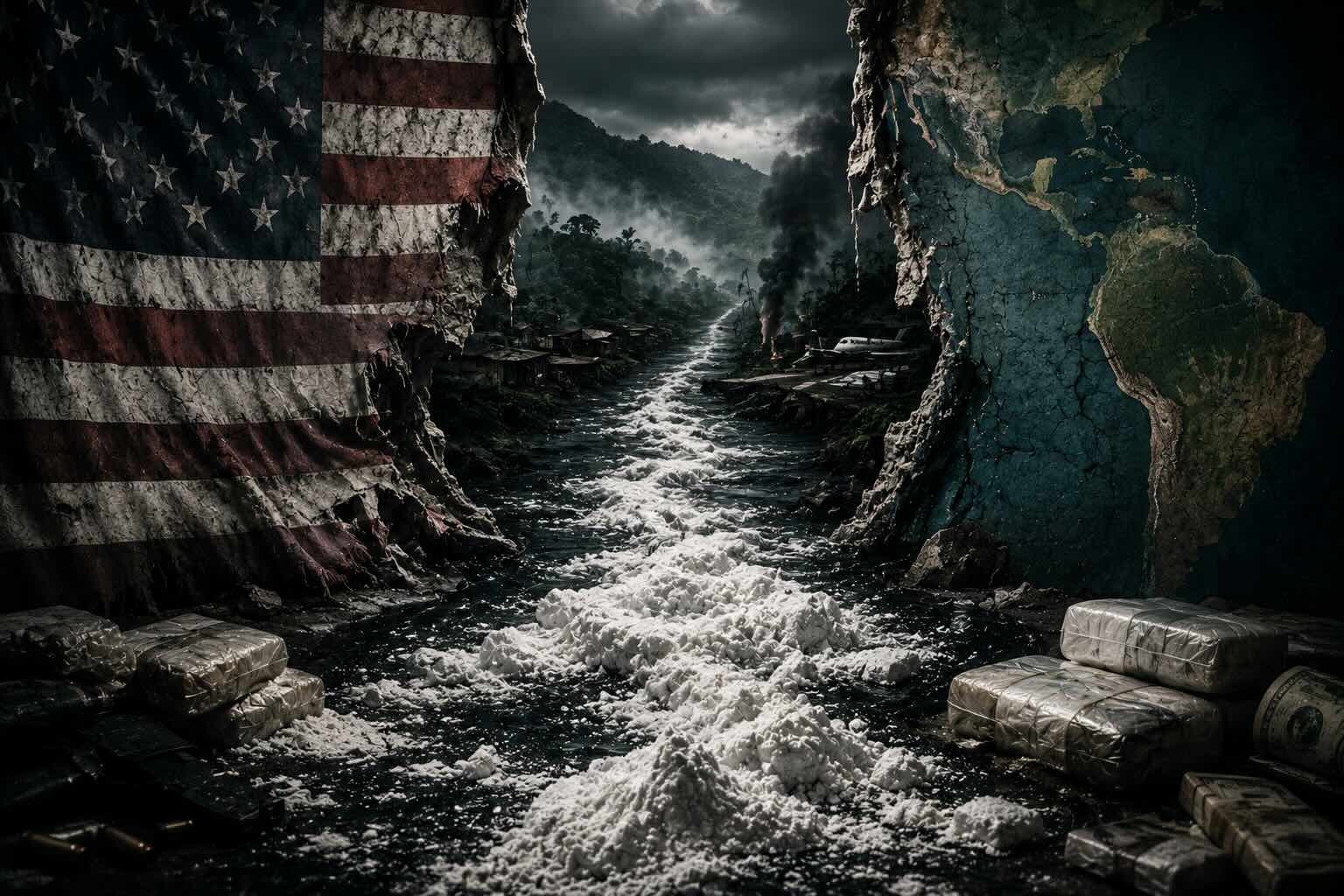
For decades the poisonous river of cocaine flowing into the United States has not respected borders, languages, or governments. It has carried with it shattered families, violent street gangs, organized crime, corruption, and the slow corrosion of national security on both sides of the hemisphere. America cannot win the war against narcotics unless the nations where those drugs are cultivated, refined, and exported stand shoulder to shoulder with us in a common cause.
That is why the election of Colombia’s new president represents far more than a routine transfer of political power. It signals the emergence of a government that understands that narcotics trafficking is not merely a criminal enterprise but an act of economic warfare, social sabotage, and terrorism directed against free societies. By declaring uncompromising war on the narco terrorists who have held vast regions of Colombia hostage for generations, the new administration has extended its hand to the United States in a partnership rooted not in ideology, but in the mutual defense of civilization, sovereignty, and the rule of law.
History teaches that nations rarely perish from invasion before they first decay from within. Rome was not conquered in a single day. Its institutions were hollowed out, its confidence diminished, and its enemies emboldened long before the barbarians breached the gates. The same lesson has echoed throughout the modern era wherever governments have surrendered territory, sovereignty, or political will to criminal empires masquerading as revolutionary movements. Today, Colombia stands at another such historic crossroads.
The election of Abelardo de la Espriella marks one of the most consequential political shifts in the Western Hemisphere in decades. After years in which drug cartels, Marxist guerrillas, criminal syndicates, and narco terrorist organizations expanded their influence across large portions of Colombia, the Colombian people have elected a president who has declared that accommodation has ended and confrontation has begun. During and immediately following his victory, De la Espriella made unmistakably clear that his administration intends to treat narco terrorists not as political actors worthy of endless negotiations, but as enemies of the Colombian state to be defeated. He has pledged a sweeping security crackdown, closer cooperation with the United States, and a renewed campaign against the criminal organizations that have profited from cocaine production, extortion, kidnapping, and political intimidation. His incoming government has also signaled that Colombia will cooperate more closely with American led regional efforts aimed at strengthening the fight against organized crime and narcotics trafficking.
This declaration is not merely a change in rhetoric. It represents a rejection of the dangerous illusion that peace can be purchased through endless concessions to violent criminal organizations. Throughout history, governments that confuse weakness with compassion inevitably invite greater violence. Winston Churchill warned Britain that choosing dishonor over resistance would ultimately produce both dishonor and war. Colombia has lived through precisely that tragic cycle for generations.
The history of Colombia is inseparable from the scourge of narco terrorism. Pablo Escobar transformed Medellín into the headquarters of one of the largest criminal enterprises the world has ever witnessed. His cartel assassinated judges, murdered journalists, bombed civilian airliners, bribed politicians, and openly challenged the authority of the Colombian government. Escobar understood an enduring truth about organized crime. Criminal empires flourish whenever governments hesitate to use lawful force against them.
Although Escobar himself was eventually eliminated, his empire did not disappear. It fragmented into new cartels, new trafficking networks, and increasingly sophisticated alliances with Marxist guerrilla organizations such as the FARC and the ELN. Drug trafficking became the financial engine powering insurgency, terrorism, kidnapping, illegal mining, human trafficking, and corruption across enormous swaths of the country. Even after the celebrated peace agreements of the last decade, numerous dissident factions and criminal organizations continued expanding their operations while coca cultivation and cocaine production reached historic highs. Armed groups now compete for territory, intimidate entire communities, and exploit illegal economies that generate billions of dollars annually.
The consequences extend far beyond Colombia’s borders. Cocaine flooding into North America fuels addiction, organized crime, money laundering, human misery, and violence throughout the United States. Every kilogram that leaves Colombia finances additional weapons purchases, corrupts more public officials, recruits more young criminals, and strengthens transnational criminal organizations operating across the hemisphere. The poison that begins in the jungles and laboratories of South America too often ends in American emergency rooms, county morgues, devastated neighborhoods, and grieving homes where parents wonder how their children were swallowed by an invisible empire of narcotics and death.
President Donald Trump has long argued that drug cartels should no longer be viewed as ordinary criminal enterprises but as terrorist organizations that threaten national sovereignty. That philosophy increasingly appears to be influencing governments throughout Latin America. Ecuador has intensified military operations against cartel organizations. El Salvador demonstrated that aggressive law enforcement can dramatically reduce organized criminal violence. Argentina has embraced stronger security policies. Now Colombia appears poised to join this growing coalition dedicated to restoring state authority over territories long surrendered to criminal control.
Critics will undoubtedly warn that such policies are too aggressive. They will invoke concerns about civil liberties, political polarization, and executive authority. Those concerns deserve thoughtful consideration in every constitutional republic. Yet history also teaches that liberty cannot survive where criminal organizations become more powerful than legitimate governments. Citizens cannot enjoy constitutional freedoms while living under the constant threat of assassination, extortion, kidnapping, and narcotics fueled violence.
Abraham Lincoln understood that preserving constitutional government sometimes requires extraordinary resolve against forces determined to destroy it. Ronald Reagan recognized that communist movements financed by narcotics trafficking represented not merely criminal enterprises but strategic threats to democratic civilization throughout the Western Hemisphere. Their warnings remain strikingly relevant today, as narco terrorist networks operate less like street gangs and more like hostile shadow governments with their own armies, treasuries, intelligence networks, propaganda machines, and political patrons.
Colombia’s new president inherits enormous challenges. Powerful cartels possess vast financial resources, heavily armed militias, sophisticated intelligence networks, and decades of experience corrupting public institutions. They will not disappear simply because a new administration takes office. Success will require sustained political courage, professional military leadership, honest law enforcement, judicial integrity, international cooperation, and unwavering public support.
For the United States, this moment should be welcomed and strengthened. A Colombia prepared to cooperate with Washington, D.C. in reducing narcotics trafficking and defeating narco terrorism is not merely a regional ally. It is a strategic partner in the defense of our own cities, borders, families, and national security. America should encourage this new seriousness, share intelligence where appropriate, coordinate interdiction efforts, and make clear that the days of treating narcotics trafficking as a remote foreign problem are over. The cartel pipeline is not a distant inconvenience. It is a hemispheric war.
Whether De la Espriella ultimately succeeds remains to be seen. Campaign promises are always easier than governing. Yet one truth is already unmistakable. Colombia has declared that narco terrorism is no longer a political inconvenience to be managed through endless negotiations. It is an existential threat to national sovereignty that must be confronted directly. That declaration matters not only to Colombia but to every nation struggling against transnational criminal organizations that poison communities, undermine democratic institutions, corrupt governments, and finance violence across international borders. The battle against narco terrorism is not simply Colombia’s fight. It is the fight of every free nation that refuses to surrender civilization to organized criminal empires.

