

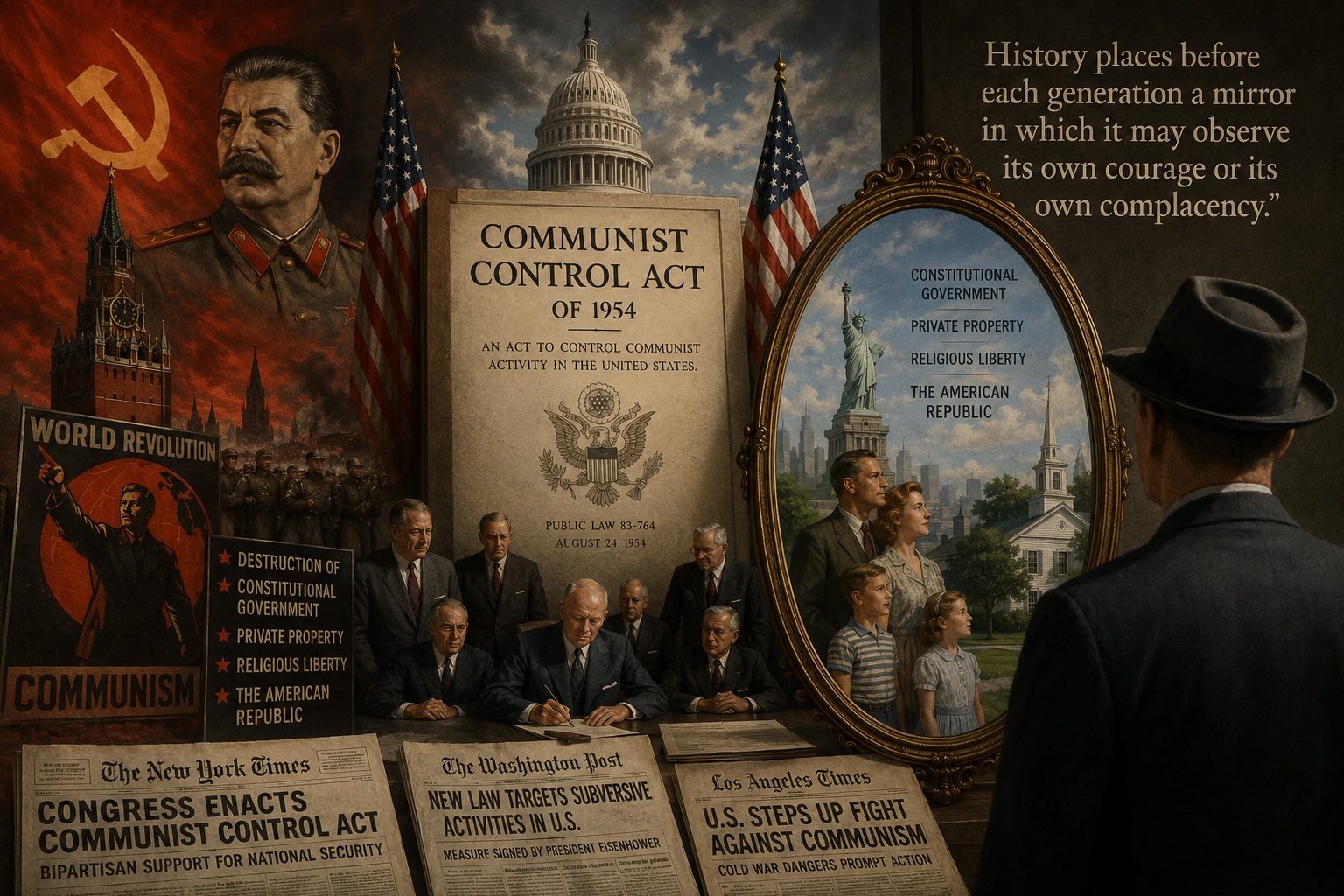
History possesses an uncanny habit of placing before each generation a mirror in which it may observe its own courage or its own complacency. Few statutes illustrate that truth more vividly than the Communist Control Act of 1954. Enacted during one of the most dangerous periods of the Cold War, the legislation reflected a bipartisan recognition that communism was not merely another political philosophy competing in the marketplace of ideas. It was understood to be the political instrument of an international revolutionary movement directed from Moscow whose explicit objective was the destruction of constitutional government, private property, religious liberty, and ultimately the American Republic itself.
The lawmakers who approved the Act were hardly naïve reactionaries consumed by paranoia. Many had witnessed firsthand the expansion of Soviet espionage, the betrayal of atomic secrets by ideological sympathizers, the subversion uncovered by congressional investigations, and the systematic infiltration of labor organizations, universities, and government institutions. They understood that the Communist Party of the United States had frequently functioned not as an independent political organization but as an extension of Soviet strategic interests. Congress therefore concluded that the Party should not enjoy the same legal protections ordinarily afforded to legitimate political organizations dedicated to preserving constitutional government.
That determination, however, encountered an increasingly expansive interpretation of the First Amendment. During the following decade, the federal judiciary steadily shifted toward protecting political advocacy, even advocacy advocating profound changes to the American system of government. The Supreme Court’s decision in Brandenburg v. Ohio fundamentally altered the constitutional landscape by holding that speech advocating unlawful conduct could not be punished unless it was intended and likely to produce imminent lawless action. The distinction between advocating an idea and committing a crime became one of the defining principles of modern First Amendment jurisprudence.
As a consequence, the Communist Control Act gradually receded into practical obscurity. Although portions of the statute technically remain within the United States Code, the Act has been rendered largely unenforceable by constitutional precedent and by subsequent congressional action repealing or superseding many of its provisions. It survives more as a historical reminder of Cold War anxieties than as an effective prosecutorial tool.
This legal evolution explains why the Department of Justice (DOJ) today focuses almost exclusively upon criminal conduct rather than ideological affiliation. Federal prosecutors do not initiate cases merely because an individual professes communist, socialist, anarchist, or any other political beliefs. Instead, they require evidence of espionage, terrorism, sabotage, foreign intelligence activity, fraud, conspiracy, violence, or other violations of federal criminal law. The Constitution protects unpopular opinions far more vigorously than many Americans realize.
That constitutional framework also explains why organizations such as the Democratic Socialists of America (DSA) continue to operate lawfully despite fierce criticism from conservatives who view many of their policy positions as profoundly harmful. Whether one believes the DSA advocates destructive economic policies or promotes an ever expanding administrative state is ultimately irrelevant to the constitutional inquiry. Under current Supreme Court doctrine, political advocacy remains protected unless it crosses the narrow line into criminal conduct or incitement to imminent violence.
Many Americans understandably find this distinction frustrating. They observe political rhetoric celebrating Marxist thinkers, denigrating capitalism, or calling for sweeping transformations of American institutions and naturally wonder why laws enacted during the Cold War appear dormant. The answer lies not in prosecutorial indifference but in constitutional evolution. The First Amendment, as interpreted over the past half century, has become one of the broadest protections of political speech anywhere in the world.
None of this should be mistaken for a declaration that ideological movements pose no danger. History offers abundant evidence that authoritarian movements frequently advance not through sudden revolutions but through gradual cultural influence, institutional capture, educational indoctrination, and persistent political activism. Americans possess every right to oppose such movements vigorously through elections, public debate, legislative reform, and civic engagement. The Constitution protects the right to advocate against socialism just as fully as it protects the right to advocate for it.
The Communist Control Act therefore stands today as a monument to an earlier era when Congress confronted an external ideological adversary with extraordinary legislative measures. Its practical dormancy reflects not the disappearance of ideological conflict but the triumph of constitutional protections that distinguish between belief and criminal conduct. Whether that balance remains sufficient for the challenges of the twenty first century is a question that belongs not only to lawyers and judges but to every citizen entrusted with preserving the blessings of liberty for generations yet unborn.

