

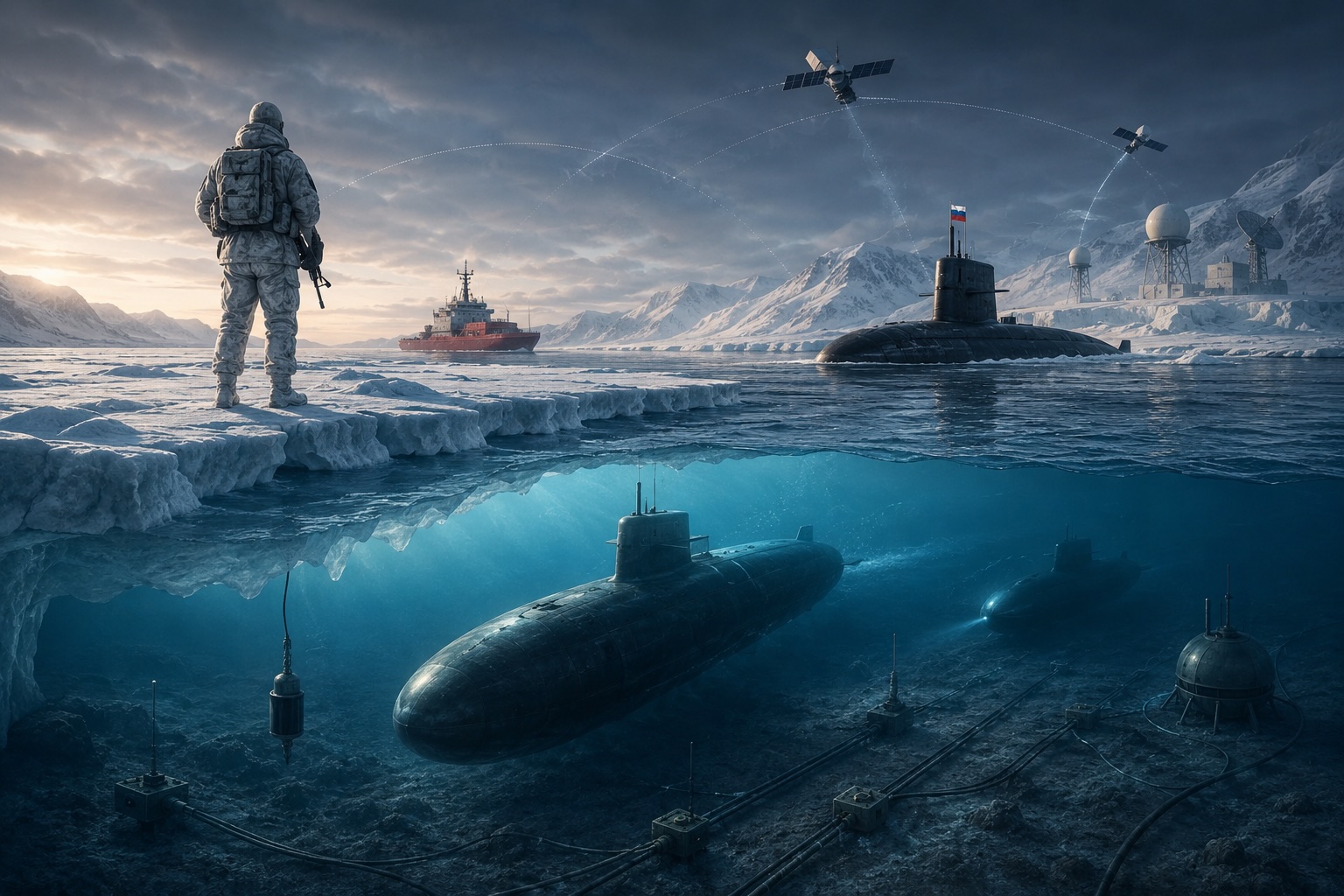
For generations Americans looked north and saw an immense frozen wilderness, remote from the intrigues and conflicts consuming the rest of the world. That complacent picture is now obsolete. The Arctic is becoming one of the most consequential theaters of great power competition, where shipping lanes, energy deposits, submarine routes, communications systems, military surveillance, and critical infrastructure converge beneath a deceptively tranquil landscape of ice and sea. China and Russia understand this transformation perfectly and both have been expanding their presence while Washington, D.C. has too often treated the High North as a distant geographical abstraction.
On June 8, 2026 Utah Republican Senator Mike Lee introduced the Arctic Security and Diplomacy Act, S. 4708 along with Democratic Senator Jeanne Shaheen of New Hampshire as cosponsor. The bipartisan legislation targets a vulnerability that deserves far more public attention. Foreign vessels can enter strategically sensitive Arctic areas ostensibly to study currents, ice, ocean chemistry, seabeds, and marine conditions. The same information that produces an academic paper can help a military determine where submarines can operate, how underwater acoustics behave, where sensors might be positioned, and how naval forces could maneuver through one of the most unforgiving environments on Earth.
Intelligence Online reported that “dual use scientific missions are under scrutiny by Congress” as lawmakers seek to counter espionage by Beijing and Moscow. The phrase “dual use” is crucial. A research vessel need not arrive bristling with missiles to serve a strategic purpose. Bathymetric surveys, currents, temperature profiles, hydrographic information, salinity, acoustic conditions, magnetic anomalies, and detailed seabed mapping all have legitimate scientific applications. In the hands of a hostile military or intelligence service, they can also possess extraordinary strategic value.
Senator Lee has correctly refused to indulge the fiction that every foreign vessel displaying the word “research” on its paperwork deserves American credulity. “The United States must not tolerate China’s increasing incursions into US waters under the guise of surveys and research”, Lee said. He continued, “This legislation shuts the door to foreign adversaries attempting to commit espionage and exercise influence at our doorstep in the Arctic, affirming the sole right of the American people to determine who may approach their shores, from the Aleutians to the Beaufort Sea.”
Espionage has always prospered behind camouflage. During the Cold War, intelligence officers traveled as diplomats, businessmen, journalists, and trade officials. In the Arctic of the 21st century, the laboratory coat can perform the same function as the trench coat. The research vessel has become a maritime Trojan horse, outwardly innocuous while possessing the ability to collect information whose military significance may greatly exceed its scientific appearance.
The United States Coast Guard documented a striking increase in Chinese research vessel activity near Alaska throughout 2025. On July 25, 2025 the Coast Guard detected the Chinese icebreaker Xue Long 2, operated by the Polar Research Institute of China, approximately 290 nautical miles north of Utqiagvik, Alaska. The vessel was operating on the United States extended continental shelf, approximately 130 nautical miles inside its boundary. A Coast Guard C 130J Hercules aircraft was dispatched to monitor it under Operation Frontier Sentinel, an initiative appropriately described as meeting “presence with presence” when adversarial activity occurs near Alaska.
By August 2025 the Coast Guard was monitoring five Chinese research vessels operating in or near the American Arctic. On August 5, 2025 a Coast Guard aircraft responded to the Chinese research vessels Ji Di and Zhong Shan Da Xue Ji Di as they traveled northeast through the Bering Sea. The following day the Coast Guard Cutter Waesche encountered Zhong Shan Da Xue Ji Di moving north through the Chukchi Sea above the Arctic Circle. The Coast Guard described this as part of a three year trend of increasing Chinese research vessel activity in the American Arctic. Their presence does not prove that every scientist aboard is an intelligence operative or every instrument an espionage device. It does make strategic indifference untenable. Nations do not spend enormous sums constructing ice capable vessels, dispatching them thousands of miles from home, and cultivating decades of polar expertise without considering the strategic dividends. Beijing thinks in generations, not news cycles. What appears to be scientific curiosity in isolation can become reconnaissance when viewed as one component of a much larger strategy.
China is not an Arctic nation, yet Beijing declared itself a “near Arctic state” in its 2018 Arctic policy and has pursued influence through scientific research, investment, infrastructure, shipping, and cooperation with Moscow. It has incorporated these ambitions into its so called “Polar Silk Road,” extending the logic of its Belt and Road Initiative into the polar region. The Arctic contains enormous natural resources and increasingly accessible maritime corridors, while occupying a singular military position between North America and Eurasia. Beijing does not require sovereignty over Arctic territory to benefit from access, information, infrastructure, and persistent presence.
Russia presents a different but complementary challenge. Unlike China, Russia is indisputably an Arctic power, controlling approximately 53% of the Arctic coastline. Moscow has spent years refurbishing bases, airfields, radar installations, missile systems, and other military infrastructure throughout its northern territory. Its relationship with Beijing creates an ominous combination. Russia possesses geography, infrastructure, and extensive Arctic experience. China brings capital, industrial capacity, technology, and an appetite for long term strategic penetration. The Pentagon has warned about this convergence and its 2024 Arctic Strategy stated that Chinese and Russian activities and their growing cooperation and both countries have conducted joint military exercises near Alaska, while their coast guards have increased cooperation. Former Deputy Assistant Secretary of Defense, now Department of War, Iris Ferguson observed that China uses scientific research, economic relationships, and other instruments of national power to insinuate itself into the region. Her warning that the United States must remain “clear eyed” about Beijing’s intentions should have been axiomatic years ago.
President Donald Trump recognized the broader vulnerability during his first administration. In 2020 his administration changed American policy so that marine scientific research conducted by foreign academics, governments, and international organizations inside the United States Exclusive Economic Zone and on the American continental shelf became subject to advance consent by the United States government. Scientific cooperation is valuable, but cooperation does not require strategic gullibility. The Lee/Shaheen legislation would place that principle on a stronger statutory foundation. Foreign vessels seeking to conduct marine scientific research in American waters would have to obtain consent from the State Department. Vessels belonging to or reasonably suspected of association with adversarial countries such as China and Russia would be disqualified. The legislation also directs the Secretary of State, working with the Secretary of War and intelligence community leaders, to develop a strategy for identifying and countering foreign espionage and influence operations throughout the Arctic.
The measure moved quickly after its introduction. On June 17, 2026 the Senate Foreign Relations Committee ordered S. 4708 favorably reported with an amendment in the nature of a substitute. That bipartisan progress is significant because Arctic security should not become another casualty of Washington, D.C.’s reflexive partisan warfare. A Chinese intelligence collector does not care whether an American senator scrutinizing him or her has an R or a D beside his name. Lee and Shaheen deserve credit for recognizing that sovereignty transcends party politics.
The larger lesson concerns the changing nature of espionage. Americans tend to imagine intelligence collection in cinematic terms involving clandestine meetings, stolen documents, dead drops, and covert agents. Strategic intelligence can also be accumulated openly and incrementally. 1,000 seemingly innocuous measurements can form a mosaic whose final image is extraordinarily sensitive. In the Arctic, geography itself is intelligence.
The region is also changing rapidly. Retreating ice is making previously inaccessible waters navigable for longer portions of the year, while resources once imprisoned beneath ice and hostile seas become increasingly accessible. Nature once provided America with a formidable glacis in the north. As that barrier becomes more permeable, geography’s protection must be supplemented by surveillance, infrastructure, diplomacy, intelligence, icebreakers, and military capability.
The Coast Guard has described itself as America’s only surface presence in the Arctic and emphasized the necessity of a robust national icebreaker fleet. Presence matters because sovereignty that cannot be observed, patrolled, and defended risks becoming increasingly theoretical. Operation Frontier Sentinel sensibly embraces the principle that adversarial presence must be met by American presence. Foreign vessels operating in strategically sensitive areas should never assume nobody is watching.
Moscow and Beijing have different interests but ample reasons for mutual suspicion. Russia is unlikely to relish becoming China’s junior partner in territory central to its national identity and economic future. China has no Arctic coastline of its own and remains dependent upon access provided by actual Arctic states. American strategy should exploit these limitations rather than squander them; the appropriate response is neither hysteria nor complacency. It is vigilance backed by capability.
America needs better domain awareness, more ice capable ships, stronger surveillance, closer coordination with Arctic allies, and laws distinguishing legitimate scientific cooperation from activities conducted by governments with demonstrably adversarial objectives. The Arctic Security and Diplomacy Act addresses one portion of that equation by establishing that access to American waters for scientific research is a privilege subject to American national security interests, not an entitlement bestowed upon every government clever enough to paint the word “research” on the side of a ship.
China has repeatedly demonstrated its ability to blur the boundary between civilian and military activity. Scientific institutions, universities, infrastructure projects, technology companies, commercial enterprises, and research programs exist within an authoritarian system in which the state possesses immense power to obtain information and harness ostensibly civilian capabilities for national objectives. Treating Chinese state-connected polar research as though it operates within the same institutional ecosystem as an independent American university expedition would be an exercise in fatuity.
The Arctic is becoming an enormous ice bound chessboard, but its pieces no longer consist solely of bombers, submarines, missiles, and military bases. Research vessels, icebreakers, ports, communications infrastructure, resource projects, and scientific partnerships can all acquire strategic significance. Washington, D.C. cannot play this game while pretending half the pieces are decorative. The United States still has an opportunity to establish clear rules before today’s vulnerability metastasizes into tomorrow’s crisis. The Arctic Security and Diplomacy Act is not a declaration against international science. It is a declaration that American sovereignty and national security take precedence over the convenience of hostile governments seeking privileged access to strategically sensitive waters.
The Arctic may look pristine from thousands of feet above, but beneath that immaculate white surface lies an increasingly consequential contest for information, access, resources, influence, and military advantage. Beijing and Moscow recognize the stakes. The United States must demonstrate the same perspicacity. The wolf does not become a lamb merely because it arrives aboard a research vessel carrying scientists and measuring instruments. America should welcome genuine scientific cooperation while making certain that foreign powers never mistake our openness for blindness.

