

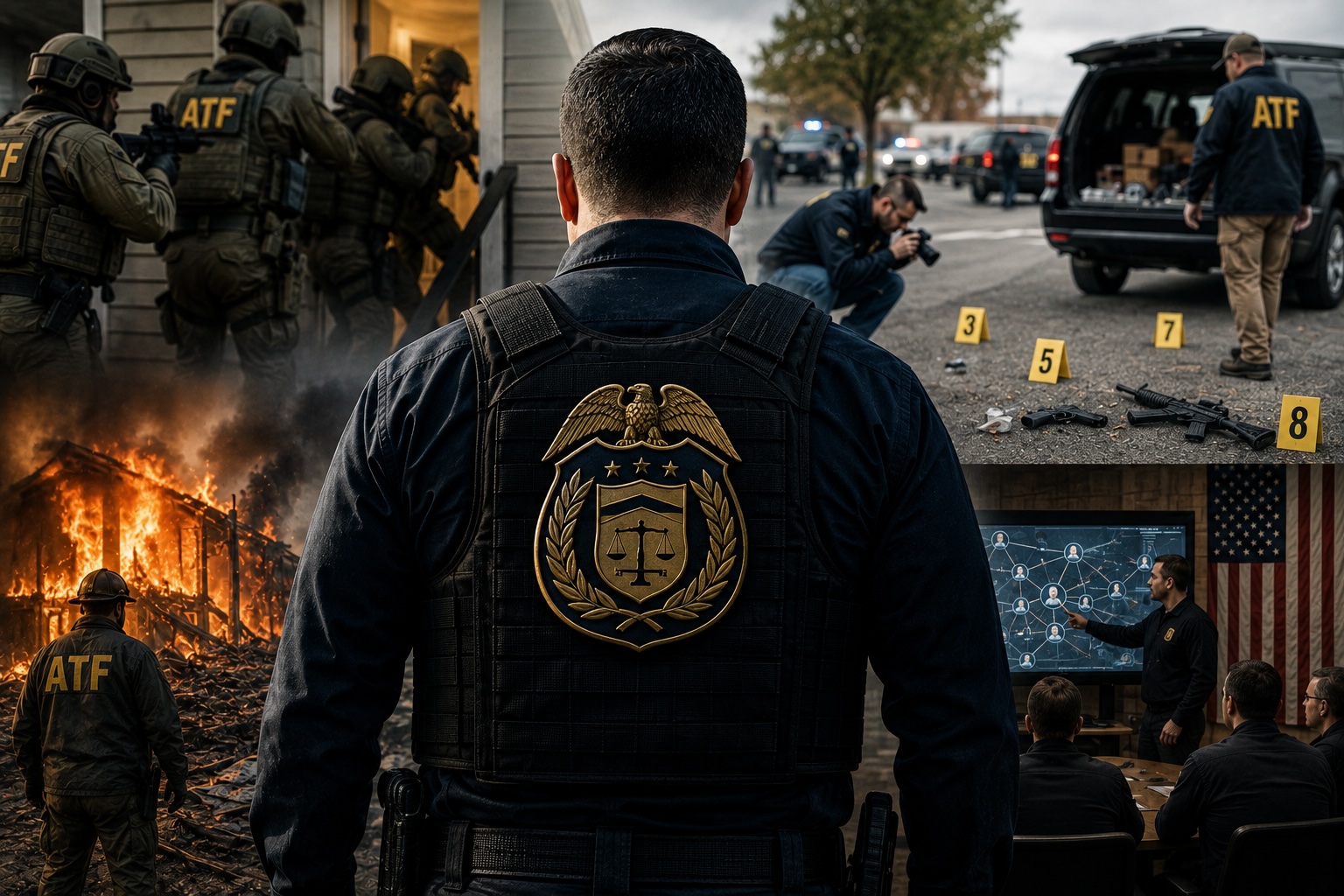
For far too many years, the Bureau of Alcohol, Tobacco, Firearms and Explosives (ATF) drifted from the mission Congress intended when it created the agency. Instead of concentrating its resources on violent criminals, firearms traffickers, bombings, arson investigations, and organized criminal enterprises ATF increasingly became entangled in regulatory battles that alienated law abiding gun owners. President Donald Trump’s decision to appoint Robert Cekada as ATF Director represents a deliberate course correction that restores the agency to its original purpose and, in doing so, strengthens both public safety and constitutional liberty.
As I wrote when President Trump nominated Robert Cekada, he was the right man for the job. Nothing that has occurred since his confirmation has changed that conclusion. Quite the contrary. Director Cekada has made it abundantly clear that the ATF’s future lies in pursuing violent offenders rather than treating ordinary Americans exercising their Second Amendment rights as suspects. His leadership reflects the understanding that constitutional rights and effective law enforcement are not mutually exclusive. They reinforce one another when government remains faithful to its proper role.
One of the first major initiatives under Director Cekada has been an ambitious review of dozens of ATF regulations that accumulated over many years. The objective is not simply deregulation for its own sake. Rather, it is to eliminate confusing, redundant, or legally questionable rules that consumed agency resources while creating uncertainty for lawful firearms owners and federally licensed dealers. Cekada has consistently argued that regulatory clarity allows the ATF to devote greater manpower and investigative attention toward violent crime, firearms trafficking, and criminal organizations that actually threaten American communities.
That approach reflects the ATF’s historic strengths. The bureau has long been one of the federal government’s premier agencies for investigating serial arsonists, bombings, criminal explosives networks, and firearms trafficking conspiracies. ATF agents played indispensable roles investigating the Oklahoma City bombing in 1995, the Centennial Olympic Park bombing in Atlanta in 1996, and countless acts of arson and criminal explosions that required sophisticated forensic expertise unavailable elsewhere in the federal government. ATF’s National Center for Explosives Training and Research has become an internationally respected institution due to ATF’s unmatched experience in explosives investigations. Those capabilities save lives. They should always remain among the agency’s highest priorities.
ATF has likewise demonstrated tremendous value when targeting violent gangs and interstate firearms trafficking organizations. Programs such as Project Safe Neighborhoods and cooperative violent crime task forces have repeatedly shown that focused investigations against repeat offenders produce measurable reductions in shootings and gun related violence. Criminals who steal firearms, purchase weapons through straw buyers, traffic guns across state lines, or use firearms in furtherance of violent felonies deserve the full attention of federal investigators. That is precisely where Director Cekada intends to concentrate the bureau’s efforts.
The opposite approach has frequently produced controversy without corresponding improvements in public safety. Over the past decade ATF found itself at the center of repeated political disputes involving shifting regulatory interpretations, stabilizing braces, unfinished firearm frames and receivers, and other administrative questions that often generated years of litigation before ultimately reaching the federal courts. Whatever one’s views on those individual policies there is little evidence that dedicating enormous institutional energy to constantly expanding regulatory definitions substantially reduced violent crime. Instead, the agency often found itself defending administrative decisions rather than pursuing armed robbers, gang members, cartel traffickers, and violent felons.
Earlier failures also illustrate the dangers of allowing politics to overshadow sound law enforcement. Operation Fast and Furious remains one of the darkest chapters in the bureau’s history. Federal officials knowingly permitted firearms to move into the hands of Mexican drug cartels under the misguided theory that investigators could later track the weapons to higher level traffickers. Instead, many of those firearms disappeared, and some were later recovered at violent crime scenes, including the murder of United States Border Patrol Agent Brian Terry. The scandal permanently damaged public confidence because it represented a profound failure of judgment and accountability. It also demonstrated what happens when leadership loses sight of the agency’s core mission of stopping illegal firearms trafficking before innocent people are harmed.
Fast and Furious whistleblower and author Peter J. Forcelli stated, “I’ve called out ATF when they got things wrong. I did so publicly and quite bluntly. I’ve seen what happens when the enforcement of the nations gun laws becomes politicized. I’ve also known Robert Cekada for over 30 years. He understands what any good law-enforcement officer understands, and that is the fact that it is the criminal that represents a danger to the American public. It is not the inanimate object; the gun. Far too often political zealots have focused on disarming the American populous while taking a soft stance on violent criminals. One thing I can say for certain is that Robert Cekada will make sure that ATF is a laser focused all in going after what really threatens honest tax paying citizens. The armed criminal.”
Robert Cekada brings something uniquely valuable to this challenge. He is not a political celebrity installed to wage ideological warfare from the director’s office. He is a career law enforcement professional who served as an NYPD detective before joining the ATF more than two decades ago. Having worked through the bureau’s investigative ranks and senior leadership, he possesses an intimate understanding of both its extraordinary strengths and its past shortcomings. That institutional knowledge cannot be replicated by someone viewing the agency from the outside.
Equally important, Cekada understands that preserving constitutional rights enhances rather than weakens the credibility of federal law enforcement. Americans who obey the law should never view the ATF as an adversary searching for technical violations. When citizens believe the government respects their constitutional liberties, cooperation with legitimate criminal investigations becomes easier, not harder. Public confidence is earned through fairness, consistency, and adherence to the rule of law rather than headline grabbing political gestures.
President Trump deserves considerable credit for recognizing that distinction. Rather than selecting someone whose primary qualification was ideological symbolism, he chose a seasoned professional capable of restoring public confidence while directing the bureau back toward its statutory responsibilities. That decision reflects an understanding that successful law enforcement depends upon competent leadership, disciplined priorities, and respect for constitutional boundaries.
America does not need an ATF that measures success by the number of new regulations it promulgates or the political controversies it generates. America needs an ATF that relentlessly pursues armed criminals, dismantles firearms trafficking organizations, investigates bombings and arsons with world class expertise, removes illegal weapons from violent offenders, and works cooperatively with state and local law enforcement to make neighborhoods safer. Those objectives are entirely consistent with the Second Amendment and entirely consistent with the bureau’s original mission.
Robert Cekada appears determined to restore that balance as he outlined in The Hill and when he succeeds, the ATF will once again become known not as a political lightning rod, but as a professional federal law enforcement agency dedicated to protecting innocent Americans from violent criminals while respecting the constitutional rights of the citizens it serves. That is exactly the direction President Trump envisioned, exactly the direction the bureau needs, and exactly why Robert Cekada was the right choice to lead it.

