

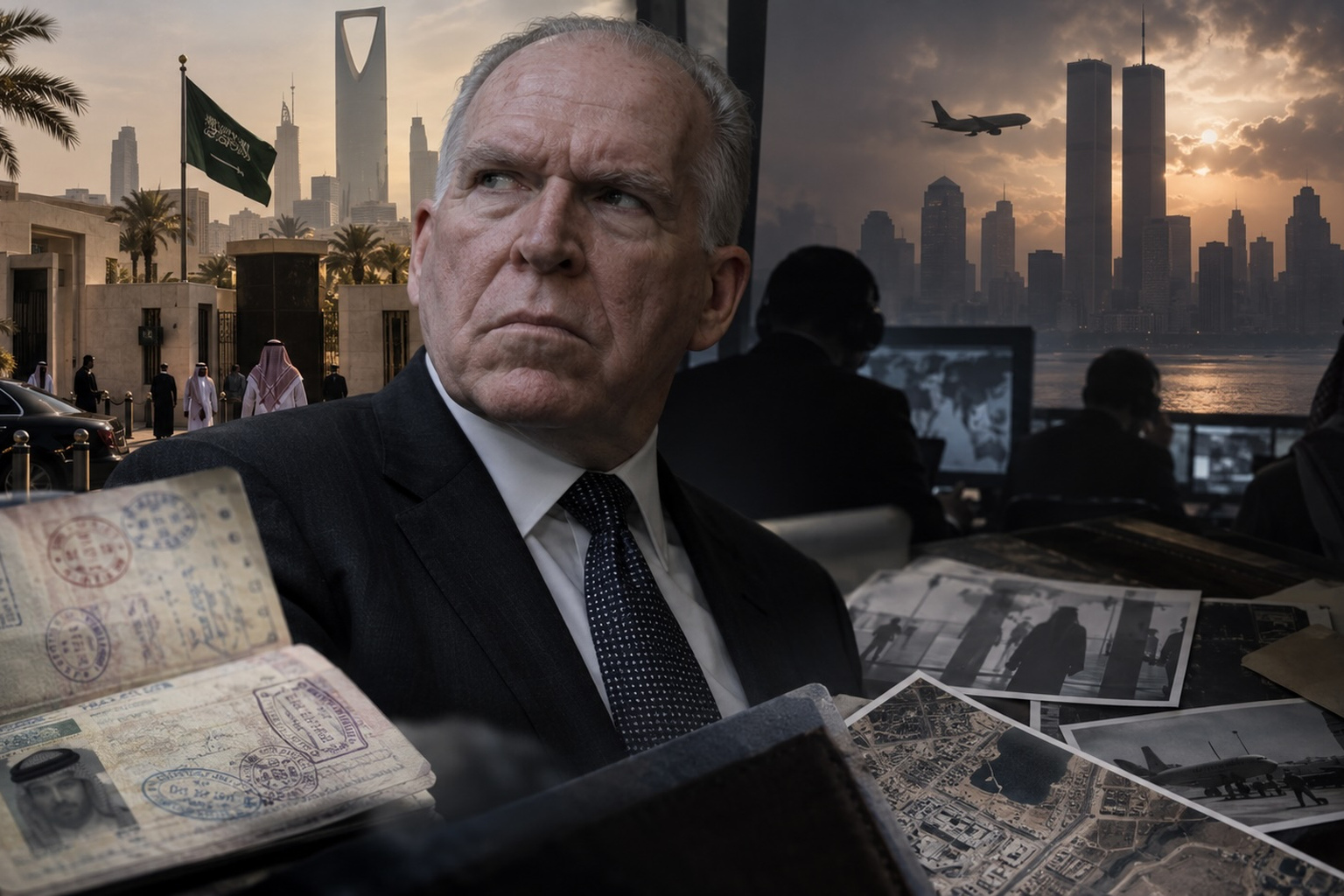
The Brennan File: Saudi Visas, a CIA Station, and 9/11
Twenty-five years later, our country mourns the victims of 9/11. Gatherings take place around the sites where the planes, manned by terrorists, struck and killed innocent people. Names are still read, and we stand together as Americans, in solidarity.
What is rarely discussed on this day is how they got in. Fifteen of the nineteen hijackers were Saudi nationals. Their visas were issued in Jeddah and Riyadh. Most of the Jeddah stamps came from one single consulate.
Four were issued at the embassy in Riyadh. Eleven of the Jeddah stamps were handled by a single junior consular officer. Overlooked paperwork there made all that occurred on this day possible.
The State Department’s own accounting, confirmed in the days after the attacks and later laid out in the 9/11 Commission’s terrorist-travel monograph, showed the pattern. Most of the applications were incomplete.
Four were issued at the embassy in Riyadh. The 9/11 Commission’s terrorist-travel staff report later recorded the pattern: one consular officer issued visas to eleven of the nineteen hijackers. Most of the applications were incomplete. Almost none of the applicants were interviewed.
The rejection rate for Saudi visitors at the time was about 3%. That was not fate. It was a cultivated culture of approval: a system that treated a high-risk threat as a low-risk transaction.
John Brennan sits in that story as CIA chief of station. Before that, he was a political officer in Jeddah in the early 1980s. He ran the Agency’s station in the Kingdom from 1996 to 1999. Station chiefs sit at the intersection of liaison, collection, and influence with the host service. In Saudi Arabia that meant the General Intelligence Presidency, a relationship Washington had cultivated for decades and was reluctant to strain.
A station chief is judged by what he makes a priority. In Saudi Arabia in those years, the priority was the liaison relationship. Visa screening of young Saudi men was not.
The culture at the consulate was to approve.
Brennan left the station in 1999. The culture did not leave with him.
Former consular officer J. Michael Springmann ran the visa section in Jeddah from 1987 to 1989. He has spent years arguing that the CIA used that post to move people it wanted in the United States, mujahideen first, others later, and that State officers who objected were overruled.
Springmann’s tour ended long before 9/11. He later wrote about that work in Visas for Al Qaeda. He says the U.S. consulate there did not function like a normal State Department office: CIA officers worked there while posing as regular diplomats, and the consul general and the CIA’s local chief pressed visa officers to approve travelers who failed the usual tests. Those tests ask whether a person has real ties at home and an honest reason for the trip. Springmann says the standing rule was to make travel easy for Saudis.
His account describes a practice. Most of the world faced a hard look: an interview, a full application, and proof the traveler would go home. Thin files were supposed to be refused. Favored Saudi travelers, he says, often skipped that review when the Saudi government or the CIA office wanted them moved. Springmann left Jeddah more than a decade before the hijackers got their visas.
In June 2001 that practice was made official. Visa Express, mandated Kingdom-wide on June 1, let applicants drop paperwork at designated travel agencies. No interview required. Three of the hijackers used it: Abdulaziz al-Omari, Salem al-Hazmi, and Khalid al-Mihdhar on his June 13 renewal.
The surviving applications, pulled and reviewed after the attacks, reveal careless oversight. The review found misspellings, blanks, and answers that should have required a second look.
Wail al-Shehri listed his occupation as “teater.” He and his brother gave “Wasantwn” as a destination. Mihdhar listed “Hotel” as a U.S. address.
The program that let those forms through had been pitched as a courtesy to a wealthy ally whose citizens almost never overstayed. In practice it was also a gift to anyone who already knew how to fill out a form badly and still get a stamp.
Brennan later became CIA director. When the 28 pages and the families’ lawsuits kept the Saudi question alive, he repeated the institutional line: no evidence the Saudi government as an institution directed the plot. That sentence is carefully drawn.
It does not explain why the man who had been the Agency’s senior officer on the Arabian Peninsula during the years the network assembled was never forced to answer, in public and under oath, what his station knew about the flow of young Saudi men through Jeddah and Riyadh.
No one has produced a confession. The record is dates, incomplete forms, and a liaison relationship that treated Saudi visas as low-risk until nineteen men proved they were not.
Remembering 9/11 as only fanatics with box cutters is a kind of amnesia. The pilots and the muscle needed a door. The door was a consular system built around an ally, a station that lived off that alliance, and a generation of managers who were promoted for keeping the relationship smooth.
Brennan sat at the top of it in the years the network assembled, then climbed past the wreckage without a public accounting of what his station saw, what it asked the Saudis for, and what it decided not to fight.
Twenty-five years on, the visas are still treated as a mysterious part of the story. The mystery is how a station that was supposed to see the Kingdom clearly left the paperwork so easy, and why the officer who ran it rose instead of being asked to explain it under oath.
These men got into the country because someone inside the United States government decided Saudi paperwork was not worth a hard look. That choice did not come out of nowhere.
George H.W. Bush spent decades tying the American presidency to the House of Saud. He did it as CIA director, as vice president and then president during the Gulf War alliance with King Fahd, and later as a Carlyle adviser who traveled to Jeddah to court Saudi investors, including the bin Laden family.
Prince Bandar was close enough to the family to be treated as one of their own. A relationship that intimate makes a hard look at a Saudi file feel like a diplomatic problem. That is the part of 9/11 that still does not get a ceremony.

