

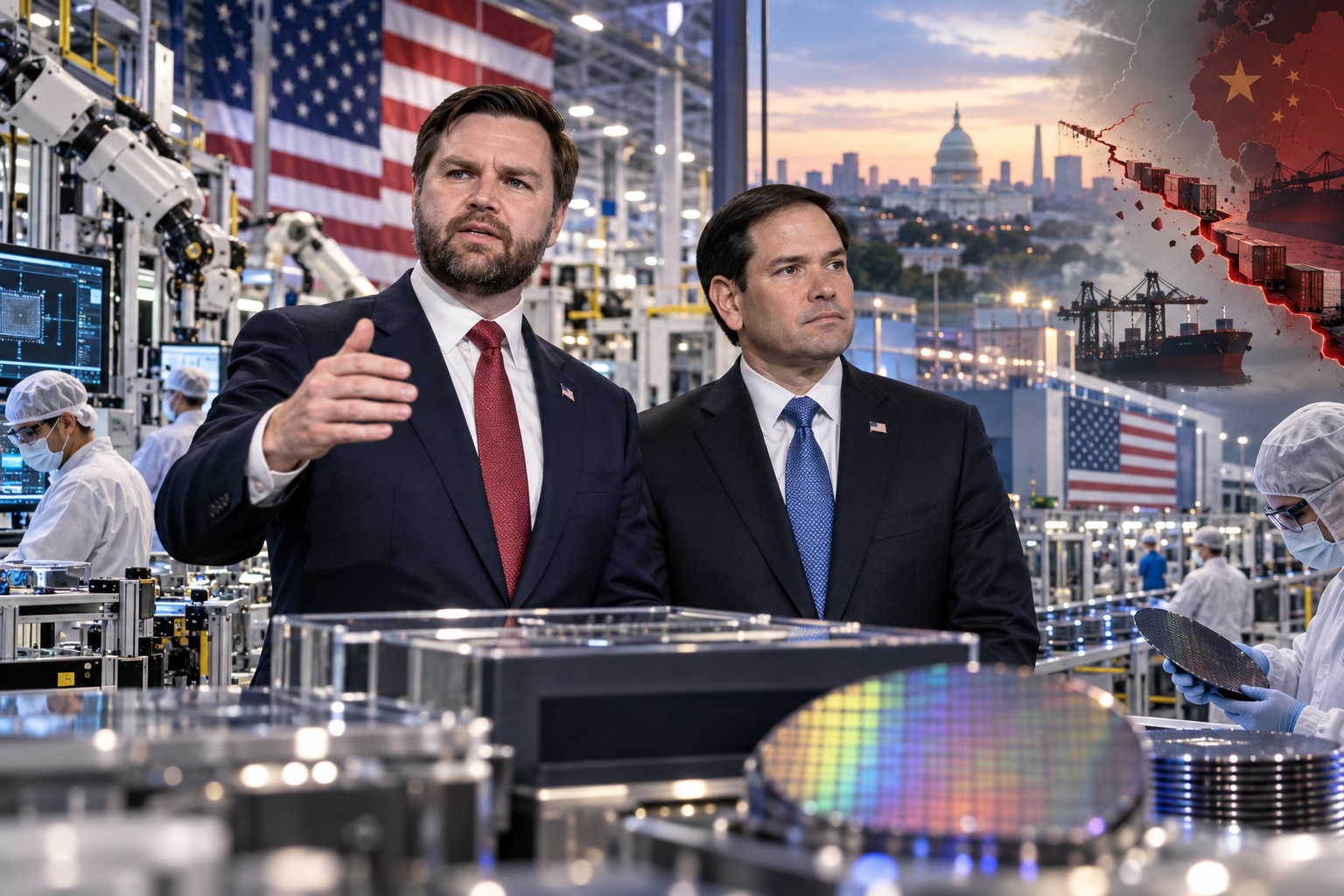
Bringing production home has always been a priority for President Donald J. Trump, and one of the original reasons he ran for office. The White House is treating that pledge as a governing job.
Tariffs, procurement, tax policy, and training are all being used so the work actually returns to U.S. ground.
On Sept. 3, Vice President JD Vance and Secretary of State Marco Rubio launched Foundry School at the Donald J. Trump Institute of Peace in Washington. Under Secretary Jacob Helberg hosted the event and House Majority Leader Steve Scalise also spoke.
The State Department program is built to train the next generation of American plant operators, engineers, and technicians. Helberg first unveiled the project on June 25 at the Pax Silica Summit as a partnership with Stanford. Sept. 3 was the public rollout. Trillions in investment have already been promised. Foundry School is how this White House intends to staff that rebound.
The gap to fill is people.
Officials put the need at about 3.8 million skilled workers by 2033 in semiconductors, defense, energy, and related industry. A Manufacturing Institute and Deloitte study found that about 1.9 million of those jobs could stay empty without any action. The openings do not fill themselves. They require engineers who can design a plant, technicians who can hold yield, and managers who can permit a site, hire at scale, and keep a supply chain on American soil.
The United States sent the skill of manufacturing overseas and never rebuilt it here. Foundry School is meant to reverse that.
The program sits under Pax Silica, the State Department’s supply-chain project for the stack Washington says will define the next century: compute, AI, chips, critical minerals, energy, and high-end production. Twenty-four signatories are in. Japan, Korea, Taiwan, and India are in the room. The premise is simple. America should not depend on a rival’s factories for the industries that matter.
This is a 17-session curriculum built with Stanford and taught across eight universities: Stanford, Arizona State, Georgia Tech, Ohio State, Penn State, the University of Kansas, Vanderbilt, and Washington University in St. Louis. Founders and CEOs from advanced firms in the United States and those partner countries will lead the sessions. The Department of Labor is also a partner.
Rubio called the last generation of trade policy a “terrible mistake.” The idea was that it no longer mattered where things were made, so long as they were cheap. The accompanying fantasy, he said, was that the world would settle into free-enterprise democracies that looked like the United States. It did not. Nation-states remained.
Borders still mattered. Other countries still acted in their own interest. That bargain, he said, left the country “dangerously dependent” on others, not only for cheap goods, but for pieces of its own security. Access to critical minerals as raw material is not enough. The country also has to process them and finish the product again. Reindustrialization, he added, will not look like a mid-century mill. It will demand more skill, and often retraining more than once in a career.
The Trump White House treats the ability to make things here at home in America, as a measure of national strength, and as work that pays.
Foundry School is the training that can cut China dependence, and teach Americans how to build the factory. Scalise framed it as out-building and out-competing Beijing. Helberg called the school a Pax Silica product and a promise kept. Onstage the point was direct.
The habit of treating factories as someone else’s overseas job is finished. Vance and Rubio were making President Trump’s argument. The country had spent years buying what it used to build, and had grown dependent on competitors such as China.
Vance put the security case in plainer terms. COVID, he said, showed what happens when lifesaving equipment is made somewhere else. “You cannot run an economy entirely on services and finance. You have to have a foundation. And that foundation is always going to be making stuff.”
The curriculum has two phases. Phase one is seven regional sessions beginning this month at Arizona State, Georgia Tech, Ohio State, Penn State, Kansas, Vanderbilt, and WashU. They cover factory design, materials and supply chains, assembly engineering, plant economics, regulation and permitting, and hiring at scale.
Phase two is a ten-session core at Stanford starting in January 2027. It covers precision tooling, automation, quality systems, new-product introduction, digital production, capital equipment, energy, site selection, and defense output.
The last session is a capstone on failed ventures: an official admission that plants die when the model never survives a real factory floor. Speaking at the launch, Rubio turned that lesson on the universities already standing. Point them at jobs, he said. Stop letting them drift.
Students are already asking whether a degree is worth the debt if it only leads to another degree. He refused to treat the work as a two-year press cycle. “Multiple American administrations are going to have to make this a priority.” He called for an effort that lasts “a generation,” and put the vice president on the program as proof this White House wants that work to outlast one term.
The seminar series is how the skill gets taught. It supplies people who can lay out production, run operations, and turn promised investment into output here.
Making things in America was once a discipline this country defaulted to. Land-grant colleges were built for agriculture and the mechanical arts, factories ran apprenticeships, and companies kept their own institutes. High schools had drafting, and vocational trades.
School-and-shop programs put students on a worksite and in a classroom in the same year. In wartime Detroit, public-school shops ran around the clock to retrain autoworkers for the arsenal. That respect did not survive cheap foreign labor. The need never faded. Design stayed, production left, and universities chased the degree.
Companies chased cheaper assembly overseas. Building a factory on American soil was no longer a priority. Permanent normal trade relations with China, signed by President Clinton, locked the shift in, and then the work itself left. This program puts industry operators back inside universities to teach real factory work. Industry and the classroom used to train the same people.
This White House is putting the old model back on purpose: train the workers here, build the plants here. Promise made, promises kept. The next generation learns the work in America before the country ships it overseas again. Foundry School is the action. Sessions are scheduled. Enrollment has not been posted.

