

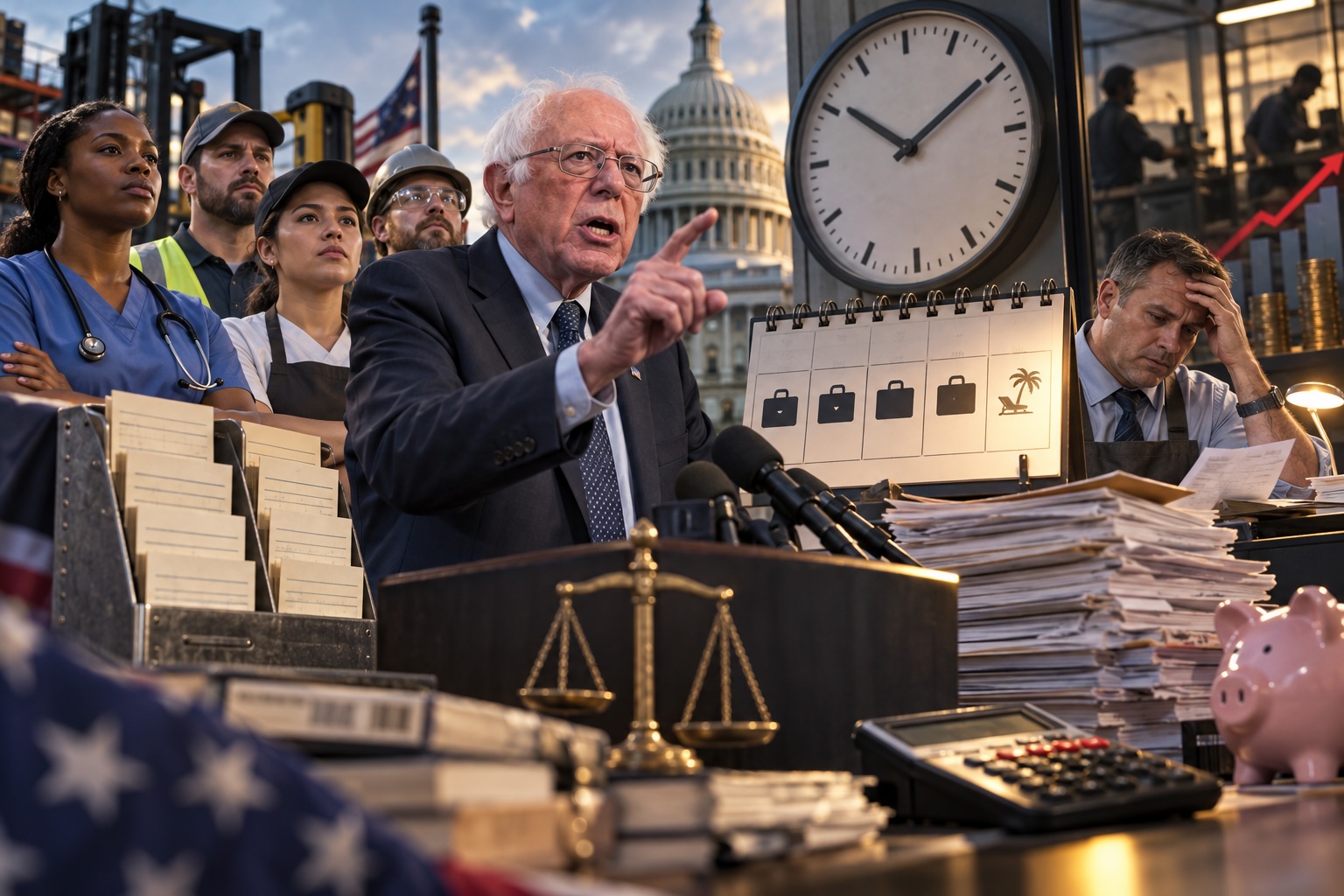
Bernie Sanders, the self-proclaimed democratic socialist from Vermont, and Rep. Mark Takano are back with the same idea they have shopped for years. Their proposed legislation, the Thirty-Two Hour Workweek Act, would rewrite federal overtime law so 32 hours counts as a full week, with no cut in pay. Takano introduced the House bill, H.R. 10323, on Sept. 8. It does not ban a 40-hour week. It makes hours 33 through 40 overtime, then keeps going.
This is not their first time at the rodeo with this topic. Takano first dropped a 32-hour bill in 2021 and again in 2023. Sanders ran a Senate version in 2024 and used a Health, Education, Labor, and Pensions Committee hearing to sell it. The New York Post covered that last run on March 14, 2024, as a push for a 32-hour week with no loss in pay, the same overtime rewrite now being refiled.
The press release leaves out the phase-in. Signing the bill would not cut the workweek that day. The first change could not begin until at least 180 days later. Overtime would then apply after 38 hours in the first year of that window, 36 in the second, and 34 in the third. Only after that third year would the threshold fall to 32 hours. A covered employee still working 40 hours a week would then be owed eight hours of time-and-a-half.
The bill also writes daily overtime into the Fair Labor Standards Act: time and a half after eight hours in a day, double time after 12. California and a few other states already do that. Most of the country does not. Employers can still ask for the extra hours. They just pay more for them. They also cannot cut weekly pay or benefits because the legal week got shorter. Newsweek laid out the mechanics.
If a shop still needs 40 hours of coverage, the worker keeps the old weekly check and collects overtime on hours 33 through 40. Same hours. Higher payroll. Or the employer hires more people, or it shortens the schedule and lives with less coverage.
The bill only reaches workers the FLSA already treats as nonexempt: mostly people who punch a clock, plus some salaried staff who fail the exemption tests. Executive, administrative, and professional employees who meet those tests stay outside the rule. So do independent contractors. A restaurant, a plant, a hospital, or a warehouse that runs on hourly labor takes the cost. A salaried office does not, unless those workers are already owed overtime.
Sanders calls a 32-hour week “not a radical idea.” He says AI and robots will throw off huge gains and those gains should not stop with “a handful of billionaires.” He also repeats the line about nearly $80 trillion moving from the bottom 90% to the top 1 percent, a talking point he has used for years, not a score of this statute. The bill text itself does not mention AI.
Takano says work has changed and the labor statute has not. Unions backing it include the AFL-CIO, SEIU, UAW, National Nurses United, the flight attendants, and UFCW. House cosponsors at introduction were Pramila Jayapal, Eleanor Holmes Norton, Rashida Tlaib, Ilhan Omar, Lou Correa, and Delia Ramirez.
The last time Congress shortened the federal week, it phased the overtime line down from 44 hours to 40 by 1940. USA Today noted what everyone in the building already knows. Republicans control the House and Senate, so the bill is going to the Education and Workforce Committee to sit.
Sen. Bill Cassidy made that case at the 2024 hearing. “It would kill jobs and increase inflation,” he said, as reported by the New York Post.
A four-day week a company chooses is one thing. Federal law already allows that. A four-day overtime trigger forced on every covered employer is another. Until a Republican Congress decides American shops should pay time and a half starting Thursday afternoon, 40 hours is still the week.

