

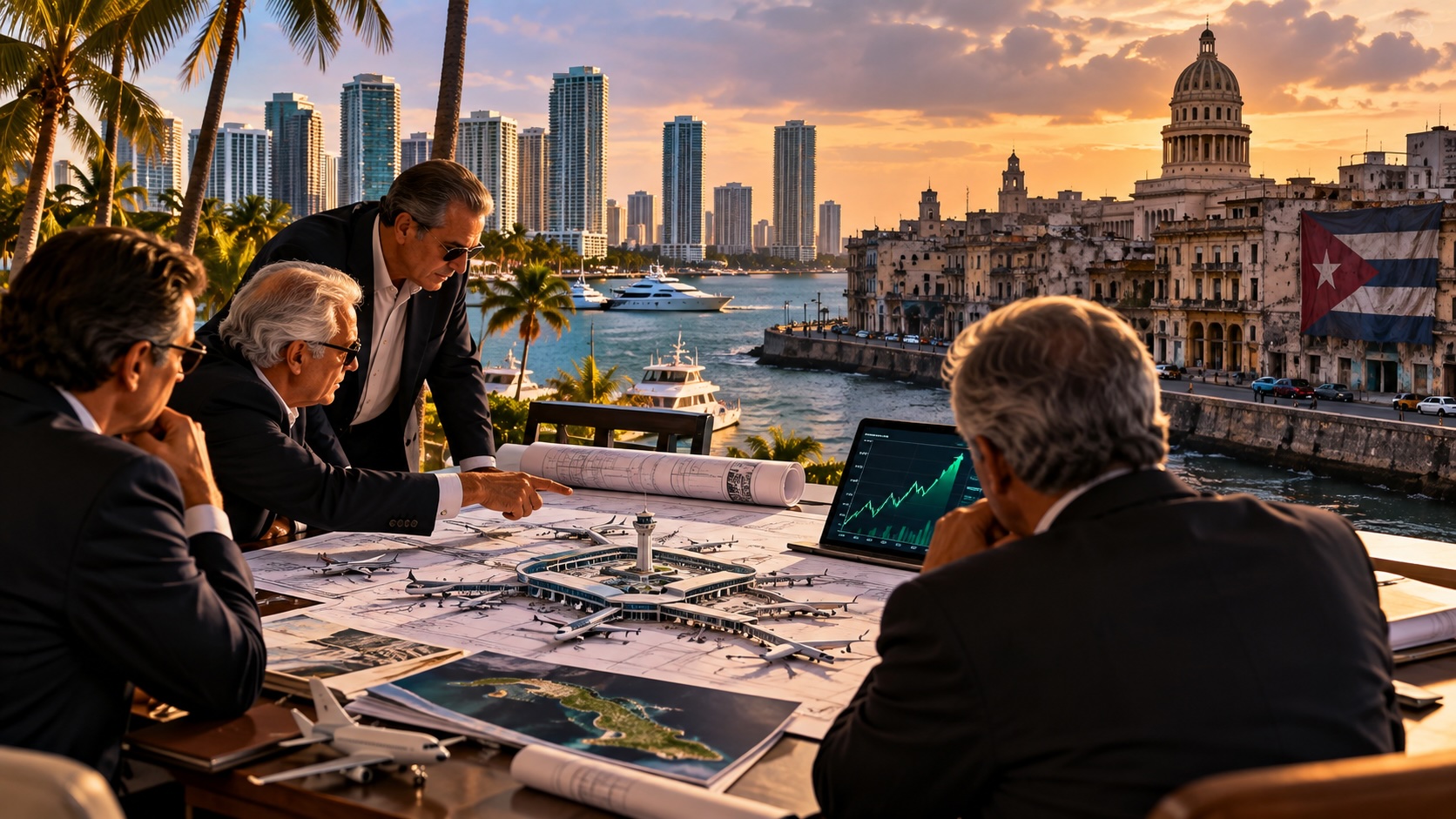
While Havana’s diplomats walked out of the U.N. this week during a speech by President Donald J. Trump, another Cuba conversation has been running for months on Biscayne Bay. Wealthy Cuban-Americans in Miami are sketching a stock market, airport rebuilds, emergency power, and a temporary government for an island that still has the same regime it has had since 1959, as reported by The Wall Street Journal.
The plans already have names and price tags. Juan Omar Sixto, 82, who chairs the new Cuban-American National Chamber of Commerce, is pulling investors toward a Havana stock and commodities exchange. “We have waited for 67 years,” he told a June gathering. “We need to start.”
Cuba has not had a stock exchange since the revolution shut it down. Organizers want about 100 families. Sixto has said that pool could represent some $200 billion in net worth. No money moves until there is real political change and legal protection for private property.
Infrastructure is the other table. Architect Willy Bermello, 75, has been on biweekly calls for an estimated $8 billion renovation of eight Cuban airports, with José Martí, Varadero, Holguín, and Cayo Coco first. “We have our people on speed dial,” he told the Journal. Separate teams are studying power barges for a grid that keeps going dark, and lawyers for claims on property seized after 1959.
The political track belongs to Jorge Mas, the MasTec chairman, Inter Miami co-owner, and head of the Cuban American National Foundation. Mas says Trump once asked what a rebuild would cost. He answered that raising the $90 billion he estimates for the first three years would be “child’s play” if the legal door is open. Mas and the Cuban American Bar Association of Miami have a 28-page draft for a provisional government of up to two years, then elections.
None of this stands apart from Trump’s Cuba policy. After the United States removed Venezuela’s Nicolás Maduro from power earlier this year, Trump said “Cuba is next.” He has talked about a “friendly takeover.” Secretary of State Marco Rubio, Cuban-American and close to Mas, is running the file.
Wednesday morning in New York, Rubio said no one will invest in Cuba under the current model. Helms-Burton still bars most American companies until Congress’s conditions are met. Foreign firms can already trade with the island. Many will not. “Why would I invest ten million dollars in Cuba if two years later they decide on their own to change the rules, keep the money, and never return it to me?” he said. “No one is going to invest in Cuba under the current governance model.” Certainty is the problem. So is the credibility of a regime that has not met those conditions.
Miami is writing org charts. Havana still runs the island. GAESA still sits on most of the formal economy.
Not everyone is buying the clock. Tony Costa said they have not changed the goal, but they have moved the goalposts. Ric Herrero of the Cuba Study Group was blunter. Anyone hoping for a swing at the Cuban piñata, he said, is retaining lawyers, particularly in Trump’s inner circle. “People are lining up for a transition that is by no means guaranteed, preparing for a friendly takeover or simply wasting their time.”
These plans are being drawn up by men who left Cuba decades ago and still call themselves patriots. Someone has to sketch the airports, the grid, and the capital the day the current system breaks. Otherwise the island gets chaos instead of an economy. Cuba is already the proof: crippled systems, cut off from markets, still waiting on the lights.

