

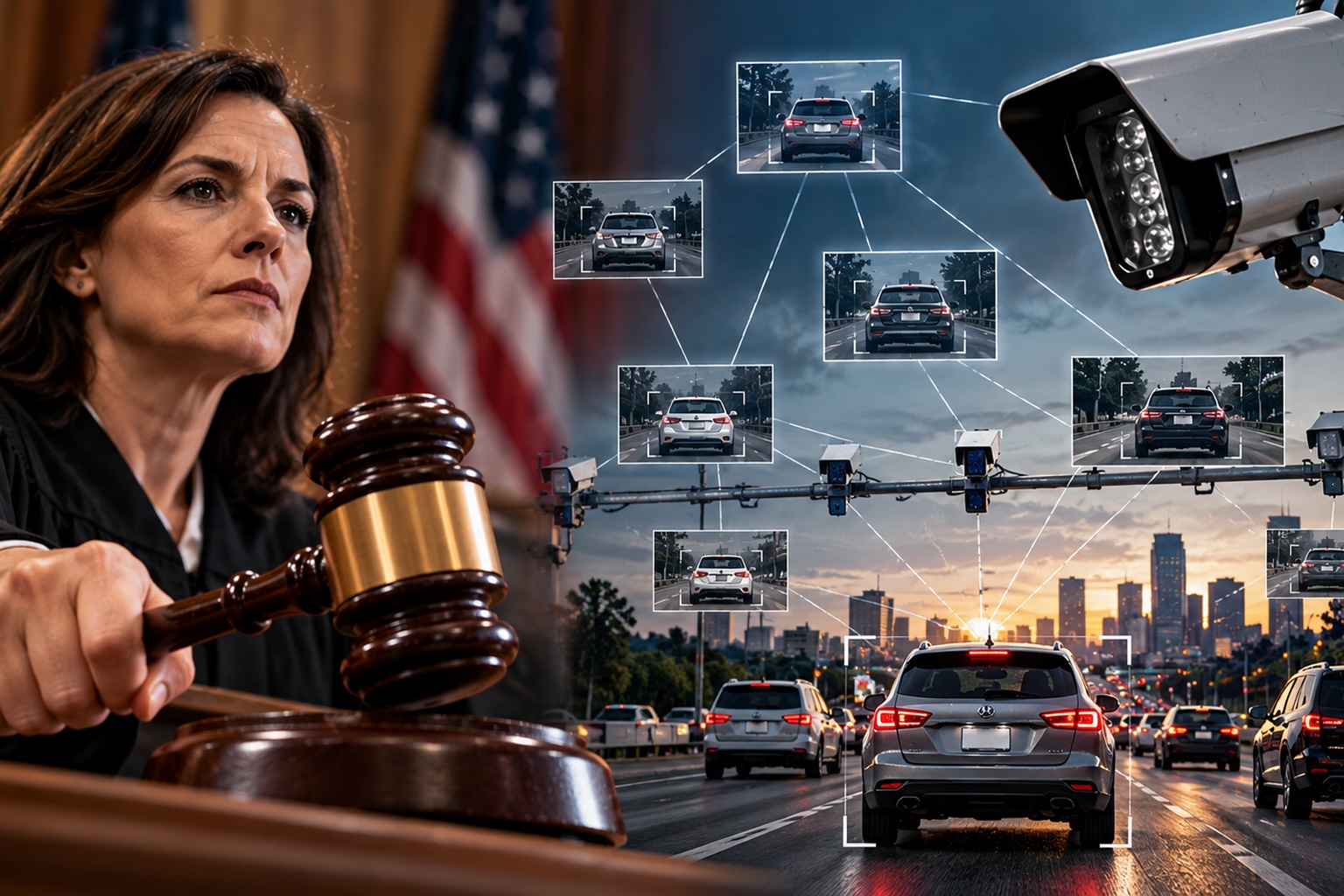
U.S. District Judge Sara E. Hill of the Northern District of Oklahoma found that a woman’s Fourth Amendment rights were violated when a deputy searched Flock Safety’s license-plate network without a warrant, simply because her rental had California plates. In an October 1 order in United States v. Melisa Susan Kyle, Hill called the system “a type of indiscriminate mass surveillance.” It is one of the first times a federal court has held that a Flock lookup itself can be a Fourth Amendment search, as reported by 404 Media.
The case started on a highway in Tulsa County. Deputy Freddie Alaniz, a Tulsa County sheriff’s deputy and Drug Enforcement Administration task force officer, was parked on the shoulder when a Mazda SUV with California plates drove past. Hill wrote that he pulled onto the road and followed the car “for no apparent reason other than the fact that it had a California license plate,” and that he ran the plate through Flock at the same time. He later stopped the driver, Melisa Kyle, after he believed he saw both unsignaled lane changes and following too closely, about 30 feet behind another vehicle. Kyle told him the Mazda was a rental.
While he questioned her, Alaniz kept scrolling the history. In her order, Hill wrote that he had access to at least two plate-reader networks, Flock and VehicleManager. VehicleManager is Motorola Solutions’ license-plate platform. Both systems ask for a reason for the query. The reasons he entered were “traffic violation” and “investigation,” when all he knew was that the plate was from California.
The query returned more than 50 records of the vehicle’s whereabouts over about a month. The officer compared her answers to that trail, treated a short California turnaround as a sign of trafficking, and used the history as part of the reason to search the car. Local reporting linked by 404 Media said officers found 91 pounds of meth. Prosecutors charged Kyle with possession of methamphetamine with intent to distribute.
The judge treated the traffic stop as valid, then suppressed the plate data and everything that followed. She found the officer lacked reasonable suspicion to prolong the stop into a drug investigation. Suppression is not dismissal.
The holding is not that an officer can never look at a plate. It is that this search reconstructed “the whole of her physical movements” and required a warrant supported by probable cause. Tracking people in public, she wrote, “becomes constitutionally problematic when law enforcement can indiscriminately and passively catalog your whereabouts over an extended period of time and then use that information for any purpose whenever convenient.”
This order is not a nationwide rule, and it does not bind other courts. Flock was not a party. A company spokesperson told 404 Media the ruling “goes against the overwhelming weight of authority in similar cases across the country, including multiple recent decisions in Oklahoma,” and that Flock expects it to be appealed and overturned. The company said the decision is limited to these facts and does not stop agencies from using the cameras. In late January, a federal judge in Virginia reached the opposite conclusion on Norfolk’s Flock network. Judge Mark S. Davis found the plaintiffs had not shown it could track “the whole of a person’s movements,” Ars Technica reported.
The scale is what makes the Oklahoma order matter even without a nationwide rule. 404 Media has reported more than 100,000 warrantless Flock searches a month from the audit logs it reviewed. A New York Times briefing in August reported 120,000 cameras logging about 20 billion vehicle scans a month. Florida and Texas have already moved to limit the cameras over privacy concerns. A Washington Post review in August found at least 50 officers charged or accused of misusing plate readers, including to stalk women. Flock’s chief executive said the company would add filters to stop that abuse.
Until legislation is in place, the networks will keep running. The Ban Flock Act, released October 2, would bar federal use of license-plate readers and their data and cut grants to governments that keep them, with exceptions for tolls and a later act of Congress that caps retention at 48 hours. It follows the No FLOCK Act in mid-September, which would withhold highway funds from states that do not limit the cameras to listed public-safety uses, and the Flock-Off Act earlier that month, which would cut off federal money for the systems. None is law.

