

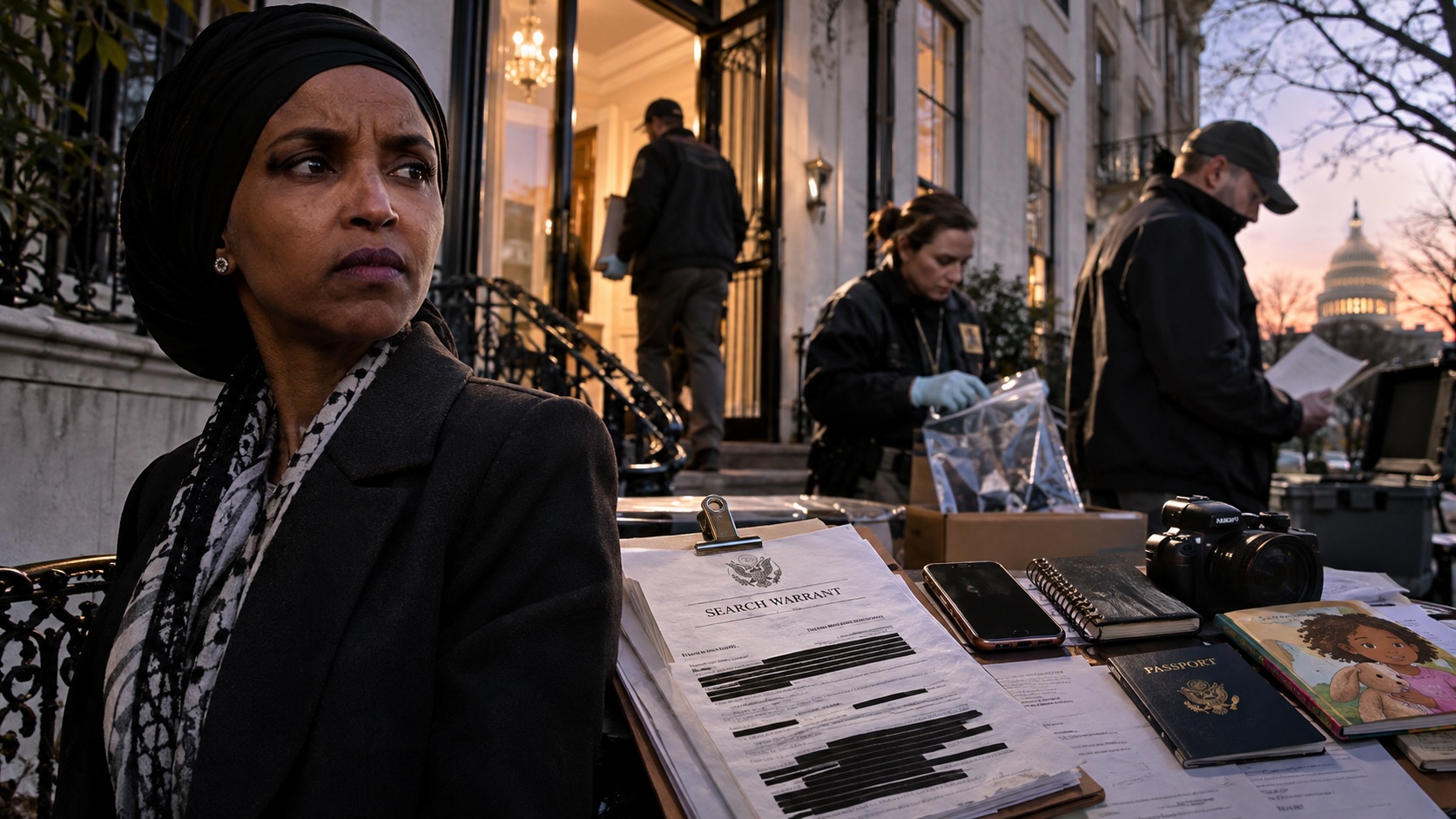
Heavily redacted court records from the October 12 search of Rep. Ilhan Omar’s Washington, D.C., home were posted Monday evening after Chief U.S. District Judge James E. Boasberg ordered them placed on the court’s public website. The 169-page packet shows that a federal magistrate found probable cause to search her home under Federal Rule of Criminal Procedure 41 and ruled that the Speech or Debate Clause required extra protections for any legislative materials.
The list of laws under investigation and the 67-page supporting affidavit remain sealed.
The October 16 brief in that public packet states that “The United States believes ILHAN has committed [redacted] crimes over decades,” beginning “long before she was ever in Congress.” The same filing says, “Nothing in the search warrant affidavit, briefing, or oral argument indicates that the United States’s case has anything to do with ILHAN’s professional life,” as reported by the New York Post.
An earlier warrant brief said investigators were seeking fruits, contraband, evidence, and instrumentalities of redacted offenses “involving Ilhan Nur Said Elmi a/k/a Ilhan Abdullahi Omar, and occurring between 1980 to the present.” Public accounts of Omar’s birth year have varied between 1981 and 1982.
Magistrate Judge Matthew J. Sharbaugh, sworn in by Boasberg in 2024, signed the warrant on October 9. In an October 15 memorandum order now included in the unsealed docket, Sharbaugh wrote that “even after ensuring that there exists probable cause to issue the warrant, see Fed. R. Crim. P. 41(d)(1), the Court must separately balance any necessary constitutional considerations” under the Speech or Debate Clause. He rejected the Justice Department’s opening claim that a search of a sitting member’s private residence did not require those extra safeguards. “No matter how small the potential volume of legislative materials at issue, the constitutional protections remain,” he wrote.
Sharbaugh wanted Omar to have a chance to identify and invoke privilege before agents began going through her records. He found the government’s first search proposals deficient because agents would have started reviewing the congresswoman’s files before she could flag protected legislative material. He wrote that the government at first “stood pat on its existing proposed search protocols without further modification.”
When the government refused to change course, Sharbaugh required modifications so the constitutional protections would work in practice, not just on paper.
After more back-and-forth, the court approved a special search protocol attached to the warrant as Attachment C. That protocol, still heavily redacted in Monday’s release, gave Omar the opportunity at the outset of the search to identify and invoke privilege. Around 6:05 a.m. on October 12, Homeland Security Investigations agents carried out the warrant at her D.C. residence.
Omar said as many as 25 agents spent four to five hours in the house and took 17 items, including phones, her husband’s notebooks, a camera, and a Somali-language children’s book. Agents also seized her personal phone, computer, and passport. She called the operation “an outrageous abuse of power and an unprecedented escalation in the weaponization of federal law enforcement to target political enemies” and said, “The Congresswoman has done nothing wrong.”
Fourteen news organizations and Judicial Watch asked the court, in In re Application of Fourteen Press Organizations for Access to Sealed Search Warrant Records, to unseal the records, arguing that the public has a right to know why federal agents searched a sitting congresswoman’s home. Boasberg, an Obama appointee, ordered the redacted materials released over the Justice Department’s objections that the investigation remains ongoing and the warrant has not been fully executed.
DOJ lawyers pointed out that the decision directly contradicts Boasberg’s own 2023 ruling in the Trump case, when he kept search-warrant materials sealed during Special Counsel Jack Smith’s investigation, writing that “the undeniable need to protect an ongoing criminal investigation tips the balance toward the Government’s request to continue sealing.” Trump had already been indicted at the time of that ruling; Omar has not been charged. The DOJ later confirmed to Fox News that the characterization of Boasberg’s contradiction is accurate and was raised in its court filings.
Boasberg sided with the government on the core affidavit, calling it “premature” to release “the vast majority” of that 67-page document for now. He ordered the rest of the search-warrant docket posted in redacted form no earlier than 5:00 p.m. Monday, and news organizations have until November 30 to challenge the blackouts. Judicial Watch President Tom Fitton saidthe group will “ask the court to unseal the suspected crimes on the search warrant.” “There is no reason for Ilhan Omar to have this information and not the American people,” Fitton said.
A federal magistrate found probable cause to search a member of Congress at home. Prosecutors say the conduct stretches back decades, long before she ever took a House oath. The public still has not been told which laws they think she broke, because the government and an Obama-appointed chief judge have left that part hidden.
Will the American people ever see justice served?

