

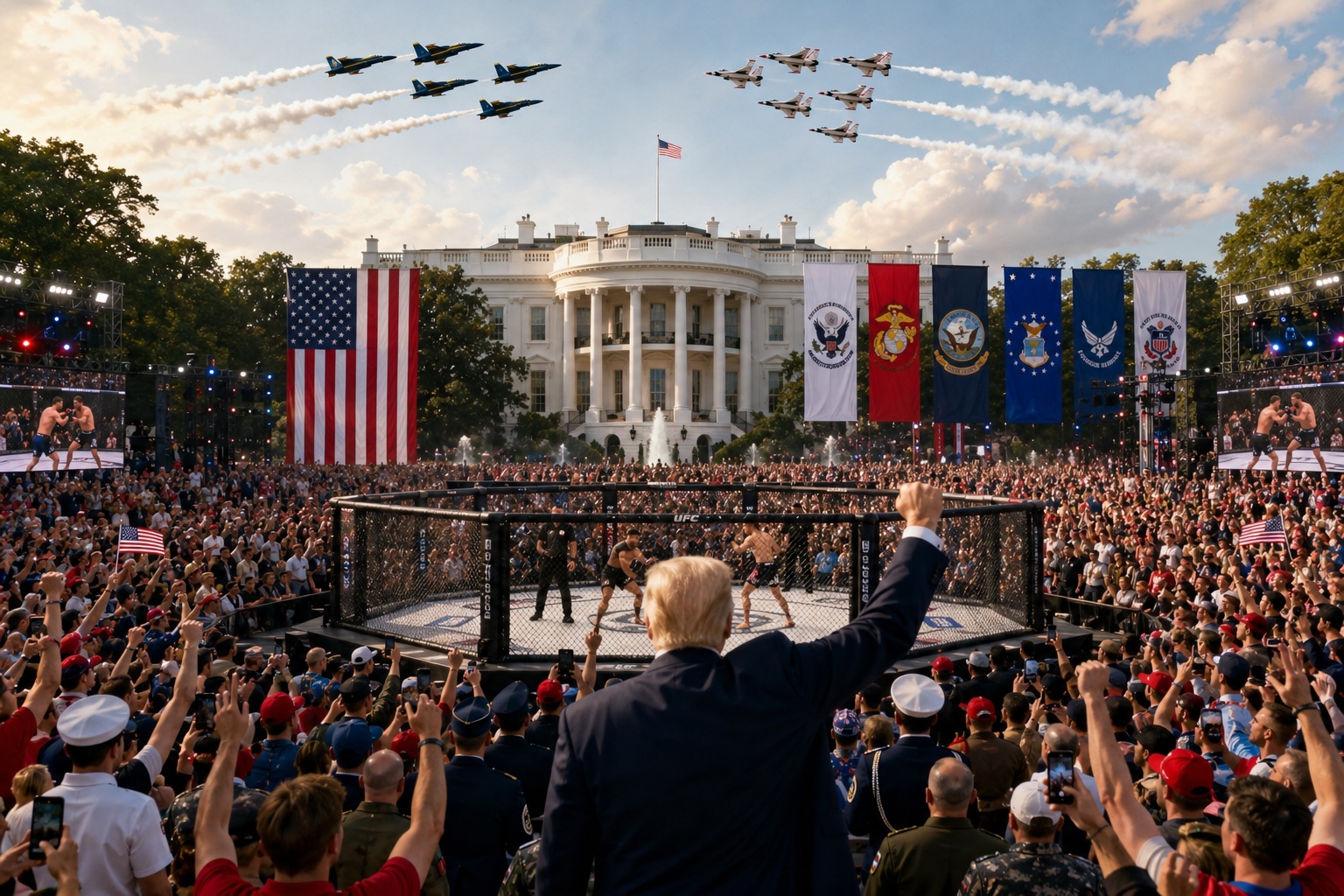
On the South Lawn of the White House this weekend, President Donald J. Trump kicked off America’s 250th anniversary celebration in a way only Donald Trump could: on his 80th birthday and against the backdrop of the Executive Mansion, beneath the flags of the United States and the branches of our armed forces, thousands gathered for UFC Freedom 250, the first professional sporting event ever held on White House grounds. The event featured championship fights, military flyovers by the Blue Angels and Thunderbirds, patriotic music, and chants of “USA! USA!” echoing across the nation’s capital. To many Americans, it was more than a sporting event. It was a declaration that the celebration of America is back. After years of national self-doubt, historical revisionism, and cultural pessimism, President Trump has launched the nation’s Semiquincentennial not with an apology for America, but with a celebration of American greatness.
That may explain why the event infuriated so many members of the political and media establishment. For years, America’s cultural elites have seemed uncomfortable with the very idea of patriotism. They have spent decades teaching Americans to focus on every failure while minimizing every triumph. They have encouraged young people to view our history through the narrow prism of grievance rather than achievement. They have attempted to transform pride in America into something that must be qualified, explained away, or apologized for. The American people never accepted that narrative.
As our nation approaches its 250th birthday on July 4, 2026, something extraordinary is happening. Patriotism is making a comeback. Across the country, Americans are rediscovering their history, their heritage, and their pride in the greatest nation ever created by man. They are flying flags. They are attending historical reenactments. They are visiting battlefields, monuments, and museums. They are teaching their children about the Founding Fathers rather than apologizing for them. Most importantly, they are rejecting the false choice between acknowledging America’s imperfections and celebrating America’s greatness.
The United States was founded upon one of the most revolutionary ideas in human history. The Declaration of Independence proclaimed that our rights come not from kings, governments, bureaucrats, or political parties, but from God. The Constitution created a system of limited government designed to protect individual liberty. The Bill of Rights established protections for speech, religion, due process, private property, and self-government unlike anything the world had ever seen. Those ideas changed human history. They still do.
Yet for much of the last two decades, powerful institutions have worked relentlessly to undermine confidence in those principles. Under President Barack Hussein Obama, America witnessed an unprecedented effort to redefine how citizens viewed their own country. Obama famously stated that he wanted to “fundamentally transform the United States of America.” In many respects, he attempted to do precisely that.
His administration increasingly promoted the notion that America’s history was primarily a story of oppression rather than opportunity. Traditional civic education gave way to ideological activism. Patriotism became suspect. National borders became an inconvenience. Historical figures were judged not within the context of their own times but through the political standards of the present.
The consequences have been profound. An entire generation was taught to focus more on America’s shortcomings than its achievements. Children learned more about what America did wrong than what America did right. They learned about slavery but not enough about the abolitionists who ended it. They learned about segregation but not enough about the sacrifices that dismantled it. They learned about conflict but not enough about courage. They learned about mistakes but not enough about greatness.
Perhaps nowhere was this revisionist impulse more visible than in the attacks on America’s historical figures and traditions. Statues were torn down. Monuments were vandalized. Christopher Columbus, one of the most consequential explorers in human history, became a target for activists determined to erase his legacy from public life. Columbus Day, which I wrote about extensively in October 2025, long recognized as a celebration of exploration, courage, and discovery, was recast as something shameful. This was never really about Columbus. It was about America. The goal was not simply to reassess historical figures. The goal was to weaken Americans’ connection to their own history. A nation disconnected from its past becomes easier to manipulate in the present.
Fortunately, the American people proved more resilient than the revisionists anticipated. Ordinary Americans understand that history is complicated. They understand that historical figures were human beings, not saints. They also understand that judging every person who lived centuries ago according to modern political fashions is intellectually dishonest and historically illiterate. More importantly, Americans understand that our history is overwhelmingly a story of progress, achievement, innovation, and liberty.
America liberated Europe from Nazi tyranny. America rebuilt much of the world after World War II. America placed a man on the Moon. American scientists revolutionized medicine. American entrepreneurs transformed technology. American soldiers defended freedom across the globe.
Millions continue to seek refuge and opportunity in the United States because they understand something many American elites have forgotten. America remains exceptional. Not because Americans are genetically superior. Not because we are flawless. But because the principles upon which this nation was founded remain the greatest expression of individual liberty ever conceived.
President Trump’s return to office has coincided with a renewed confidence in those principles. Rather than apologizing for America, he celebrates it. Rather than diminishing our history, he embraces it. Rather than viewing patriotism as a relic of the past, he understands that love of country remains essential to national unity.
The approaching 250th anniversary offers Americans a unique opportunity. We can continue down the path of historical revisionism and national self-loathing. Or we can rediscover the truth about our country. The truth is that America is neither perfect nor evil. America is extraordinary. The truth is that our history includes mistakes, but it also includes the fact that we corrected those mistakes and continue to do so. Our achievements remain unmatched by any nation in human history.
The truth is that generations of Americans built a constitutional republic that has provided more freedom, prosperity, and opportunity than any government the world has ever known.
As fireworks illuminate the sky this July 4th and Americans celebrate two and a half centuries of independence, they will not merely be celebrating a date on a calendar. They will be celebrating an idea. The idea that free people can govern themselves. The idea that liberty comes from God, not government. The idea that individuals should be free to pursue happiness, prosperity, and purpose without interference from an all-powerful state. Those ideas remain worth defending. They remain worth teaching. And they remain worth celebrating.
Patriotism is back because Americans are remembering who they are. President Trump has helped lead that revival. And as America enters its 250th year, the greatest chapter of the American story may still lie ahead.

