

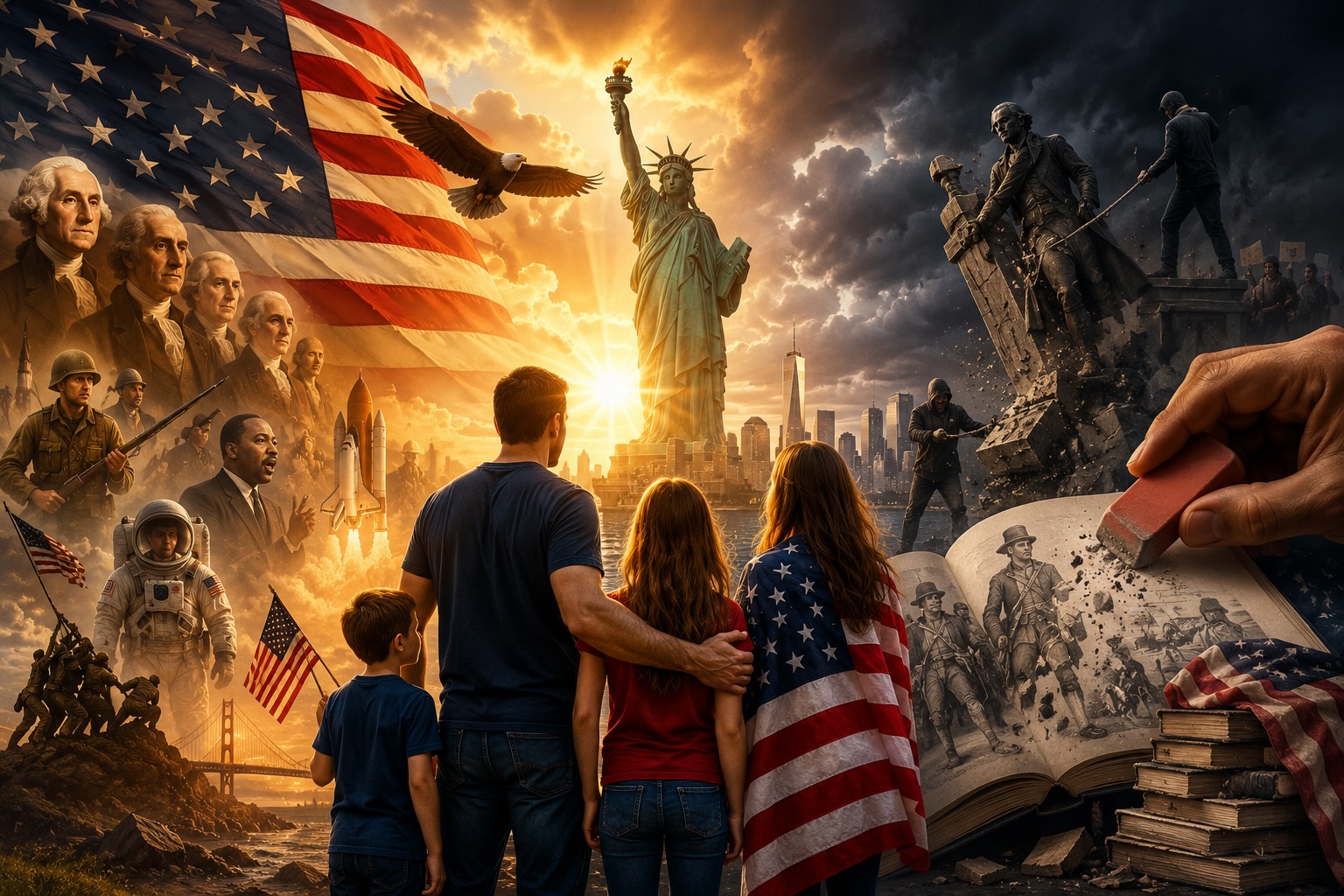
As America approaches the 250th anniversary of our independence, the nation finds itself engaged in a struggle far more important than politics, elections, or public policy. We are engaged in a battle for our national memory. The question before us is whether future generations will inherit an understanding of America rooted in truth, gratitude, and pride, or whether they will inherit a distorted version of our history that emphasizes our shortcomings while ignoring our triumphs.
On July 4, 1776 fifty-six brave men affixed their names to the Declaration of Independence and, in doing so, committed an act of extraordinary courage. They were not merely protesting taxes or expressing dissatisfaction with government policy. They were declaring that all men are created equal and endowed by their Creator with certain unalienable rights. They were asserting that freedom comes from God, not government, and that legitimate government exists only through the consent of the governed. These principles transformed human history and became the foundation upon which the United States was built.
The American Revolution was one of the most remarkable events in the history of civilization. A collection of colonies populated by farmers, merchants, craftsmen, and laborers challenged the most powerful empire on Earth and prevailed. The victory was not merely military. It was philosophical. The Founding Fathers created something the world had never seen before: a constitutional republic designed to preserve individual liberty and limit the power of government. For nearly two and a half centuries, that framework has endured through wars, economic crises, political upheaval, and social transformation.
What makes America exceptional is not the absence of flaws, is our ability to recognize our mistakes and correct them. Throughout our history, we have expanded liberty, broadened opportunity, and worked to fulfill the promises contained within our founding documents. We fought a devastating Civil War to end slavery and preserve the Union. We expanded constitutional protections to millions of citizens previously denied equal treatment. We have equal pay and fought for our women to have the right to vote. We repeatedly demonstrated that America possesses a unique capacity for self correction while remaining faithful to the principles that gave birth to the nation.
Unfortunately, there are those who seek to reduce America’s history to a catalog of grievances. They teach young people that the United States is defined primarily by its failures rather than its achievements. They encourage Americans to view the Founders solely through the lens of their imperfections while ignoring their courage, wisdom, and vision. They remove monuments, rename schools, and rewrite historical narratives in ways that diminish the accomplishments of those who built and defended this country. This effort does not promote historical understanding. It promotes historical amnesia.
A mature nation is capable of acknowledging both its successes and its failures. We do not honor George Washington because he was perfect. We honor him because he sacrificed power when he could have seized it. We do not celebrate Thomas Jefferson because he was without contradiction. We celebrate him because he gave humanity one of the greatest statements of liberty ever written. We do not revere Abraham Lincoln because he never made mistakes. We revere him because he preserved the Union and guided the nation through its greatest crisis. History should be studied honestly, but honesty requires a full accounting of both virtue and imperfection.
As we prepare to celebrate America’s 250th birthday, we should remember the generations who preserved this Republic through sacrifice and service. We should remember the soldiers who endured Valley Forge and secured independence. We should remember those who fought to preserve the Union during the Civil War. We should remember the Greatest Generation that stormed the beaches of Normandy, fought across the Pacific, and defeated the forces of tyranny during World War II. We should remember the veterans of Korea, Vietnam, Iraq, Afghanistan, and every conflict in which Americans answered the call of duty. The freedoms we enjoy today were not inherited by accident. They were purchased at tremendous cost by men and women willing to place the nation above themselves.
The coming anniversary also presents an opportunity to restore a sense of national confidence. For too long, Americans have been encouraged to apologize for their country rather than appreciate it. Patriotism has too often been portrayed as something outdated or unfashionable. Yet every nation requires a shared understanding of its history and a shared appreciation for the sacrifices that made its existence possible. A people disconnected from their past cannot build a strong future. National pride is not arrogance. It is gratitude for the blessings we have inherited and a commitment to preserve them for those who follow.
President Donald Trump has made the celebration of America’s 250th birthday a centerpiece of his vision for the nation. The anniversary provides an opportunity not only to commemorate our history but also to teach it. Young Americans deserve to learn about the courage of the Founders, the heroism of our soldiers, the ingenuity of our inventors, the faith of our pioneers, and the countless ordinary citizens whose hard work built the greatest nation in human history. They deserve an education that inspires rather than demoralizes and informs rather than indoctrinates.
At its core, the battle for our national memory is about identity. Every family preserves stories about those who came before. We tell those stories because they remind us who we are. We pass down photographs, heirlooms, traditions, and memories because they connect us to something larger than ourselves. Nations are no different. When a nation forgets its history, it loses its sense of purpose. When it abandons its heroes, it loses its understanding of courage. When it ceases to value its traditions, it weakens the bonds that unite its people.
As we approach this historic milestone, Americans should celebrate with confidence and gratitude. We should honor the farmers who left their fields to fight for independence, the immigrants who arrived seeking freedom, the workers who built our industries, the entrepreneurs who drove innovation, the parents who raised generations of patriotic citizens, and the soldiers who defended liberty around the globe. Their stories are America’s story.
The first 250 years of the American experiment have been extraordinary. Despite every challenge, every crisis, and every prediction of decline, the United States remains the most successful and influential republic in human history. Whether the next 250 years are equally successful will depend in large part on whether we remember who we are, where we came from, and what generations of Americans sacrificed to preserve this remarkable nation. America’s future begins with America’s memory. As we celebrate our 250th birthday, let us resolve to preserve that memory, honor those who came before us, and ensure that future generations inherit the truth about the greatest nation the world has ever known.

