

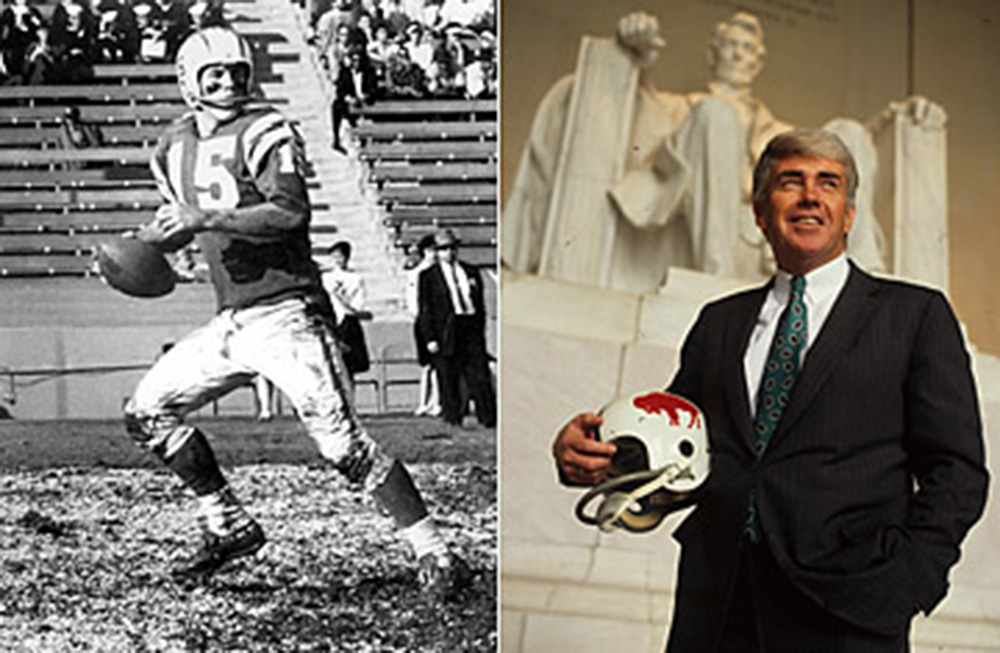
The late Congressman Jack Kemp is known among conservatives as one of the most influential lawmakers of the 1970s and 1980s for his innovative stances on economic policy. His political bonafides should not erase his record as an all-time great pro football quarterback, one deserving of Hall of Fame honors.
Drafted by the Detroit Lions in 1957, Kemp struggled to find stability early in his career, bouncing among various teams before joining the AFL’s Los Angeles Chargers in 1960. His breakthrough came after landing with the Buffalo Bills in 1962, where he quickly established himself as a star quarterback and strong locker-room leader. Kemp led Buffalo to its first winning season in 1963 and then to consecutive AFL championships in 1964 and 1965.
Kemp’s heroics were on display during the 1964 AFL Championship when he faced off against his former team, the Chargers. The Chargers were expected by many to rout the Bills with head coach Sid Gillman’s revolutionary passing attack and their edge over experience, but the Bills proved surprisingly formidable. Kemp etched his way into the annals of history by leading the Bills to a 20-7 win.
The next year saw an AFL title rematch between the Chargers and the Bills, and the margin of victory was even more lopsided. They defeated the Chargers by a 23-0 margin, running the favored team out of the building. Kemp won the MVP of the championship game after receiving MVP honors during the regular season, sharing that honor with the likes of NFL all-time greats Terry Bradshaw, Joe Montana, Emmitt Smith and Patrick Mahomes.
Kemp may not have had the gaudy stats we are accustomed to seeing from modern quarterbacks, but his achievements must be viewed within the context of their era. Modern rules had not been invented to protect the quarterback from the brutality of defensive pressure. Footballs had not been standardized and were difficult to throw. Fields were rife with divots and treacherous for receivers. Football was a different game back then, and Kemp’s unique toughness is what makes him worthy of Canton.
Kemp’s durability is what made him a true legend. Over his professional career he endured a dozen concussions, two broken ankles and a crushed hand, yet insisted a doctor permanently set his hand in a passing position so he could continue playing. Kemp once finished a game despite having a dislocated finger on his throwing hand, playing in excruciating pain because he was dedicated to lead his team to victory.
Unlike many other football players, Kemp refused to let chronic injuries slow him down. Kemp could throw the ball long distances despite a chronically dislocated right shoulder, and he played much of one season with a finger that had to be popped back in after every snap. He often required pain-killing injections just to suit up — but he never wavered for his team.” Former teammate Ed Rutkowski noted that quarterbacks are supposed to avoid contact, but Kemp ignored that wisdom and “ran head-on into linebackers,” a style that contributed to eleven concussions during his career.
Even though Kemp may have suffered many concussions, it did not affect his sharpness as a lawmaker. Kemp was one of the most articulate arbiters of the conservative ideology during his time in Congress beginning upon his election in 1971. He fought back against the status quo of Keynesian economics on behalf of the supply side revolution embodied by the Reagan presidency. He co-authored the Kemp-Roth tax cut proposal in the late 1970s, calling for a dramatic across-the-board reduction in income tax rates. It was scoffed at by the political class at the time, but Kemp’s efforts caught Reagan’s attention.
When Ronald Reagan ran for president in 1980, Kemp’s ideas provided the intellectual backbone for the Reagan agenda. The Economic Recovery Tax Act of 1981 closely mirrored the Kemp-Roth framework, slashing marginal tax rates and signaling a decisive break from the stagflation-era policies of the 1970s. The result was a surge in investment, job creation, and economic expansion that demonstrated the effectiveness of pro-growth policy. Within the Reagan coalition, Kemp served as both a policy entrepreneur and a persuasive communicator. He helped translate complex economic theory into an optimistic political message centered on growth rather than austerity.
However, Kemp was more than a tax cutter. He was deeply committed to what he called an “opportunity society.” He advocated for enterprise zones in struggling urban neighborhoods, arguing that lowering taxes and regulations in distressed areas would attract businesses and create jobs where they were needed most. This put him ahead of his time within the GOP, as he actively courted minority communities – similar to what President Trump successfully did with his “Platinum Plan” – and made the case that conservative economics could be a pathway to upward mobility for all Americans.
But Kemp should not be indicted into the Pro Football Hall of Fame as some type of handout for conservatives, throwing us a bone to keep us placated by the modern woke NFL that puts up low IQ degenerates like Bad Bunny as their halftime entertainment. Kemp deserves the honor based on his own merits as one of the greats from the often-forgotten pre-Super Bowl era. Pro football stars like Jack Kemp helped to build the foundation that allowed the NFL to springboard itself into the unstoppable entertainment juggernaut it is today, and for this, he deserves his rightful place in the Hall of Fame.

