

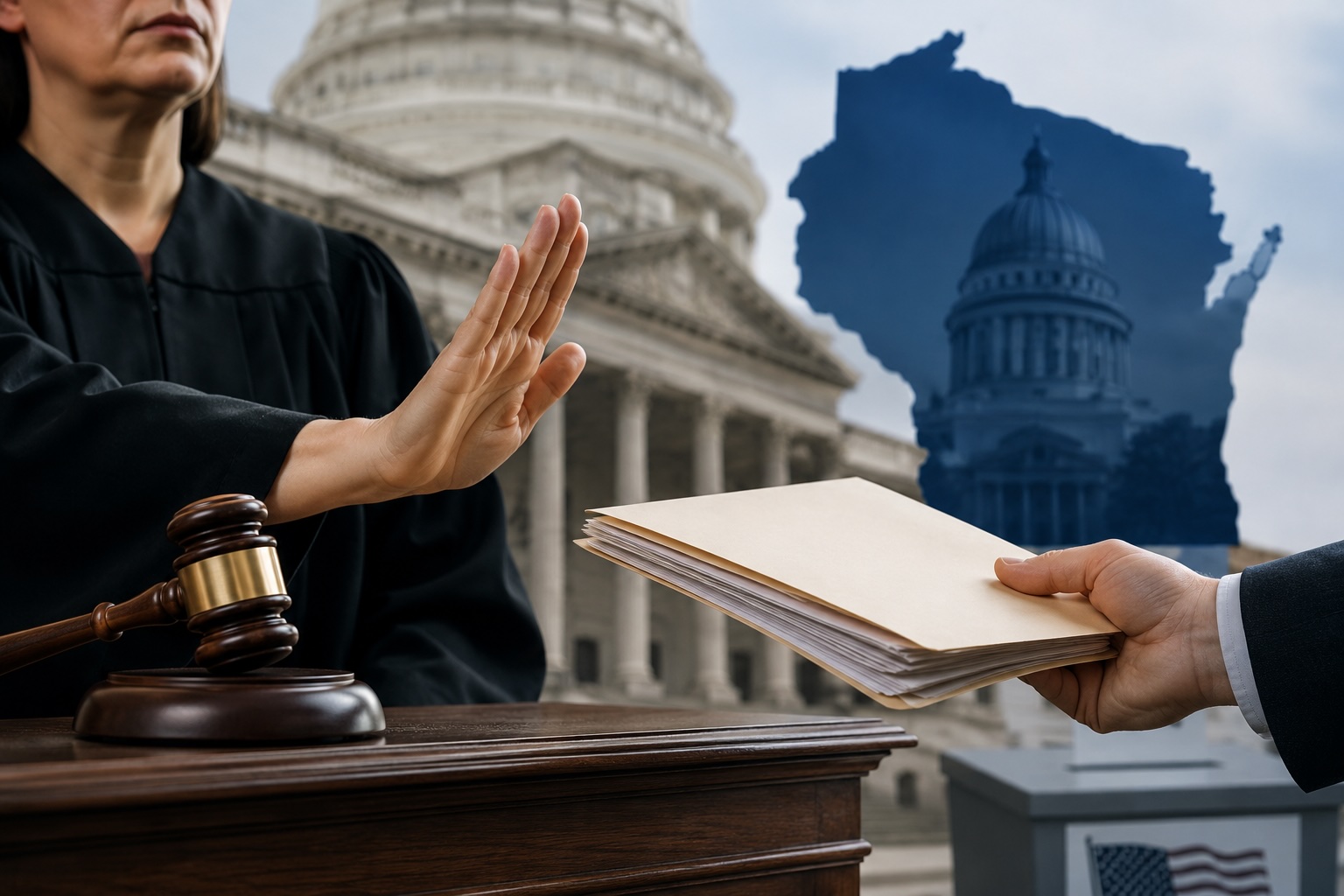
A federal judge has blocked the Trump administration’s effort to obtain Wisconsin’s full, unredacted statewide voter registration list.
Governor Tony Evers and state Democrats hailed the outcome as a victory.
Dan Lennington of the Wisconsin Institute for Law & Liberty did not hold back his words, telling The Center Square exclusively that the Evers administration and Wisconsin Elections Commission are desperately trying to hide the truth about who is actually registered to vote.
Lennington emphasized that Wisconsin has taken in roughly $77 million in federal dollars over the past two decades specifically to maintain its voter registration system. With that funding comes the reasonable expectation that federal officials can review the data they help support, much like audits for other taxpayer-funded programs.
The Department of Justice under President Trump has access to a redacted public dataset that is missing essential identifying information, including full names, dates of birth, residential addresses, driver’s license numbers, and the last four digits of Social Security numbers. Additional unredacted identifiers were therefore requested to properly validate eligibility and confirm the accuracy of the records.
“What’s really going on here is that the Evers Admin and the Elections Commission are desperately trying to prevent anyone from finding out whether illegals or felons are on the voting rolls,” Lennington stated. “They are hiding behind ‘privacy’ as a pretext. They just don’t want scrutiny about who they are allowing to vote in this state.”
This resistance is nothing new. Governor Evers has taken similar positions by blocking access to welfare and Medicaid rolls, routinely citing privacy while questions of fraud and improper enrollment go unaddressed. In a closely contested state frequently decided by mere thousands of votes, keeping basic voter data hidden raises serious red flags about election integrity.
The effort to secure unredacted voter data directly supports the federal government’s obligations under the National Voter Registration Act and the Help America Vote Act. Accurate list maintenance demands the capacity to verify citizenship, confirm residency, eliminate duplicates, and identify ineligible voters. Absent genuine transparency, these legal safeguards exist only on paper.
Lennington characterized the judge’s decision as an overly narrow reading of broad federal authority and predicted it would encounter vigorous appellate challenges.
Many have long warned that weak verification standards and defensive secrecy invite abuse—especially in swing states, where every legitimate vote must count and every ineligible one must be excluded.

