

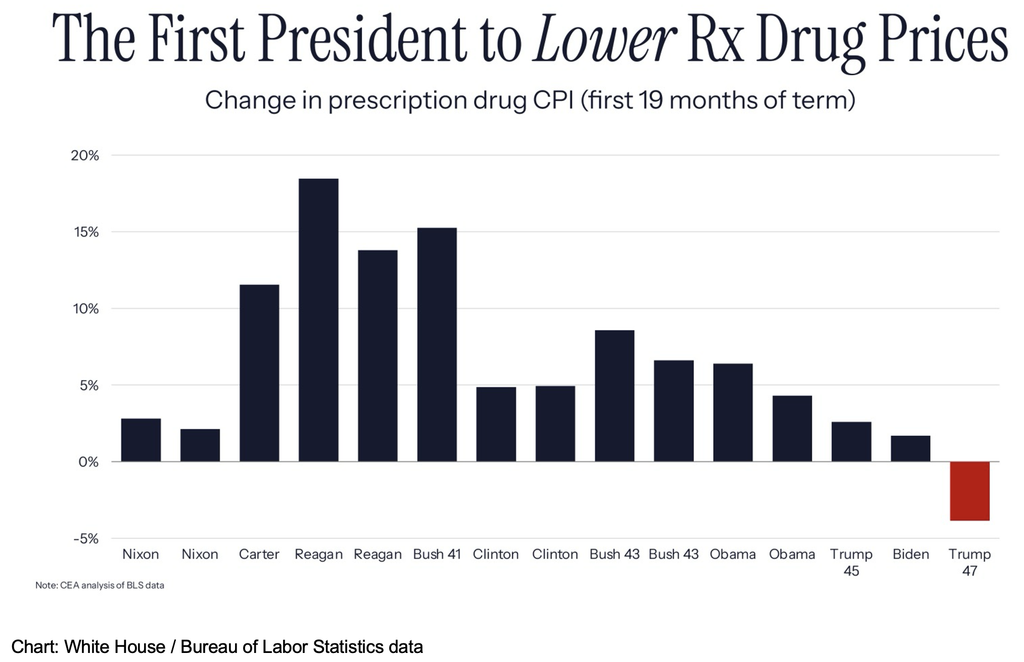
President Donald J. Trump’s recent prescription drug policy changes, implemented in February 2026, have delivered the steepest annual decline in U.S. prescription drug prices in more than six decades.
Prices fell 3.1% in the year ending July 2026, the largest drop since March 1963, according to Bureau of Labor Statistics Consumer Price Index data.
This is a dramatic reversal from decades of relentless price increases, during which American patients absorbed the bulk of global pharmaceutical research and development costs while other nations paid far less for the same medications.
White House officials attribute the historic decline primarily to President Trump’s Most Favored Nation (MFN) policies and the TrumpRx platform.
Under MFN agreements, 17 of the world’s largest drugmakers, covering roughly 86% of the branded drug market, have committed to aligning U.S. prices with the lowest rates paid by comparable developed countries.
This ends the long-standing practice in which Americans, representing about 4% of the world’s population, generated the majority of global pharmaceutical profits and effectively subsidized cheaper drugs abroad.
TrumpRx, the administration’s direct-to-consumer website launched in February 2026, has already delivered more than $700 million to patients.
The bulk of these reductions come from GLP-1 medications for diabetes and weight loss, which once exceeded $1,000 per month and now start as low as $149. Insulin, inhalers, fertility treatments, cholesterol drugs, and dozens of other costly medicines have also seen cuts of 50 to 90% or more for cash-paying customers.
Prescription prices are also down 3.9% since President Trump took office and have fallen every single month of 2026. Nonprescription drugs declined 2.4% over the same period, while medical-care commodities overall dropped 2.7%.
The Department of Veterans Affairs alone locked in more than $10 billion this fiscal year, with hundreds of billions projected over the longer term from the full MFN framework.
The United States functioned as the world’s pharmaceutical piggy bank for generations until President Trump took action. Other nations imposed price controls that kept costs near manufacturing levels, allowing them to free-ride on U.S.-funded innovation.
U.S. list prices were three to four times higher than those in many other countries for identical drugs produced in the same facilities.
These cost declines show just how quickly the TrumpRx website, launched in February 2026, and the subsequent MFN deals have delivered real, large-scale results, all in less than six months.
Pharmaceutical drug prices have long been known to fluctuate, since this implementation prices have not risen in any month this year; an unusually sustained stretch of deflation in a category that had climbed roughly three times faster than overall inflation since 1985.
The shift carries broader implications for the global pharmaceutical market. By forcing greater price equity, the United States is reducing the incentive for foreign free-riding and potentially encouraging other countries to pay their fair share.
Early projections suggest tens or hundreds of billions in cumulative U.S. gains. Families are already feeling relief at the pharmacy counter.
The Trump administration remains firmly committed to putting Americans first and delivering lasting prescription drug relief for years to come.
The CPI’s historic 3.1% drop is a direct result of TrumpRx and this administration’s commitment to delivering the lower costs the American people deserve.
Combined with real-world discounts on life-changing medications, the era of the United States serving as the world’s default high-price market is ending under President Trump’s watch.

