

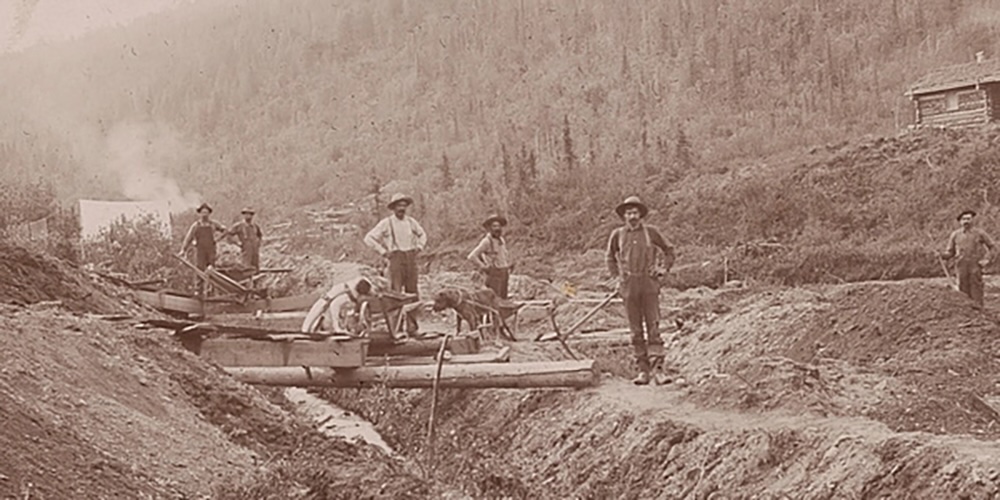
On this day in American history, the nation struck gold, not metaphorically, not symbolically, but literally, in a way that would recalibrate the trajectory of the Republic and electrify the world’s imagination. On January 24, 1848, gold was discovered at Sutter’s Creek in California, a moment so consequential it did not merely alter the economy, it re engineered the American psyche. It ignited the California Gold Rush, accelerated the settlement of the West, and unleashed an epoch of ambition so potent that it still reverberates in the American character today.
This was not simply a lucky gleam in a riverbed. It was a national summons to the audacious, a clarion call to adventurers, entrepreneurs, risk takers, and ordinary citizens who suddenly understood that greatness was not reserved for the hereditary elite. In America, prosperity could be seized by the persistent, the ingenious, and the unafraid.
The discovery occurred at Sutter’s Mill, owned by John Sutter, where James W. Marshall noticed shimmering flakes while inspecting the mill’s water channel. At first, the find was guarded quietly, as though a secret could be kept against the gravitational pull of human hope. But gold has never been containable. Gold does not remain cloistered. It leaks into conversation, metastasizes into rumor, and then erupts into public knowledge, riding on the breathless momentum of possibility.
Within months, the world would know, and once the world knew, it could not unknow.
The President of the United States at the time was James K. Polk, and his official confirmation of the discovery conferred legitimacy upon what many initially dismissed as frontier exaggeration. In December 1848, Polk addressed Congress and affirmed that gold had indeed been found in California, effectively sanctifying the rush that was already building into a stampede. That confirmation mattered. When the President validates a rumor, it ceases to be rumor and becomes a national cause. Polk’s words did not merely endorse a fact. They catalyzed an exodus, transforming California from a distant curiosity into the next great arena of American opportunity.
The Gold Rush did not create American ambition. It revealed it in its most incandescent form. America has always been the land of men and women willing to wager on themselves, to abandon the merely comfortable for the magnificently uncertain, to trade safety for a shot at glory. The Gold Rush was entrepreneurship in its purest and most exhilarating form: no guarantees, no privileges, no gatekeepers, only grit, stamina, and an unyielding belief that tomorrow could be more abundant than today.
And it was not only miners who prospered. The most astute pioneers were the ones who understood a timeless rule of commerce: when multitudes surge toward opportunity, the surest fortune is often made by providing what those multitudes need to survive, to work, and to endure. Tools, food, clothing, housing, transportation, banking, land claims, supplies, and services became the arteries of a rapidly forming marketplace. Entire enterprises appeared with astonishing rapidity, not because a distant bureaucracy issued a decree, but because Americans perceived demand and met it with invention.
That is not merely capitalism. That is American ingenuity functioning at full throttle. It is the national instinct to create solutions, to convert disorder into productivity, and to turn aspiration into infrastructure.
The Gold Rush accelerated the settlement of the West with astonishing speed, and in a span of just a few years, California transformed from a remote frontier into a booming economic engine. The region drew migrants not only from the eastern United States, but from Latin America, Europe, and Asia, all of them compelled by the magnetic promise of prosperity. These were not tourists. They were pioneers, undertaking journeys that demanded endurance bordering on the heroic. They crossed deserts and mountain ranges, sailed punishing distances, braved sickness and deprivation, and confronted uncertainty so relentless that it would have broken lesser souls.
Why did they keep going Because they believed in the American promise. Because they believed in upward mobility. Because they believed freedom means the right to attempt the improbable, and to be judged not by pedigree but by perseverance.
Those pioneers did not merely seek gold. They built settlements, established towns, forged supply routes, and created marketplaces that turned wilderness into community. They carved civilization out of the frontier with courage, sweat, and a stubborn conviction that no obstacle is final if the goal is worthy. They proved, in real time, that the American frontier was not simply a geographic expanse. It was a crucible, and within it, the national identity was tempered.
The economic consequences were immense. The Gold Rush injected vast new wealth into the American economy and hastened America’s rise as a continental power. California’s population ballooned, and the explosive expansion of commerce made it obvious that the West would no longer be a distant abstraction. It would be a central pillar of American prosperity. The growth was so rapid, so undeniable, that it helped propel California toward statehood at remarkable speed, while simultaneously demonstrating a deeper truth that still defines us: America is not a nation of inherited status. America is a nation of earned possibility.
When people speak of the American Dream today, they sometimes speak as though it were a slogan, a nostalgic relic, a sentimental phrase used to decorate speeches. But on January 24, 1848, that dream became tangible enough to hold in your hand, bright enough to see in a stream, and powerful enough to move populations.
A few flakes in the current became a beacon. A rumor became a revolution. A remote frontier became the proving ground for the most ambitious society on Earth.
Ask yourself this: What kind of country responds to a discovery in the wilderness by building cities, reshaping trade, and accelerating national development in the span of a few short years? Only one. The United States of America.
The Gold Rush was not perfect. No vast human undertaking ever is. But it was unmistakably American: daring, industrious, hopeful, and relentlessly forward looking. On this day, we remember Sutter’s Creek not simply because gold was found there. We remember it because it reminded the world that when America sees opportunity on the horizon, Americans do not shrink back. They surge forward, they explore, they create, they build, and they prove, again and again, that the true treasure of this nation has never been hidden in the earth.
It has always been alive in the American spirit.

