

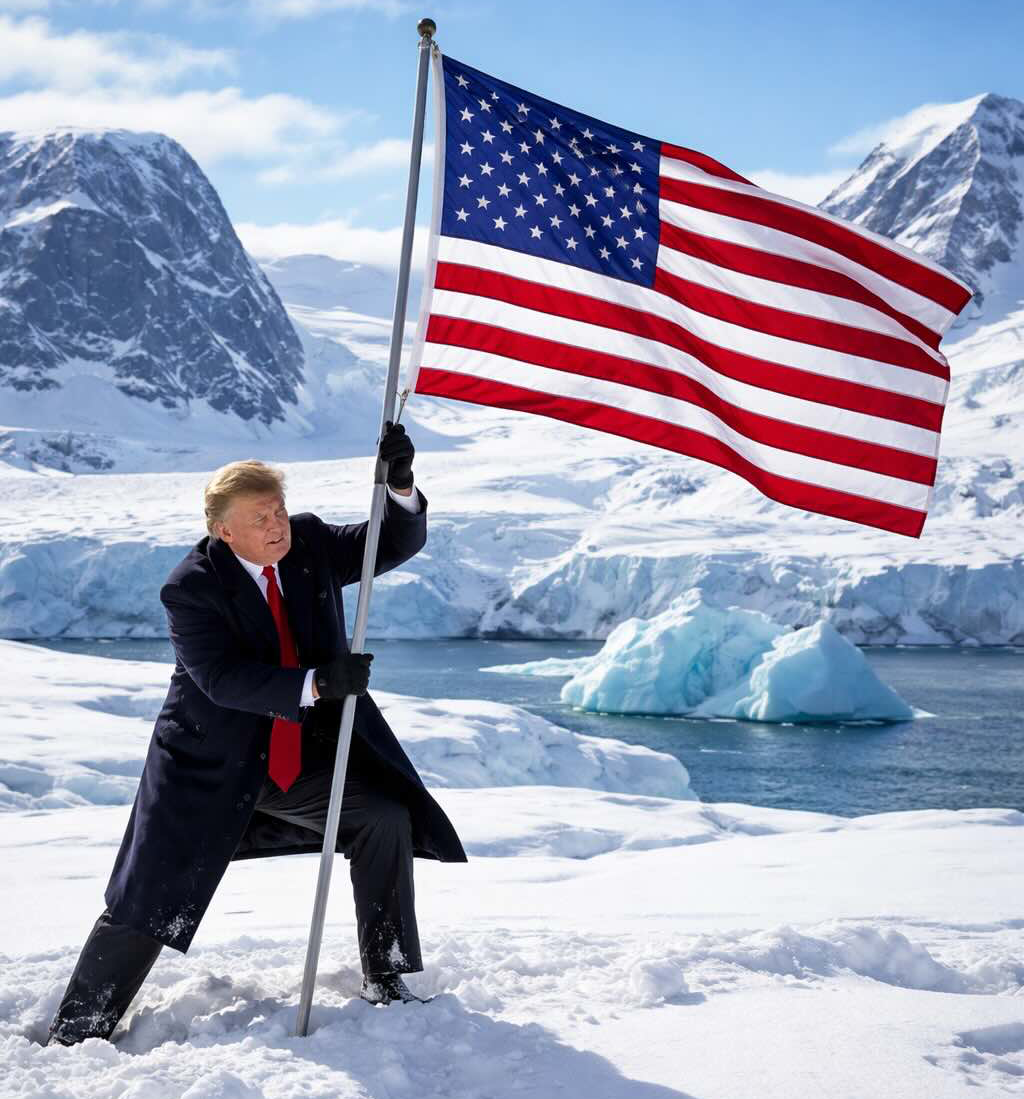
The media and the political establishment want you to believe that President Donald J. Trump’s interest in Greenland is some bizarre vanity project, a tabloid fantasy, or a quirky distraction. That lie is convenient, because it allows the swamp to mock the very idea of strategic foresight.
But the truth is far more damning for Trump’s critics and far more sobering for the American people. The United States did not suddenly discover Greenland in 2019. Serious American presidents and statesmen have sought to acquire Greenland for more than a century and a half because Greenland is not merely a frozen landmass at the edge of the world.
It is the Arctic key.
It is the North Atlantic fortress.
It is a mineral vault.
And in a world where China and Russia are aggressively expanding their reach, Greenland is now the kind of prize that can decide America’s survival.
America’s interest in Greenland has always been rooted in the cold arithmetic of national security. Geography is destiny, and Greenland sits at the strategic intersection of North America, Europe, and the Arctic.
It is the northern rampart of the Western Hemisphere. It is the gateway to the Arctic routes that are opening as ice recedes. And it is the most obvious fixed point from which an adversary can monitor, menace, and manipulate the transatlantic space that has underpinned Western security since World War II.
That is why presidents who actually understood the world, presidents who had functioning strategic instincts, recognized Greenland’s value long before Donald Trump ever entered politics.
The first real American push to acquire Greenland dates back to the era of the Alaska Purchase. After the United States bought Alaska in 1867, Secretary of State William H. Seward, serving under President Andrew Johnson, began exploring expansion into the Arctic sphere, including Greenland and Iceland. This was not some whimsical idea, it was strategic.
American officials pursued information on Greenland’s resources and commercial value, and efforts were made to build public support around the concept. In that era, Greenland was already being evaluated as an American asset, not as a European curiosity. The motivation was straightforward: Control trade routes, influence trade, and expand America’s strategic perimeter.
Even in the nineteenth century, the men making American foreign policy understood that whoever dominated the North Atlantic would dominate the future.
Fast forward to 1946. The world had just survived global war, but the next conflict had already begun. The Soviet Union was expanding, and American military planners understood the terrifying implications of Arctic geography.
Under President Harry S. Truman, the United States offered Denmark one hundred million dollars in gold for Greenland. Why? Because Greenland is a sentinel.
It sits along the shortest strategic path between North America and Russia. It became central to early warning systems, missile defense logic, and the broader architecture of deterrence. Truman’s offer was not a purchase attempt driven by greed. It was a recognition of reality.
The Arctic is not remote.
It is the front door.
When President Trump brought Greenland back into the conversation, the usual hysterics erupted. The same media that cannot define sovereignty without choking on their own smugness sneered and laughed.
But Trump was correct. The world is now entering an era in which critical minerals, rare earths, Arctic shipping lanes, and power projection in the High North will matter as much as oil did in the last century.
Greenland is not simply an island. It is an Arctic platform. And the stakes are not theoretical. They are urgent, immediate, and irreversible.
Ask yourself a simple question. Who do you want controlling the mineral supply chains of the future, the United States or the Chinese Communist Party?
Ask yourself another. Who do you want projecting Arctic power from the Atlantic gate, America and her allies or Vladimir Putin’s militarized empire?
These are not academic debates. These are questions of national survival.
Greenland is rich in the materials that will decide the next century of industrial and military power. It holds major deposits of rare earth elements, graphite, uranium, and other critical minerals. These resources are not vague abstractions. They are the ingredients of modern sovereignty.
Rare earths are used for advanced electronics, military systems, energy technologies, and the hard machinery of the modern economy.
Graphite is indispensable for high demand industrial applications and energy technology manufacturing.
Uranium is a strategic commodity with obvious national security and energy implications.
Greenland also contains critical base metals such as copper, lead, and zinc, all of which are foundational to industrial production and defense supply chains.
A survey cited in public reporting found Greenland contains twenty five of the European Union’s thirty four critical raw materials. That fact alone should terrify every American who still believes in national independence and strategic power because when the West cannot build, it cannot defend. And when America cannot defend itself, freedom becomes a temporary condition.
China is not a benign trading partner. It is an extraction machine. It seeks dependence. It seeks leverage. It seeks veto power over the industrial bloodstream of the West.
Russia is not a misunderstood rival. It is a revanchist state with nuclear power, Arctic ambitions, and a long record of opportunism whenever the West hesitates.
If China secures control over Greenland’s mineral future, it gains the ability to squeeze Western manufacturing, disrupt supply chains, and dictate terms to the very countries it intends to surpass.
If Russia expands influence in Greenland’s Arctic domain, it gains strategic proximity to North America and a more dominant posture in the North Atlantic.
Either outcome is unacceptable.
Greenland is not a curiosity.
It is a strategic prize.
It is a resource vault.
It is a fortress.
And it is precisely the kind of place that weak leaders ignore until it is too late. Somewhere along the way, Washington stopped thinking like a great power and started thinking like a frightened bureaucracy. But geography does not care about your politics.
The Arctic is opening. Global competition is accelerating. Mineral supply chains are now a battlefield. Greenland sits at the center of this contest, and it will not wait for the United States to become serious again.
President Trump was right to force this issue into the national conversation. He was right to shatter the stale consensus. He was right to speak plainly about what the strategic class has tried to obscure.
Greenland is not a joke. As I’ve written previously, it is the crown jewel of Arctic power.
And if America wants to remain a sovereign nation, it must start acting like one.

