

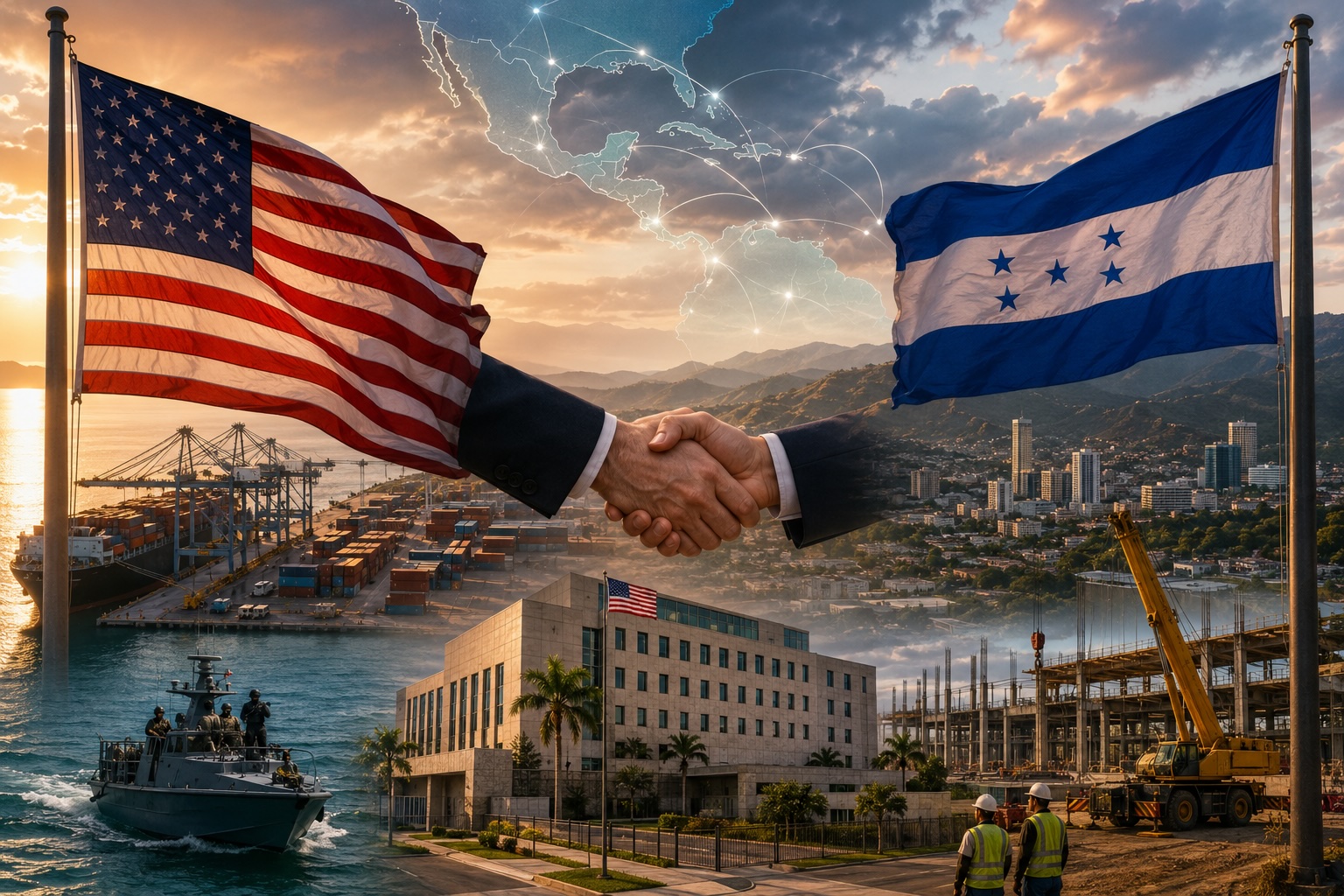
President Trump has done more to reorder the Western Hemisphere in eighteen months than his predecessors managed in twenty years. The Shield of the Americas coalition, launched in March, turned a decade of hollow summit language into actual intelligence sharing and joint operations against the cartels, with governments that want to use it. Major trafficking organizations have been designated as terrorist entities and treated accordingly. Secretary Rubio has assembled a working coalition of roughly a dozen friendly capitals. Tariff leverage has been applied where it produces results and relaxed where partners deliver. And the June ambassadorial slate was a statement of seriousness, sending Daniel Perez to Brazil, Mark Abreu to El Salvador, Peter Snyder to Ecuador, Nate Morris to Colombia, and Paul Kalmbach to Paraguay. Those are consequential posts filled with people who carry weight.
The results include an election almost no one in Washington expected to break the right way. In the final stretch of the Honduran presidential race, with polling tight and the outcome genuinely uncertain, President Trump endorsed Nasry Asfura. Asfura won by a razor thin margin and took office in January. The endorsement was decisive.
In six months Asfura has preserved the extradition treaty his predecessor moved to terminate, an instrument that has already delivered more than fifty Hondurans into American custody on narcotics charges. He suspended roughly twenty cooperation agreements signed with Beijing under the previous government, including a free trade deal that had been under negotiation for two years, and has left his ambassadorship in Beijing unfilled since January. Senior officials have said the 2023 break with Taipei is under review. He came to Mar a Lago in February to talk migration, tariffs, and security. No other government in Central America has moved that far that fast on Washington’s agenda.
I have a personal stake in getting this right. I grew up in Tegucigalpa and went to school there, and my family’s ties to Honduras go back decades and continue today through missionary work. For most of my life I have watched Washington discover Honduras in the middle of a crisis, commit loudly, and drift once the cameras leave, and I have watched Honduran leaders learn to plan around that pattern. It is legible from Beijing as well. What is different now is that the drift has stopped, and there is an administration in Washington and a government in Tegucigalpa that want the same things at the same time. That does not happen often, and it does not last long.
What remains to be done in Honduras is substantial, and all of it is time sensitive.
On energy, the Honduran Congress is in the final stage of negotiating a reform of the state utility, which loses close to two million dollars a day. Asfura went public this month asking legislators to pass it. Behind that vote sits the largest power procurement in Central American history, an international tender for 1,500 megawatts of firm capacity contracting supply out to 2030 under a sovereign guarantee. When those bid documents were first circulated, one of the audiences briefed was a forum of Chinese investors. The European Union has already positioned itself with an eight million euro grant engineered to unlock as much as five hundred million euros in European Investment Bank lending. The Development Finance Corporation has signaled it will move in once the legal framework is repaired. The reform text itself decides whether American capital can participate at all, because it governs collateral, the treatment of existing power contracts, and whether long dated agreements survive a change of government.
On logistics, Puerto Cortés is the only port in the CA-4 that can receive the largest container ships crossing the Atlantic. Its operator is investing a hundred million dollars this year in nine additional hectares of yard, twelve gantry cranes, and two quay cranes, taking capacity to 1.4 million TEUs by early 2027 against 816,000 handled last year. Industrial investment in the surrounding corridor is projected to create eight to ten thousand jobs. This is the nearshoring infrastructure the administration has been asking the hemisphere to build, already under construction, a short sail from the American market.
On the cartels, Honduras sits astride the principal cocaine corridor to the southern border, and its north coast and Bay Islands are where interdiction either happens or does not. A government in Tegucigalpa that wants to be a Shield of the Americas partner is worth a great deal, and partnerships of that kind are built by people with standing, not by cables.
The reflexive objection is that Honduras is too dangerous to do business in. That reputation is now well behind the data. Honduran police recorded a 2025 homicide rate of 15.3 per hundred thousand, down from 26.07 the year before, which puts the national figure below what Baltimore and New Orleans reported over the same period. What holds capital back is uncertainty about contract enforcement, not violence, and reducing that uncertainty is diplomatic work.
Which leaves one gap in an otherwise commanding hemispheric record. Of the seven countries in Central America, six have a confirmed ambassador at post or a name before the Senate. Costa Rica and Panama are filled. Belize received a nominee in April, El Salvador in June, and Nicaragua on August 7. Guatemala’s nominee withdrew in July, but a name at least went forward. Honduras has not appeared in a single nomination message of this administration, and it has not had a Senate confirmed American ambassador appointed under either Trump term. Nicaragua, run by a regime this administration has rightly treated as hostile, has a nominee pending. Honduras, which voted the way the President asked it to, does not.
The United States has just finished a $429 million embassy in Tegucigalpa, nine acres and an eight-story chancery, opened last year. A country does not build that for a relationship it intends to manage at arm’s length. What that building needs now is a chief of mission who carries the President’s personal confidence. The June slate reflected that judgment, sending political appointees with standing to Brazil, Colombia, and Paraguay rather than treating those capitals as rotational assignments. Rank and proximity are operational variables in Honduran politics rather than formalities. They determine who sits with a congressional bloc leader before a floor vote rather than after, and whether the Honduran across the table believes he is hearing the President or hearing a readout.
My parents still live in Tegucigalpa. I have watched three American administrations pass through that relationship without leaving much behind. This one could be different, and the window for it is measured in months.
Honduras is not a problem to be managed. It is a country that voted the way this President asked it to, has governed the way he hoped it would, and is making decisions this month that will bind for a decade. The administration has put the right people in the right posts across the hemisphere. Honduras belongs on the list.
Nick Raineri is a partner at TSG Advocates in Washington, D.C. He previously served as a political appointee at the Office of the Director of National Intelligence and helped stand up the Department of Defense’s Office of Strategic Capital. Born in Chicago, IL, he grew up in Tegucigalpa, Honduras, where his parents currently reside, and graduated from Academia Los Pinares.
Ed. Note: An abbreviated version of this article originally appeared in The Washington Times

