

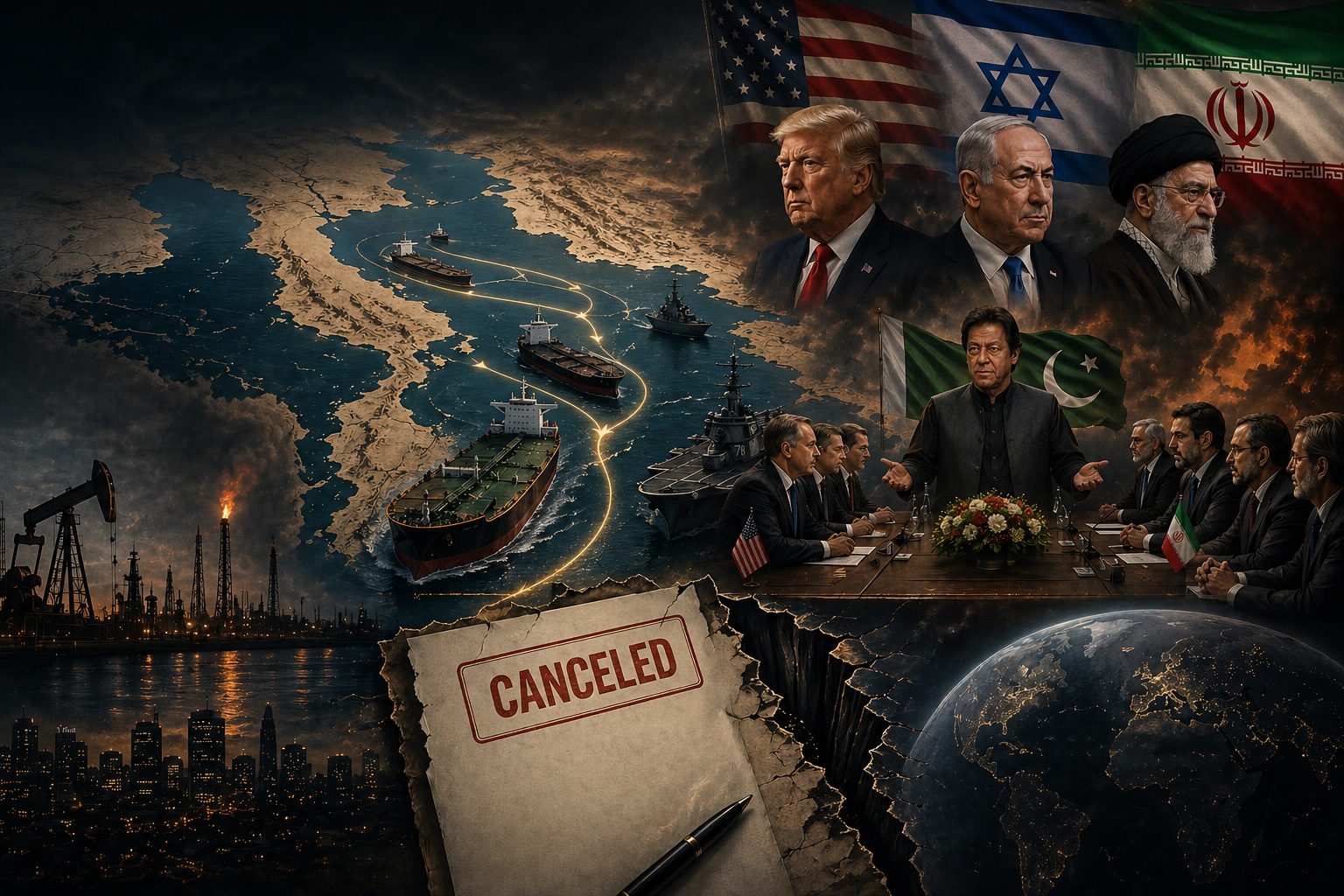
The Persian Gulf remains the narrow throat through which much of the modern world still breathes. Oil tankers, naval task forces, insurance markets, commodity prices, and the confidence of nations all pass through those waters.
In recent weeks the United States, Israel, and Iran moved from open confrontation to a tenuous ceasefire brokered in part through Pakistan. Yet diplomacy built in haste is often architecture built on sand. On April 25, 2026 President Donald Trump abruptly canceled a planned American delegation to Islamabad Pakistan for the next round of negotiations with Iran, signaling that the Pakistan mediation channel had, at least for now, collapsed under the weight of mistrust, confusion, and irreconcilable demands. This was not a trivial scheduling change it was a geopolitical rupture heard around the world.
The proposed American mission was expected to include Jared Kushner and special envoy Steve Witkoff, both of whom are trusted emissaries frequently deployed when delicate negotiations require both discretion and direct presidential confidence.
They were to travel to Islamabad for another attempt at stabilizing the postwar environment with Iran, reducing tensions in the Gulf, addressing the Strait of Hormuz, and confronting the central issue that shadows every modern Middle Eastern negotiation: Iran’s nuclear ambitions.
Instead, President Trump pulled the plug. He announced the decision publicly on Truth Social on Saturday afternoon, April 25, 2026. “I just cancelled the trip of my representatives going to Islamabad, Pakistan, to meet with the Iranians. Too much time wasted on traveling, too much work! Besides which, there is tremendous infighting and confusion within their “leadership.” Nobody knows who is in charge, including them. Also, we have all the cards, they have none! If they want to talk, all they have to do is call!!! President DONALD J. TRUMP” he wrote.
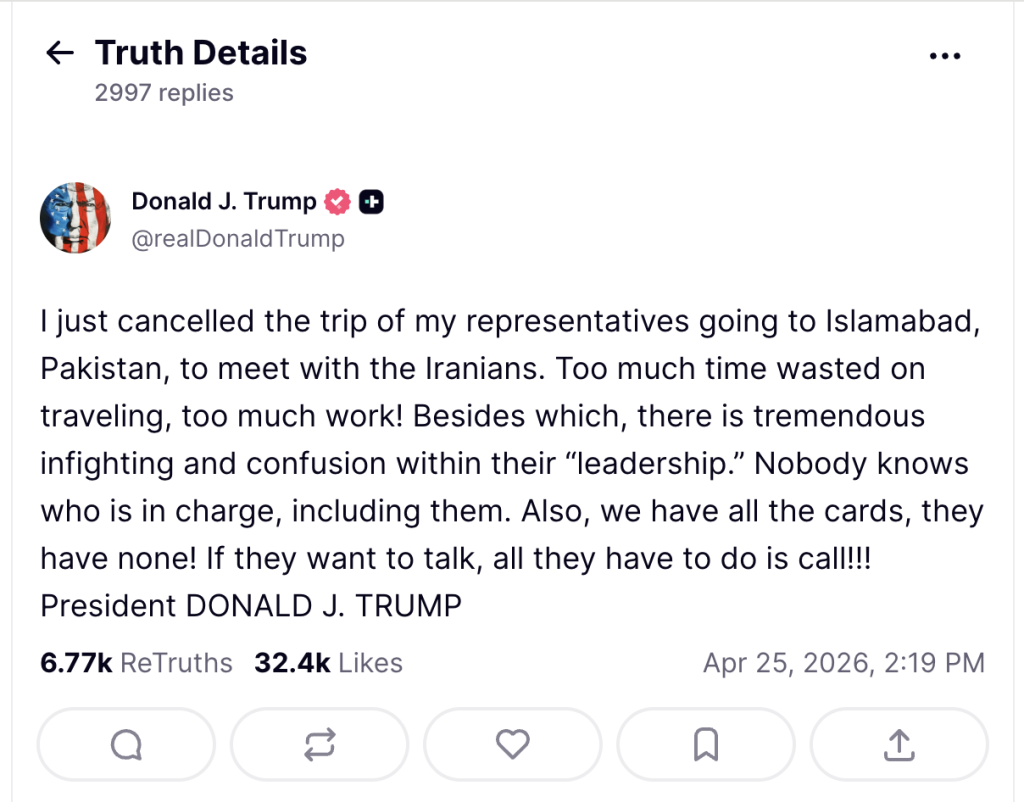
His language was classic Trumpian candor. He argued there was no reason to waste sixteen to eighteen hours flying halfway around the world merely to “talk about nothing.” He cited excessive travel, needless cost, internal chaos inside the Iranian regime, and uncertainty over who in Tehran was actually empowered to negotiate. He then delivered the blunt strategic summary that has echoed across every major newsroom since: America has all the cards, Iran has none.
Hours later, while in West Palm Beach, Florida the President reportedly elaborated to reporters that if Iran wished to talk seriously, they knew how to reach him. They could call. That sentence matters more than many understand. It means the United States was no longer willing to dignify pageantry without substance.
The media has portrayed the event in two competing ways. Hostile outlets described it as embarrassment, disarray, or a diplomatic setback. They suggested a last minute cancellation reflected instability. They lamented a missed opportunity. Such coverage predictably ignored the far more obvious truth: walking away from an unserious negotiation is not weakness. It is leverage. The favorable media coverage emphasized that Trump refused to send senior Americans on a symbolic pilgrimage merely to satisfy foreign egos, bureaucratic theatrics, or the vanity of process worshippers who mistake meetings for progress.
The facts, however, are clearer than the commentary. Pakistan had become the unlikely intermediary between Washington and Tehran after recent military confrontation and a ceasefire reached on April 8, 2026. Islamabad offered itself as host, mediator, messenger, and neutral corridor. Pakistani Prime Minister Shehbaz Sharif and Field Marshal Asim Munir were widely credited with helping create the temporary truce and arranging follow on discussions.
A first round of talks in Islamabad around April 11 and 12, 2026 reportedly ran for roughly twenty one exhausting hours. They produced no final agreement. Why? Because the two sides remain oceans apart on fundamentals.
The United States seeks what any rational power would demand: no Iranian path to a nuclear weapon, meaningful verification, strict limitations on enrichment, handling of highly enriched uranium stockpiles, curbs on missile threats, and an end to destabilizing proxy warfare. Iran seeks what every revolutionary regime seeks after strategic setbacks: sanctions relief, security guarantees, preservation of core capabilities, face saving language, and time.
Tehran insists that uranium enrichment on Iranian soil is a sovereign right. Washington, DC sees enrichment capacity as the seed from which future extortion grows. Tehran wants a temporary pause and Washington wants durable prevention. Tehran wants relief first and Washington wants proof first. That is the chasm.
On April 25, 2026 Iranian Foreign Minister Abbas Araghchi reportedly arrived in Islamabad, met Pakistani officials, conveyed demands, and departed without direct engagement with the Americans. That sequence is devastating in diplomatic terms. If the Iranian representative flies in, speaks only to intermediaries, and leaves before facing the opposing side, it signals either tactical evasion, internal division, or contempt for the process itself. President Trump said there was “tremendous infighting and confusion” inside Iran and that nobody knew who was in charge. One need not be Metternich to grasp the significance. Negotiations cannot proceed when authority is nonexistent.
Put simply, nobody knows who’s in charge in Teheran. Is power held by elected civilians? By clerical hierarchy? By military factions? By intelligence organs? By rival camps seeking advantage through delay? If no one can bind the state together then no agreement is worth the paper upon which it is printed. This is why the Pakistan mediation process has stalled. Not because Pakistan lacked effort.
Pakistan pursued the role energetically. It offered geography, channels of communication, regional relationships, and urgent self interest. Islamabad has every reason to prefer calm in the Gulf; energy flows matter to Pakistan. Regional instability matters. Prestige matters. Diplomatic relevance matters. But mediators can bridge distance. They cannot abolish reality. And the reality is this: Iran wants to preserve the strategic fruits of its nuclear infrastructure while obtaining economic rescue. America wants to prevent the bomb permanently while rewarding only verifiable compliance. Those are not adjacent positions. They are opposing philosophies.
The collapse of the mediation in Pakistan was also logistical in a more profound sense. Trump has long understood that travel itself can become tribute. Endless summits, choreographed handshakes, ceremonial motorcades, and smiling photographs often serve the weaker side more than the stronger. They grant legitimacy, buy time, fracture pressure, and create headlines suggesting equivalence. The President refused to play that game. He evidently judged that a transcontinental flight by senior American representatives, after Tehran had not committed to serious direct engagement, would hand Iran spectacle without concession. That calculation is strategically sound.
The broader stakes remain immense. The Strait of Hormuz is still the hinge of global commerce. Insurance premiums for shipping, energy prices, and military readiness all depend on confidence that the Gulf will remain open and stable. Every failed negotiation therefore echoes from Texas refineries to European factories to Asian ports. Yet no durable peace can be built upon euphemism. Iran cannot demand recognition, relief, and legitimacy while retaining the machinery that frightens the world. Nor can Washington pretend symbolic diplomacy substitutes for enforceable terms.
Pakistan’s mediation has not necessarily died forever. Channels may reopen. Intermediaries can reassemble. Messages can be carried quietly. Backchannels may already be active by the time you read this. But the Islamabad pageant, as conceived for April 25 and 26 of this year is finished.
President Trump canceled it publicly, personally, and unmistakably. He did so through Truth Social, then reinforced it before reporters in Florida. He made clear that America would not traverse the globe to chase ambiguity. That is the essence of the moment. The age of flying great distances merely to admire the scenery of failed diplomacy may be ending.
And if Tehran truly wants terms they now know the simplest route and just pick up the telephone.

