

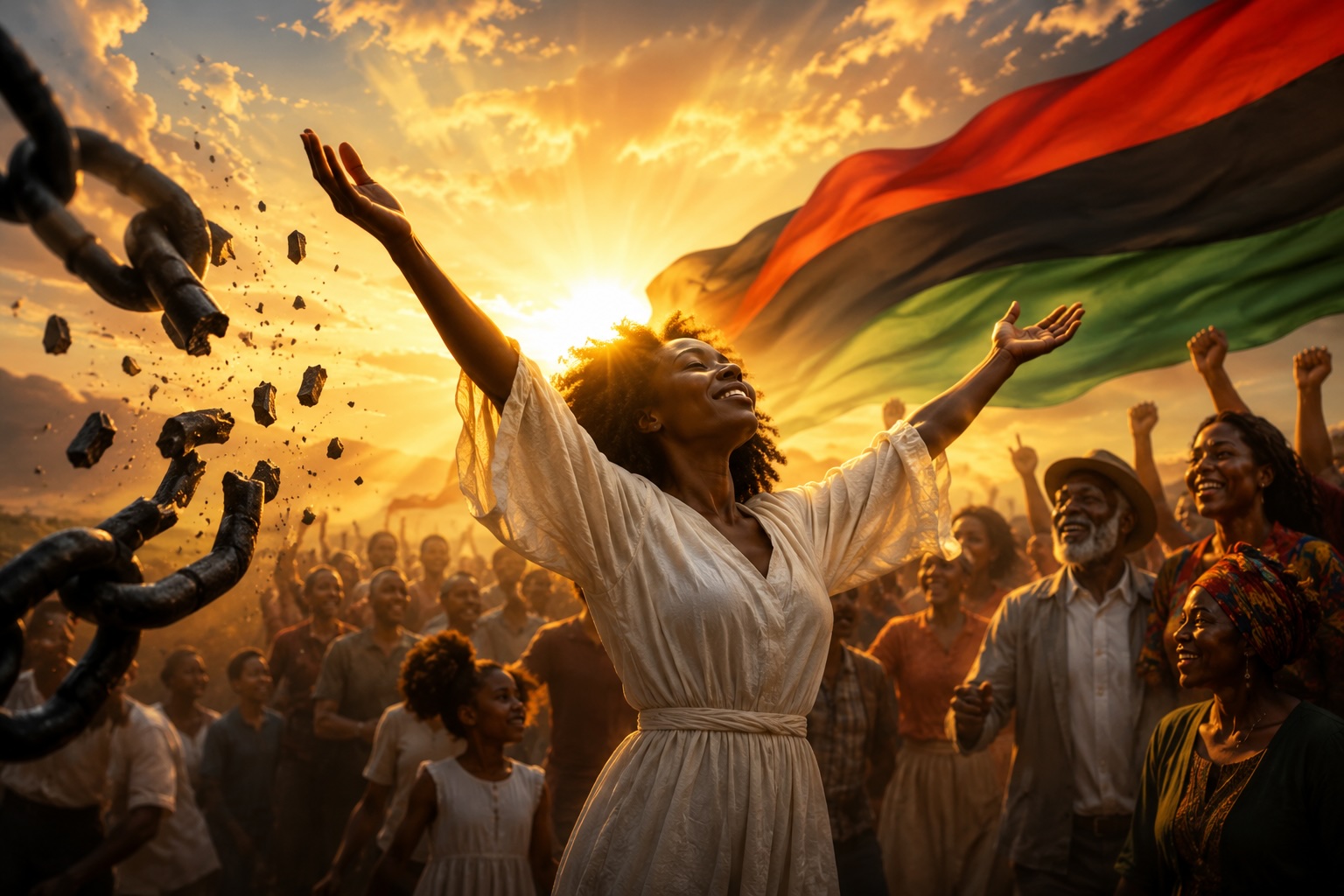
Every nation has defining moments. Days when history bends toward justice. Days when a promise, long delayed, finally becomes reality. For the United States, Juneteenth is one of those days. On June 19, 1865, Union Major General Gordon Granger arrived in Galveston, Texas, and issued General Order No. 3, announcing that all enslaved people were free. More than 250,000 black American men, women, and children living in bondage in Texas learned that the institution which had controlled their lives was finally at an end. The Civil War was effectively over. The Confederacy had collapsed. The Emancipation Proclamation had been law for more than two years. Yet in Texas, slavery persisted until federal authority arrived to enforce freedom.
The movement to make Juneteenth a federal holiday did not begin recently. For decades, activists and lawmakers sought national recognition of the day. After overwhelming bipartisan support in Congress, the Juneteenth National Independence Day Act passed the Senate on June 15, 2021, passed the House the following day, and was signed into law on June 17, 2021.
Although President Joe Biden ultimately signed the legislation, there is often an overlooked chapter in this story. During the 2020 presidential campaign, President Donald Trump included making Juneteenth a national holiday as part of his “Platinum Plan” for Black America. Trump publicly pledged support for federal recognition of Juneteenth, helping bring additional national attention to the holiday during a period when public awareness of its history was expanding rapidly.
It is difficult for modern Americans to fully comprehend the emotions of that day. Imagine awakening one morning as property and going to sleep that evening as a free human being. Imagine hearing that your children could no longer be sold away from you. Imagine learning that your labor, your future, and your very life now belonged to you and not to another person. Eyewitness accounts describe scenes of jubilation, prayer, tears, singing, embraces, and spontaneous celebrations. Churches filled with worshippers offering thanks to Almighty God. Families separated by slavery began searching for one another. Many freedmen immediately left plantations in pursuit of relatives, opportunity, education, land ownership, and a new beginning.
The reactions were not universally joyful. Many slaveholders were furious. Some resisted. Others delayed informing enslaved workers of their freedom for as long as possible in order to squeeze one final harvest from unpaid labor. In some areas, violence accompanied emancipation as former masters struggled to accept a world they had never imagined. Yet history had turned its page. The institution of slavery was dying, and no amount of resentment could stop the advance of freedom.
Juneteenth reminds us of an important truth about America. We are not a perfect nation. No nation composed of imperfect human beings can ever claim perfection. But America possesses something rare in human history. We possess the capacity for self-correction. We confront our failures. We debate them. We fight over them. We struggle with them. And ultimately, more often than not, we strive to right our wrongs. Slavery was one of those wrongs.
The enslavement of our fellow human beings violated the fundamental principles articulated in the Declaration of Independence. More importantly, it violated God’s law. Every man and woman is created in the image of Almighty God and endowed with inherent dignity. Human bondage was incompatible with that truth. The road toward abolition was long and painful, but Americans ultimately paid an extraordinary price to preserve the Union and eradicate slavery. More than 600,000 Americans perished during the Civil War, more than half of which were Union Army soldiers. The sacrifices of the Union Army forever altered the nation and forever expanded the blessings of liberty.
No individual better illustrates the meaning of Juneteenth than Bass Reeves. Born into slavery in Arkansas in 1838, Reeves was brought to Texas as a child when his enslavers relocated to Grayson County. He spent much of his youth in Texas laboring under a system that denied him freedom, opportunity, and basic human rights. Had he remained there, he would have been among the thousands of enslaved Texans awaiting the arrival of Union troops in June of 1865.
But Bass Reeves was not content to wait for history to rescue him. During the early years of the Civil War, Reeves displayed the courage and audacity that would later make him a legendary lawman. Following a confrontation with his owner, he escaped bondage and fled into Indian Territory. The journey was perilous. Capture could have meant severe punishment or death. Yet Reeves chose freedom over fear. He survived among American Indian tribes, learned multiple languages, mastered tracking and wilderness skills, and built the foundation for an extraordinary future.
His story provides one of the most compelling “what if” questions in American history. Had Bass Reeves lacked the courage to flee, he likely would have remained enslaved in Texas for years longer. He would have been among those awaiting the announcement that finally arrived in Galveston on June 19, 1865. Instead, his determination altered the trajectory of his life long before Juneteenth reached Texas.
By the time General Granger issued his famous order, Reeves had already escaped bondage and was living as a free man. Yet his life remained inseparably connected to the meaning of Juneteenth because he understood firsthand what freedom was worth.
Following the war, Reeves became a farmer, rancher, and family man. Then, in 1875, he was appointed a Deputy United States Marshal (DUSM). The United States Marshals Service (USMS), established in 1789, remains the oldest federal law enforcement agency in American history. Reeves became one of its most remarkable officers.
Patrolling tens of thousands of square miles across Indian Territory, Reeves pursued some of the most dangerous criminals in the American frontier. He was a master tracker, an expert marksman, and a fearless lawman. He reportedly arrested more than 3,000 fugitives during a career spanning more than three decades. His reputation for honesty became legendary. When his own son was charged with murder, Reeves personally executed the arrest warrant rather than permit family loyalty to interfere with justice.
Think about the magnitude of that transformation. A man who once could not legally own his own labor became an officer sworn to uphold the law. A former slave became one of the most respected DUSM’s in American history. A man who was once not acknowledged as a human being with basic rights became a guardian of justice for others. That is the American story at its best.
Juneteenth is not merely about the end of slavery. It is about the triumph of freedom over oppression. It is about faith over despair. It is about the extraordinary resilience of the human spirit. It is about men and women who endured unimaginable hardship yet refused to surrender hope.
The freed slaves who celebrated in Texas on that June day in 1865 could not have known what the future held. They did not know the struggles that still lay ahead. They did not know the challenges their children and grandchildren would face. But they knew one thing with certainty. They were free. And freedom changes everything.
As Americans gather to commemorate Juneteenth, we should remember both the suffering that preceded it and the blessings that followed it. We should honor those who endured slavery, those who fought to end it, and those who built new lives in its aftermath. We should remember Deputy United States Marshal Bass Reeves, who escaped bondage in Texas and rose to become a symbol of courage, integrity, and perseverance. And we should remember that while America has often stumbled, it has also demonstrated an unparalleled ability to correct its course and move closer to the ideals upon which it was founded.
Juneteenth stands as living proof that liberty, though sometimes delayed, ultimately prevails.

