

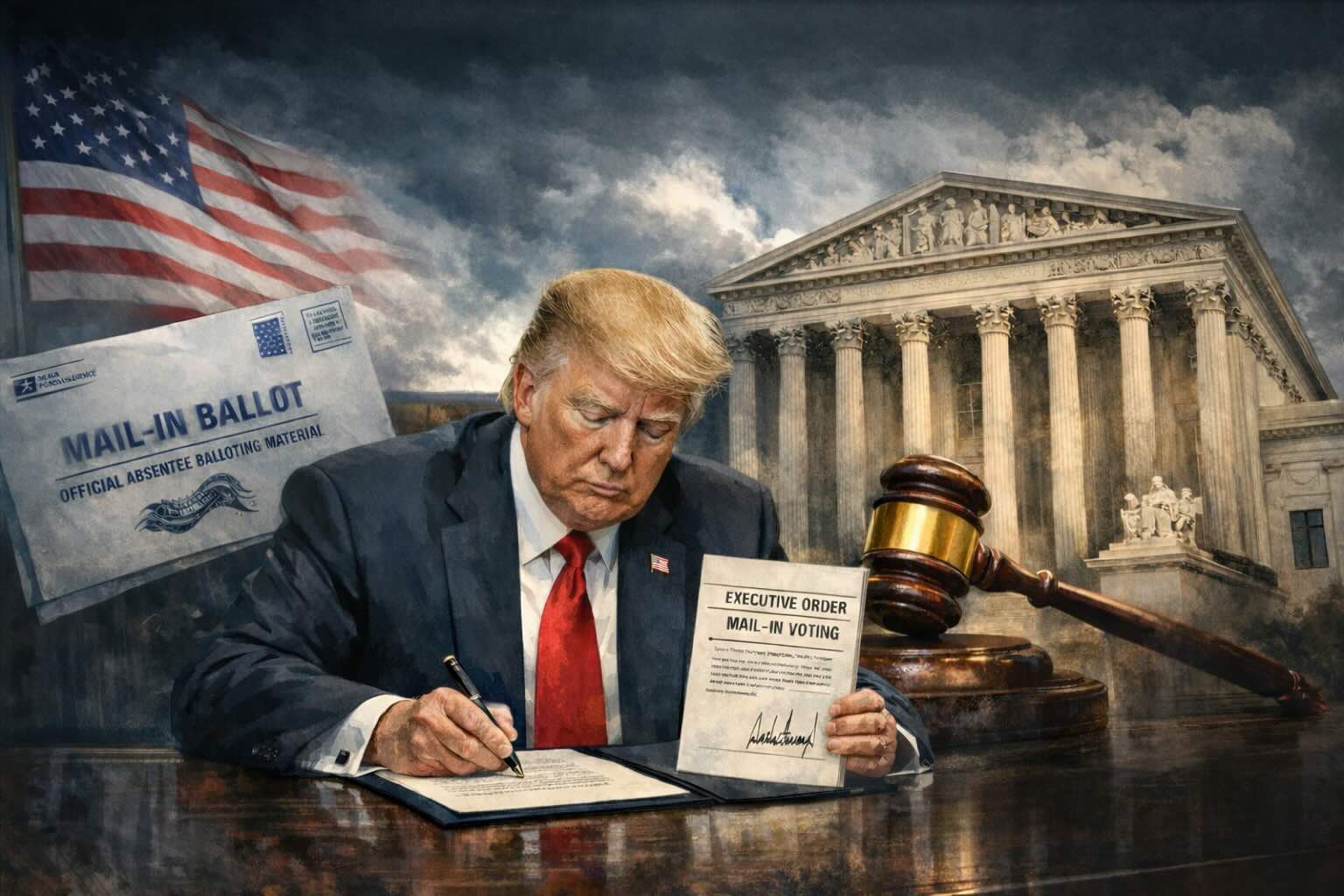
On March 31, 2026, President Donald J. Trump signed Executive Order 14399, titled “Ensuring Citizenship Verification and Integrity in Federal Elections,” which seeks to combat potential voter fraud by improving citizenship verification and mail-in ballot procedures.
The executive order is a significant, proactive step aimed at addressing long-standing concerns about the security and integrity of mail-in voting. The landmark directive requires federal agencies to create verified citizenship lists, limits the U.S. Postal Service to delivering mail ballots only to state-approved voters, and mandates secure, trackable ballot envelopes with Intelligent Mail barcodes.
Many agree these measures will safeguard our elections and help ensure only eligible citizens participate, particularly in the lead-up to the 2026 midterm elections.
However, two Republican officials with direct experience overseeing elections have expressed strong skepticism, predicting that the order faces successful legal challenges and is likely to be blocked by federal courts.
On April 5, 2026, Pennsylvania Secretary of the Commonwealth Al Schmidt and former Maricopa County, Arizona Recorder Stephen Richer—two Republican officials with extensive experience overseeing elections—appeared on ABC’s “This Week” and expressed strong skepticism about President Trump’s executive order. Both voiced concerns that the order oversteps federal authority and risks creating unnecessary confusion ahead of the 2026 midterm elections.
Schmidt, Pennsylvania’s Secretary of the Commonwealth and the state’s top Republican election official, emphasized the need for stable rules that voters can rely on. “We want voters to know that the election is going to be free, fair, safe and secure, and that everyone knows what the rules are beforehand,” he said.
“So confusion is never a positive thing unless you are seeking to sow distrust in the outcome of an election.” He added that he is “confident of an outcome in our favor” regarding Pennsylvania’s legal challenge.
Richer, who managed elections in Arizona’s largest county from 2021 to 2025, noted that while he shares some of the order’s goals—such as stronger verification and tracking—Arizona already has proof-of-citizenship requirements and ballot-tracking systems in place.
“While I agree with some of the elements in the executive order and some of the aspirations, the form does matter,” Richer said. He predicted the order would be quickly blocked by courts and argued that the federal approach risks undermining public trust rather than strengthening it.
The White House has strongly defended the order as an essential step to restore public confidence in elections.
Officials argue the President has clear authority under immigration and security laws to strengthen voter verification, pointing to narrower past actions on voter ID and citizenship checks. They emphasize that the measure addresses growing concerns from the 2020 and 2024 elections, including the risk that illegal immigrants may have cast ballots in federal races.
Legal opposition has mounted quickly. Multiple lawsuits have already been filed, including one by Senate Minority Leader Chuck Schumer and House Minority Leader Hakeem Jeffries, and another by 23 states, including Arizona and Pennsylvania, arguing that the order violates the Elections Clause of the U.S. Constitution by infringing on states’ authority over the “times, places, and manner” of federal elections.
Legal experts widely agree that while Congress has authority under the Constitution to regulate certain aspects of federal elections, a president’s executive order cannot unilaterally override existing state election laws.
Democrats have criticized the order as an unlawful attempt to restrict voter access, with Jeffries calling it “unlawful and unconstitutional” and vowing continued litigation to protect free and fair elections.
Some states led by Republicans are hesitant because putting the order into effect would be complicated and expensive, and it would conflict with the election rules they already have in place.
Across the country, many Americans have welcomed the executive order as a strong and timely action to secure our elections and restore faith in the voting process. Arizona already implements proof-of-citizenship requirements and ballot tracking systems successfully, even as most voters continue to vote by mail.
While a handful of veteran Republican election officials like Al Schmidt and Stephen Richer have raised concerns, the executive order’s unwavering commitment to election integrity has resonated deeply with Americans who demand and deserve fair, safe, and trustworthy elections.
These impending court fights will deliver a defining verdict on how far executive power can reach into state-run elections, and the outcome could fundamentally rewrite the rules of voting reform in the United States for decades.

