

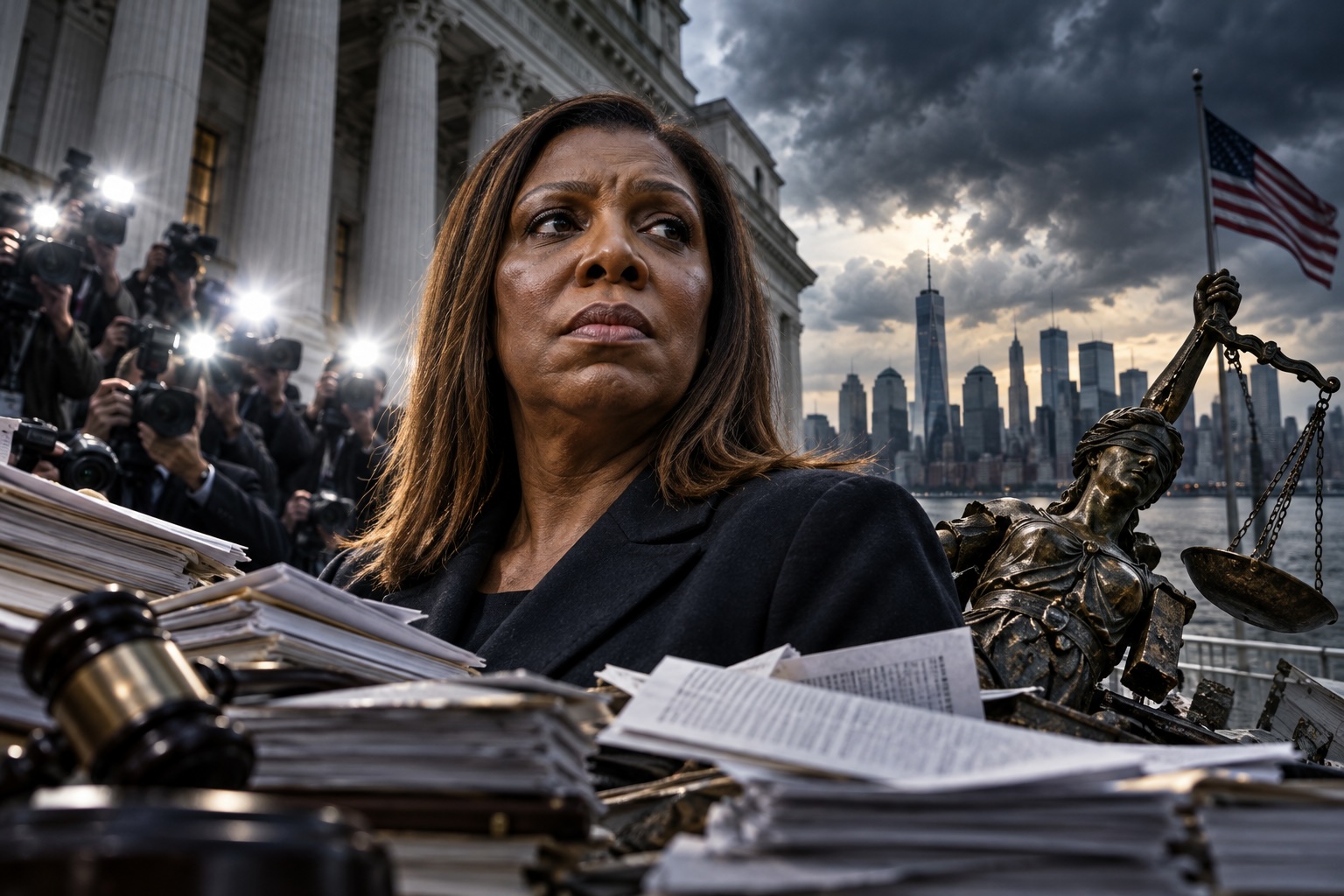
New York Attorney General Letitia James, whose campaigns have received direct contributions from George Soros and family members along with support through Open Society-linked organizations, ran in 2018 on an explicit promise to go after President Donald J. Trump and his family.
A former public defender who had never prosecuted a criminal case, James centered her campaign on the 45th President, calling him an “illegitimate president” and pledging to use “every area of the law.”
In 2018 she called the NRA a “terrorist organization.” In 2020 she sued the NRA and CEO Wayne LaPierre, seeking to dissolve the group entirely. The judge rejected that bid pointing to members’ free-speech and association rights. Many have called this charade a waste of taxpayer money and selective enforcement driven by progressive donor talking points rather than an honest reading of basic law.
Her timeline of misfortune and deception does not begin this week, or even this year. It began in 2018, when a clear pattern of bad choices, consequences, and repeated failures to do the actual job of attorney general first became impossible to ignore. Everything since has been a variation on the same theme of the same habits, the same results, and the same insistence that each setback is somehow external, temporary, or unfair.
The signs of selective focus appeared once she took office. Campaign spending later raised ethics questions, including payments tied to her longtime hairdresser, who has since been jailed on mortgage fraud allegations. Once in office, James went straight for President Trump and his family while street crime and Medicaid fraud continued, and her investigations of him never produced criminal wrongdoing.
That same priority appeared in the Medicaid Fraud Control Unit. Previous attorneys general recovered roughly $250 million a year with about 100 criminal convictions. Under James, recoveries fell as low as $19 million in some years, with single-digit convictions.
Other problems followed. In 2020 she bought a house in Norfolk, Virginia. Federal allegations claimed she listed it as a secondary residence to secure better mortgage terms while renting it out, producing roughly $18,993 in alleged savings.
Reports indicate her grandniece, who faced criminal charges and at the time was a “fugitive” from North Carolina probation, has lived there with her children since 2020. Questions regarding James’ other properties and insurance filings arose later. The resulting bank-fraud indictment was dismissed because the interim prosecutor’s appointment was ruled unlawful, a procedural escape hatch that avoided reaching the substance of the Norfolk mortgage allegations.
In 2021 her office released the report on Andrew Cuomo’s sexual-harassment allegations that helped force his resignation. Cuomo filed an ethics complaint alleging conflicts, selective evidence, and motives. The complaint produced no public discipline.
While her office spent years chasing the Trump case she had campaigned on, and coverage often framed the effort as closing in on major misconduct, campaign finance records show hundreds of thousands of dollars spent on lodging, flights, and related expenses, including stays at higher-end hotels.
During that same period her campaign filings reveal more than $310,000 was spent since she took office on luxury hotels and high-end expenses she labeled “political meetings,” including over $32,000 on Puerto Rico hotel stays, $4,600 on Martha’s Vineyard house rentals, a $12,000 private-jet payment, and additional lodging and transportation costs from 2021 onward totaling more than $215,000. Other analyses noted additional creative classifications, such as some lodging and travel costs shifted between “office,” “lodging,” and “transportation” categories for the same stays. Nightclub spending, including more than $5,000 at a New York City lounge, and certain taxi charges were also cited under broad “office” labels.
The same period saw the failed civil fraud case against Trump, in which an appellate court shut down the penalty, later valued at more than $450 million with interest, ruling it excessive while exposing its preposterous scale as political showboating rather than proportionate enforcement.
In April 2025 Federal Housing Finance Agency Director Bill Pulte sent a criminal referral alleging mortgage fraud. Beyond the Norfolk property, claims have involved a long-owned Brooklyn multi-unit building and separate insurance-fraud referrals by Pulte.
In October she was indicted in Virginia on claims she misrepresented the property’s use to obtain better loan terms bank-fraud and false-statement charges tied to the Norfolk property. The case was brought by Lindsey Halligan after the prior prosecutor declined to charge. James called it retribution. In November, Clinton-appointed Judge Cameron McGowan Currie dismissed the indictment, ruling Halligan’s appointment unlawful. These matters, dismissed due to procedural issues, not by examining evidence.
By August 2026, frustration inside the office had surfaced. Assistant Attorney General Daniel Wiesenfeld in the Investor Protection Bureau emailed more than 2,000 colleagues alleging he was ordered to keep pursuing Trump-linked matters after a year-long probe found no crime. In an exclusive New York Post interview, he said his bureau chief indicated the case should be closed but that it was “Tish’s call” and “what Tish wanted, Tish got.”
The email was quickly deleted from the office’s servers and disappeared from the inboxes of more than 2,000 employees. He was placed on leave and terminated September 5. He refused demands to destroy the evidence of improper targeting, citing threats of discipline and possible civil or criminal action. He said protection-detail detectives left a card at his home and banged on his door.
Federal investigators interviewed him and no public charging decisions followed.
The office later released his personnel records under FOIL. Former Cuomo aide Richard Azzopardi called her the “biggest hypocrite in Albany” for doing so, noting her team had previously treated the same tactic as retaliation. Her office called it a personnel matter.
On September 28 she posted that what a Cornell accuser had endured was “horrific and unacceptable” and told “survivors” that “we stand with you.” Governor Hochul appointed her special prosecutor three days later. James described the comments as empathy and said “politics stops at the door in my office.” The underlying case already contained conflicting accounts, including earlier statements from the accuser that some contact was consensual and that “none of the sexual stuff was illegal.” Two defendants moved to remove or disqualify her. An Article 78 petition is set for October 29.
An ethics expert’s report concluded she had a serious, incurable conflict requiring recusal. Jonathan Turley has also urged recusal, arguing that her pre-appointment statements created an appearance of prejudgment and that she has long followed a “sentence first, verdict afterward” approach. He concludes she is “the absolutely wrong person” to lead the investigation.
Now seeking a third term, she faces Trump-backed challenger Saritha Komatireddy. In their October 8 debate she declared, “You don’t have to look at the facts and the law. All you have to do is study what they do. It is illegal in the state of New York.” Komatireddy immediately repeated the line back to the audience.
That moment captured the record. What remains is a pathetic legacy.
Since 2018 the playbook has not shifted. The office’s highest-profile effort remained the failed, politically driven multi-year campaign against President Trump. She supported progressive bail changes and deprioritized routine street crime relative to high-profile cases. That is a record of sustained partisan theater, weaponizing the justice system to target those she named while conducting with public power. It was a clear misuse of the oath and the public power she swore to exercise impartially.

