

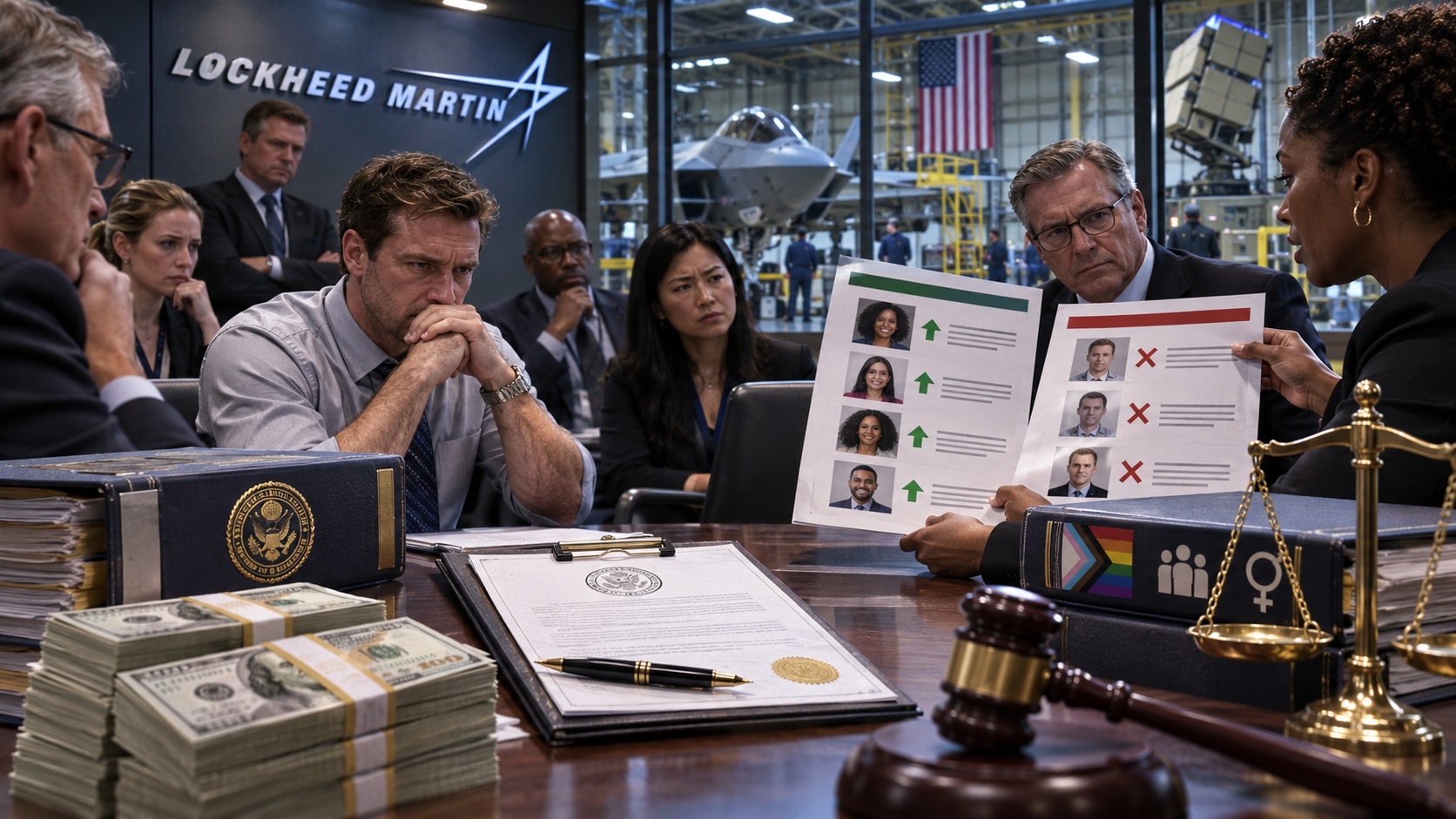
Lockheed Martin has agreed to pay roughly $29.5 million to settle federal claims that the defense giant used DEI-driven pay, hiring, and promotion practices while taking taxpayer money as a federal contractor.
The Justice Department and the Equal Employment Opportunity Commission announced the two-part deal on November 3. Under it, Lockheed will pay $22 million to the United States to resolve False Claims Act allegations covering race and sex and about $7.5 million to more than 1,000 affected workers under a Title VII settlement with the EEOC, framed as race discrimination against white employees. The EEOC called it the largest class of workers to publicly recover in a settlement tied to alleged Title VII violations arising from a DEI program.
Most federal contracts require contractors to certify that employment decisions will be made “without regard to” race or sex. Prosecutors alleged that from 2019 forward, Lockheed falsely certified that compliance while race and sex shaped who got raises, bonuses, and advancement. The centerpiece was Lockheed’s “Compensation Adder,” or Comp Adder, program, which began in 2021. It was supposed to give the top 20% of employees in each business area an extra pay bump based on merit. According to the Justice Department, before those lists were locked in, Lockheed ran statistical checks that “flagged” selections based on race and sex. When a unit was flagged, HR pressed leaders to rework the lists.
In practice, prosecutors said, that meant adding minority employees and cutting non-minority ones. One HR employee told business leaders that “increasing POC [People of Color] for Comp Adder will result in removing equal count of non-minority.” A Director of Global Diversity & Inclusion told colleagues they would “identify at least 11 additional PoC adds” so a “Race flag will clear,” ending the message with “Let’s goooooooooo” and a smiley face.
The government also alleged Lockheed tracked non-public race and sex workforce goals that steered hiring and promotions, scored managers on demographic “Performance Metrics,” and offered mentoring and leadership programs limited by race or sex.
The False Claims Act case grew out of a whistleblower suit by Tim Booher, a former Lockheed vice president in Combat Systems, as reported by the Fort Worth Star-Telegram.
Booher will receive $4.4 million from the government share of the settlement.
Lockheed cooperated in the resolution of these matters, denies the allegations, and does not admit liability. There has been no finding of wrongdoing. The claims remain allegations only.
This year the Administration launched the Task Force to Eliminate Fraud and the National Fraud Enforcement Division to enhance the Administration’s war on fraud, waste and abuse in federal programs. When unscrupulous actors exploit these programs for their own financial gain, they defraud the government, harm the people these programs are designed to aid and protect, and undermine American businesses that play by the rules.
The Justice Department Civil Division’s FCA enforcement plays a critical role in combatting such fraudulent schemes, recovering billions of dollars for American taxpayers, and holding wrongdoers accountable. FCA matters will continue to be on the forefront of the battle against fraud, and the Civil Division’s FCA work will support and advance the mission of the Task Force to Eliminate Fraud and the National Fraud Enforcement Division.
The two-part resolution obtained in this matter was the result of a coordinated effort between the Equal Employment Opportunity Commission, the Justice Department’s Civil Division, Commercial Litigation Branch, Fraud Section, and the U.S. Attorney’s Office for the Northern District of Texas with investigative assistance from the Department of War, Office of Inspector General.
Associate Attorney General Stanley E. Woodward Jr. put the stakes plainly: companies that do business with the federal government “should not make DEI compensation decisions that prioritize an employee’s race over the merit of their work.” EEOC Chair Andrea Lucas said Title VII protects every worker from race discrimination, and that protection “does not yield when discriminatory decisions are framed as diversity initiatives.”
Under the EEOC deal, Lockheed must keep a merit-based workplace where race and sex are not factors in hiring, pay, bonuses, or promotions, with EEOC oversight for the life of the agreement.

