

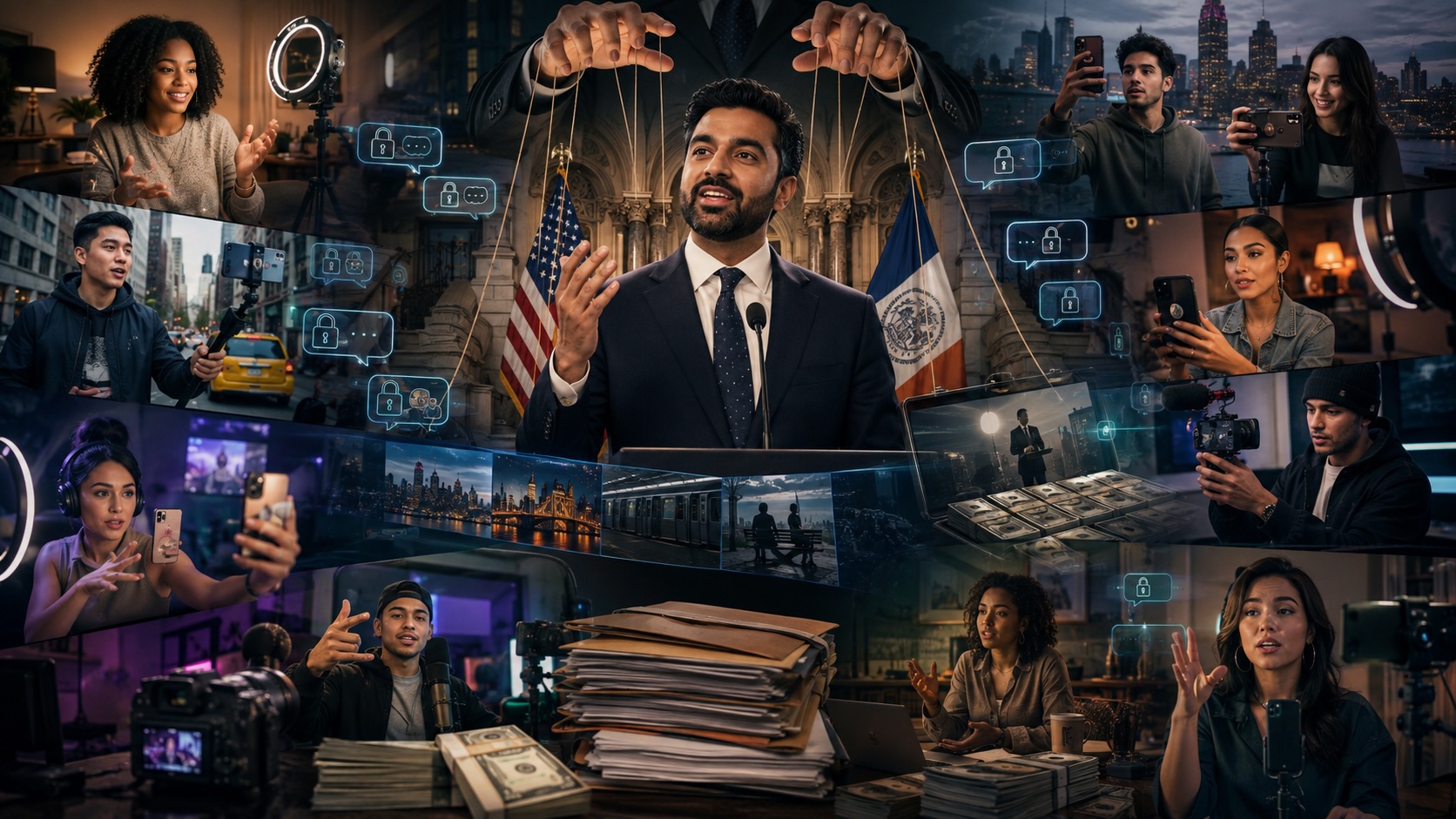
New York City Mayor Zohran Mamdani’s office turned a campaign creator list into a City Hall influencer distribution list. A Columbia Journalism Review investigation with the Tow Center for Digital Journalism found that the campaign’s Creators4Zohran network was rebuilt as “NYC Creators Announcements,” a Signal group of about 200 creators run by Emilia Rowland, director of new media and cultural communications.
This is a real ethics problem. Government speech legally belongs on the record. A campaign list exists to get a candidate elected. A city list exists to inform the public. Turning one into the other blurs political loyalty with official speech. Creators who boosted Mamdani on the trail now receive daily talking points, clips, and access from City Hall on an encrypted app.
This is ultimately about promoting Mamdani and expanding the Democratic Socialists of America’s reach. The only problem is that the audience never sees the man behind the curtain. Instead, they encounter a familiar account presenting the talking points as if they were its own.
Would the posts land the same way if viewers knew the script came directly from the mayor’s office, and that some of those voices are later paid as city vendors?
This is not volunteer civic media. It’s a paid, controlled distribution system designed to influence people without their knowledge. Political insiders who have worked this circuit have told the New York Post that these accounts do not work for free when hired for specific campaigns.
Some are taxpayer-funded contracts, routed through marketing agencies, that have paid the same creators $5,000 to $20,000 to push messaging on voting, health care, immigration, tenants’ rights, participatory budgeting, and composting.
Organic support does not require a staffed Signal channel, daily talking points, packaged clips, and a roster of 200 accounts. Organic commentary does not arrive preloaded with shiny clips from the mayor’s new-media shop.
The machine around this communications program is not a volunteer commune. It is a professional messaging apparatus: controlled talking points first, city list second, agency contracts on the side. Access is the bait. City work is the payoff.
On September 2, when asked about concerns that the encrypted Signal chats violate the city’s record-retention laws, Mamdani deflected by arguing that tapping social-media accounts is no different from engaging radio, television, and other media. The comparison is revealing. Traditional media appearances create a public record. A private Signal channel of 200 creators does not.
This is not the first time a New York City mayor’s office used the app. In 2019 and 2020, Bill de Blasio and his aides discussed official business on Signal. Watchdogs warned then that disappearing messaging collides with the city’s duty to keep public records and honor FOIL requests.
These creators are not pressing City Hall. They are being briefed, then posting. Campaigns have figured out that a familiar TikTok or Instagram account can move voters the way a television spot used to; except the post looks like a person talking, not an ad. Recruit creators, feed them language and clips, and let them post from their own accounts.
The Federal Trade Commission requires disclosure when a creator is paid to sell a product. It does not require one for political messaging. The only reliable way to learn that a creator was paid is to reconstruct the payment later in campaign-finance filings, often after the money has already moved through agencies.
Young audiences are the primary target. Pew Research finds that 21% of U.S. adults regularly get news from “news influencers,” including 38 percent of 18-to-29-year-olds. Adults under 30 are far more likely to encounter this content on TikTok, Instagram, and YouTube—and to trust what they see. The posts often read like a friend’s take. That’s the point.
Call it outreach. Call it civic education. It is not regulated, and it is being used to influence millions. The money trail has to be followed. These accounts are not asking the hard questions a journalist would. They are producing the story because a financial guarantee is attached to it.
Access is the bait. City contracts are the payoff. The audience is never told the difference.

