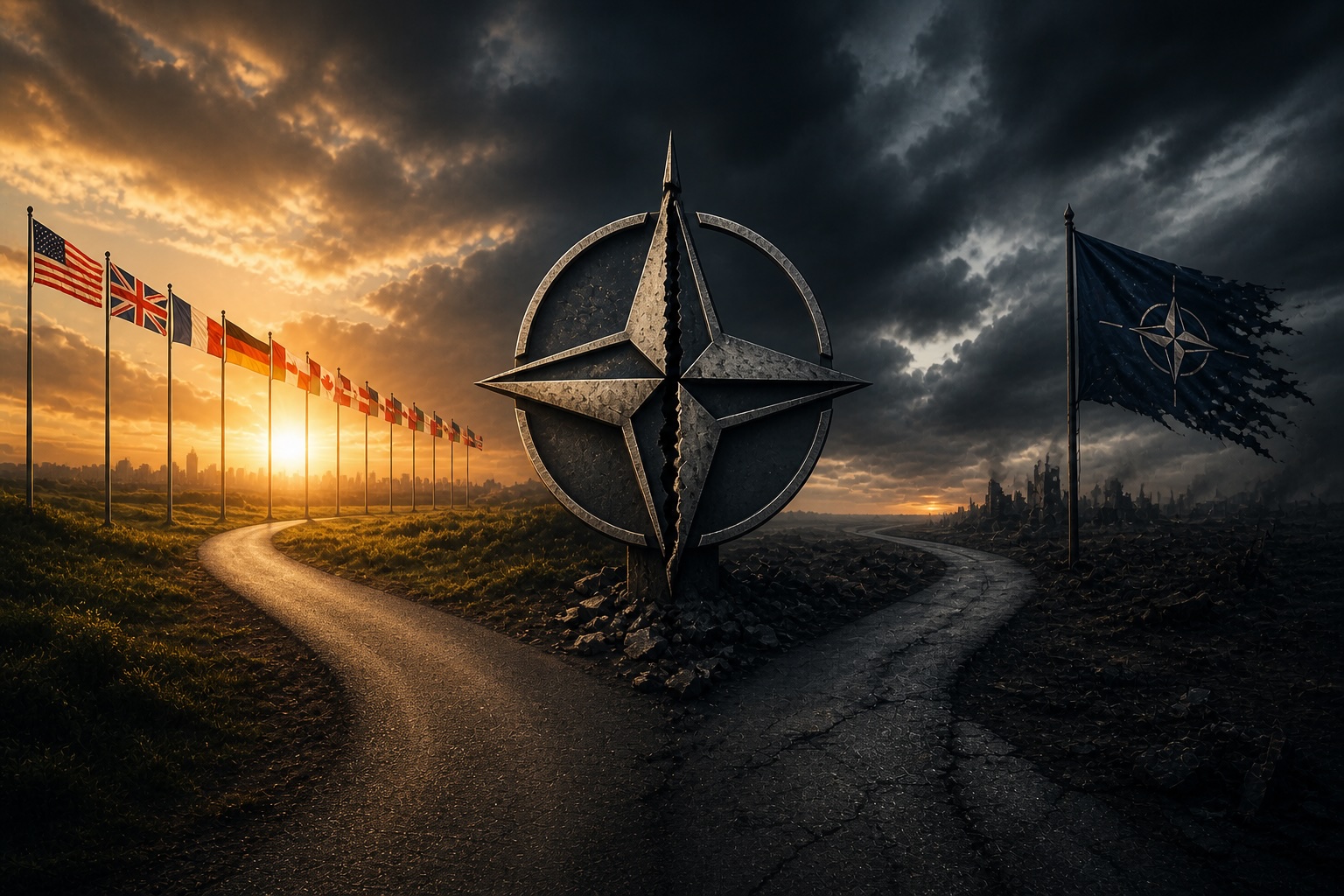
The North Atlantic Treaty Organization (NATO) was born in 1949 out of the smoldering ruins of World War II, when the great capitals of Western Europe lay either shattered by bombardment or hollowed out by exhaustion. It was not merely a treaty but a civilizational covenant, an ironclad vow that the nations of the Atlantic world would stand as one against the encroaching specter of Soviet expansion. Article 5 is the beating heart of the alliance, declared that an attack upon one would be regarded as an attack upon all. This was not diplomatic ornamentation it was a stark and solemn guarantee designed to prevent the Red Army from ever again rolling westward across a defenseless continent. The United States, ascendant and economically unscathed, became the keystone of this structure, underwriting the defense of Europe not only with troops and matériel but with its industrial sinews and nuclear deterrent.
For decades NATO functioned as a bulwark against totalitarian expansion. It was the rampart behind which Western Europe rebuilt its cities, revived its economies, and cultivated the illusion that history’s tempests had been permanently tamed. Yet alliances, like empires, are subject to entropy. What begins as a pact of mutual necessity can, over time, metastasize into an arrangement of asymmetry and indulgence.
Enter the President Trump whose view of NATO has been as unvarnished as it is disruptive. Where previous presidents spoke in the dulcet tones of diplomatic continuity, he has approached the alliance with the unsentimental calculus of a ledger clerk auditing a profligate enterprise. He has repeatedly pointed out a reality long obscured by diplomatic euphemism: the United States bears a disproportionate share of the alliance’s financial and military burden.
The figures are not merely instructive; they are startling. The United States accounts for roughly two thirds of total alliance defense spending. While American taxpayers fund a vast military apparatus that spans continents, many European allies have for years lingered below the alliance’s own benchmark of allocating 2% of the Gross Domestic Product (GDP) to defense. Nations with immense economic capacity have historically underinvested in their own military capabilities, relying instead on the implicit guarantee that American power would serve as their ultimate insurance policy. This arrangement resembles less a partnership of equals than a sprawling estate in which one industrious proprietor shoulders the costs while a coterie of tenants enjoy the comforts.
The critique is not merely fiscal; it is philosophical. The question has been raised whether an alliance conceived in the crucible of the Cold War retains its original raison d’être in a world where the Soviet Union has long since dissolved into the pages of history. To some, NATO risks becoming an ossified relic, a ceremonial guard still pacing before a gate that no longer requires protection.
Yet this worldview is not devoid of reverence for tradition and symbolism. Indeed, it is here that admiration for the British monarchy becomes particularly illuminating. There has been longstanding respect expressed for a late monarch widely regarded as a paragon of dignity, continuity, and sovereign gravitas. Interactions with her successor have likewise been framed within a broader appreciation for the pageantry and historical continuity of the Crown.
This admiration is not incidental. It reveals a perspective that, while skeptical of bureaucratic alliances, retains a deep affinity for institutions that embody endurance, hierarchy, and national identity. The British monarchy represents an unbroken thread of civilizational coherence, a living testament to the idea that power can be both ceremonial and substantive, both symbolic and real.
The juxtaposition is striking. On one hand stands a sprawling multinational consortium whose purpose has become increasingly ambiguous and whose financial architecture resembles a lopsided ledger. On the other stands an institution that has survived wars, revolutions, and societal upheavals precisely because it understands the alchemy of symbolism and authority. One is a committee. The other is a throne.
Historically, alliances that fail to recalibrate often find themselves eclipsed by events. The Delian League of ancient Greece began as a voluntary coalition against Persian aggression, only to devolve into an empire that bred resentment among its members. The Concert of Europe, forged after the Napoleonic Wars to preserve continental stability, eventually succumbed to the centrifugal forces of nationalism and great power rivalry. NATO now faces a similar inflection point, caught between its storied past and an uncertain future.
Critics argue that challenging the alliance imperils a cornerstone of global stability. Supporters contend that such scrutiny is a long overdue act of strategic realism, forcing allies to confront the inequities that have long undergirded the arrangement. In truth, both perspectives contain elements of validity. NATO is neither an anachronism to be discarded nor a sacred relic beyond reproach. It is a structure that demands renovation if it is to remain relevant.
The central question is whether NATO can evolve from a dependency model into a genuine partnership. Can Europe assume greater responsibility for its own defense, thereby transforming the alliance into a more equitable enterprise? Or will it continue to rely on the American colossus, content to let the United States taxpayers bear the burdens while others draft communiqués?
In the final analysis, the debate over NATO is not merely about budgets or troop deployments. It is about sovereignty, responsibility, and the enduring tension between idealism and realism in international affairs. The current moment has forced this debate into the open. Whether one views it as provocation or reform, it has undeniably exposed the fissures that lie beneath the alliance’s polished exterior.
And so NATO stands at a crossroads, its future suspended between legacy and transformation. Like an aging fortress whose walls once repelled invaders but now require reinforcement, it must decide whether to adapt or risk obsolescence. History offers no guarantees, only precedents. The alliances that endure are those that recognize when the world has changed and possess the courage to change with it.


