

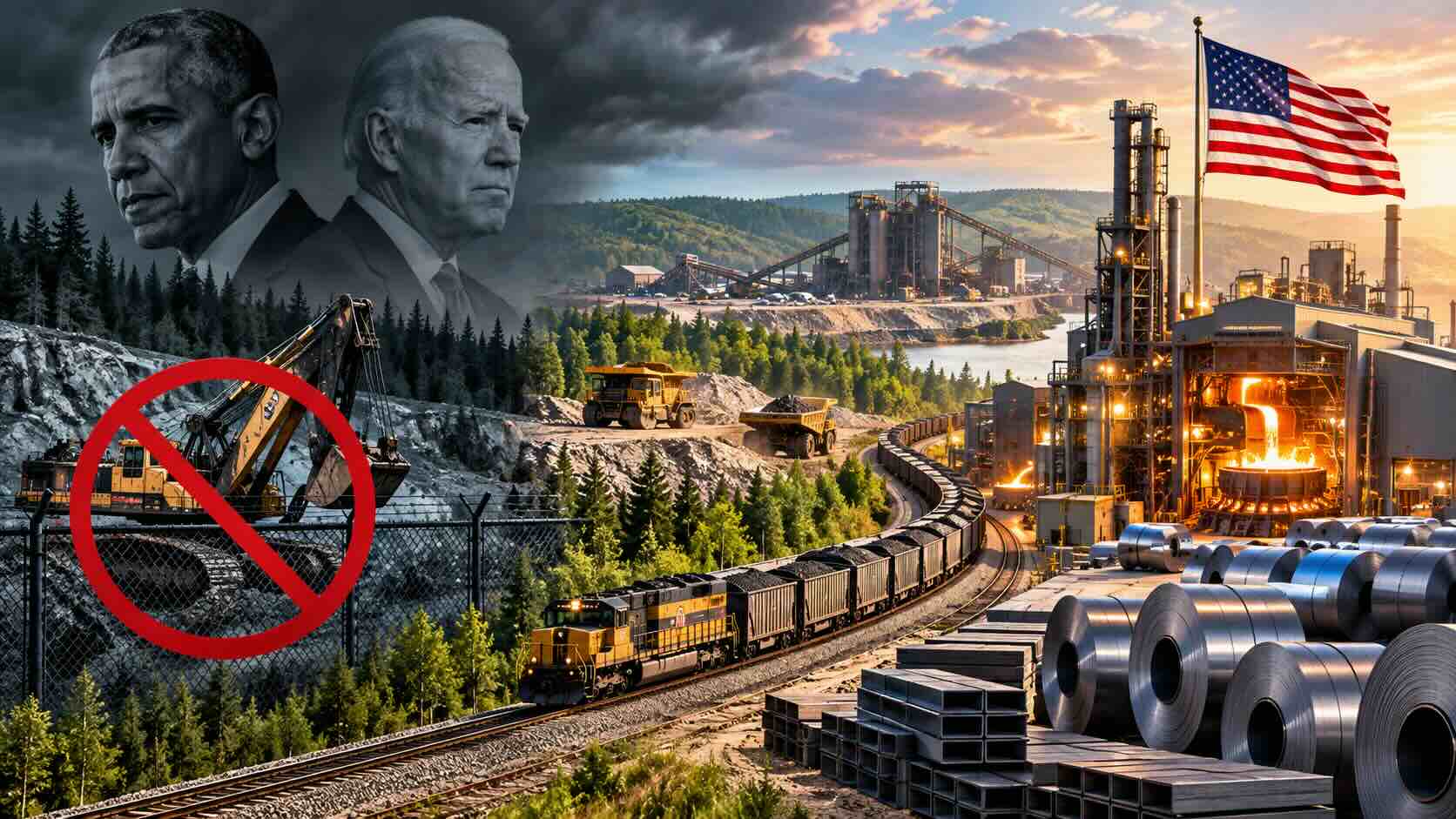
In 2016, the Obama administration blocked a proposed northern Minnesota copper-nickel mine by denying its federal Bureau of Land Management lease renewals. The Trump administration restored those leases, and Twin Metals filed a formal mine plan.
The Biden administration canceled the leases again in 2022, then banned mining for 20 years across 225,504 acres of the Superior National Forest, all while revoking a key federal water permit for another long-stalled copper-nickel mine. In 2024 they piled new rules onto taconite iron-ore processing and coke ovens, the plants that feed American steel, while imported finished steel still held about a quarter of the U.S. market.
This was not the only project stopped under Biden. In Alaska, a 211-mile road that would have opened a copper and cobalt district never got built.
Acting against that record of stop-and-starve federal mining policy,
President Donald J. Trump announced on Monday one of the largest steel plants in American history, a $15 billion Mesabi Metallics mill in Iowa.
The project is projected to create 1,750 permanent Iowa jobs, support up to 6,000 construction jobs, and add about $95 billion to the U.S. economy over construction and the plant’s first decade. First-phase output is 7.5 million tons of steel a year, later rising to about 10 million, using iron ore from Mesabi’s newly opened Minnesota mine, the first new U.S. iron ore mine in 50 years.
This is an interstate American operation. Ore is blasted and pelletized on Minnesota’s Iron Range, then melted and poured in Iowa. The White House and the company are selling a closed U.S. loop so the steel that goes into cars, appliances, infrastructure, and defense work does not have to start as someone else’s raw material.
Mesabi, an Essar Group company, has put $2.5 billion of equity into the Nashwauk mine after years of delay and a 2016 bankruptcy under a prior corporate form. The mine is built for high-grade direct-reduction pellets used by electric-arc furnaces, which now make most American steel. Those pellets are supposed to move south into Iowa instead of sitting as an isolated mining asset or leaving the country as feedstock for somebody else’s mill.
At an Oval Office event, Mesabi chairman Rewant Ruia and CEO Joe Broking stood with Commerce Secretary Howard Lutnick, Iowa Gov. Kim Reynolds, and Reps. Mariannette Miller-Meeks and Ashley Hinson. Trump revealed the steel would be mined, melted, and made in the U.S. Lutnick said the Iowa deal was done. Reynolds said the project changes the trajectory of one of the state’s most depressed regions. Hinson said Iowa already feeds and fuels the world, and now joins the manufacturing story.
Miller-Meeks placed the mill in Lee County. A specific parcel has not been formally locked by the company, and local officials still want the public package on roads, gas, power, rail, and housing. First steel is slated for around 2030. The nearer-term American yield is the construction payroll and the Minnesota mine that is already working. The longer-term yield is a Midwest mill large enough to matter.
Thanks to President Trump, steel policy flipped after 2025. Raw steel output is up 9% since Trump returned to office. Nearly 6,000 steelworker jobs have been added after almost 10,000 were lost under the prior administration. American mills now supply 84% of the U.S. finished steel market, up from 77% in 2024. New mill orders hit $17.3 billion in July 2026. Domestic shipments hit $16.9 billion that month. Officials tie those numbers to 50% Section 232 steel tariffs, faster permitting, and domestic energy.
The United States surpassed Japan in crude steel production in 2025 for the first time since 1999 and is now the world’s third-largest producer.
Eastern Iowa is in line for a heavy-industry footprint it has not had in generations. Minnesota ore stays in a U.S. supply line, and the work stays in American towns. That is this administration’s commitment. Bring the jobs home, keep the steel American, and run the mine-to-mill chain from Minnesota to Iowa instead of from a foreign dock to a U.S. factory floor.

