

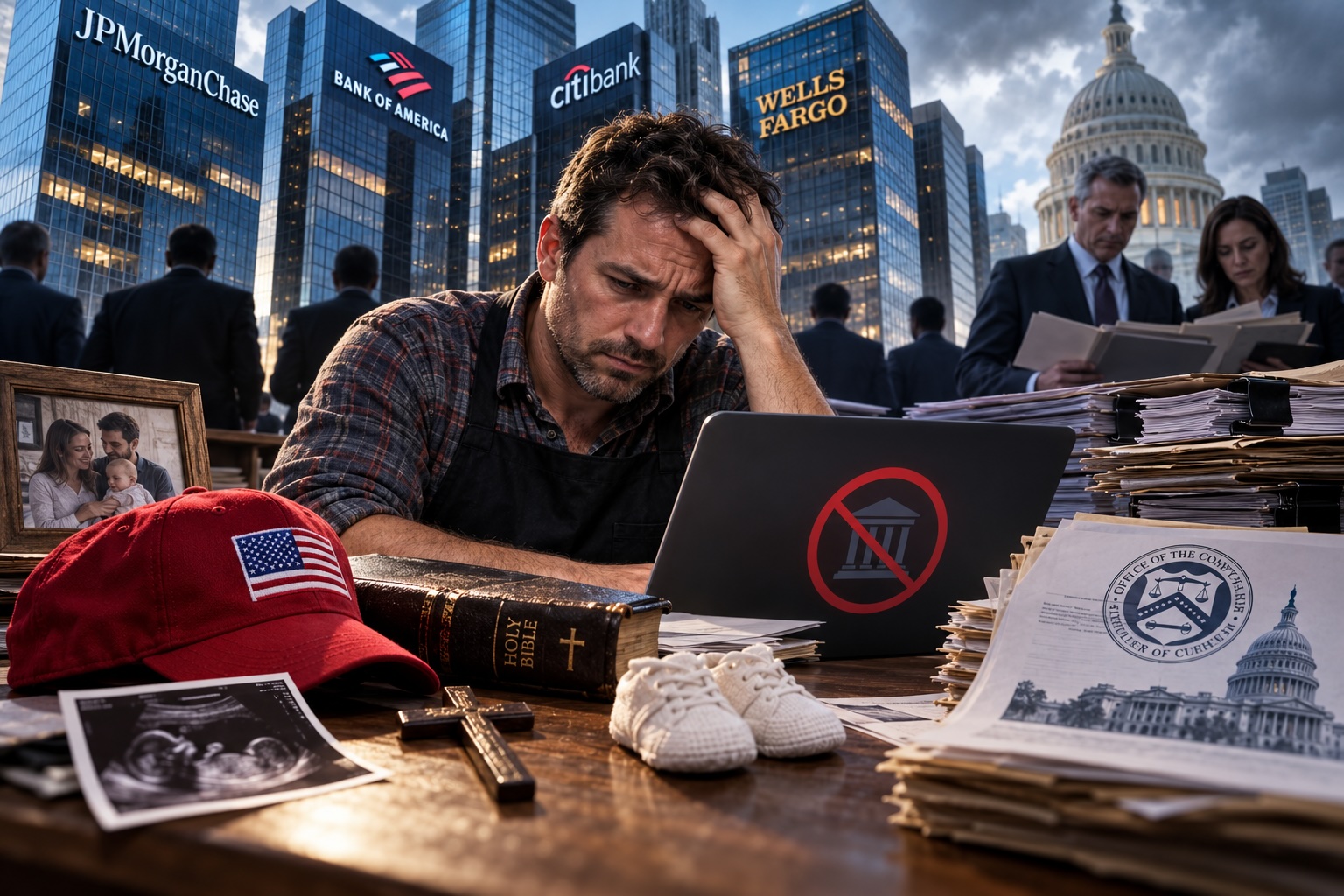
A federal banking regulator has concluded that America’s largest banks restricted and closed accounts for MAGA merchants, pro-life causes, and Christian organizations during the Biden years, hiding behind the vague excuse of “reputation risk.”
The OCC’s report, Guaranteeing Fair Banking for All Americans, found that all nine of the biggest national banks it supervises, JPMorgan Chase, Bank of America, Citibank, Wells Fargo, U.S. Bank, Capital One, PNC, TD Bank, and BMO, maintained policies between 2020 – September 2025 that disadvantaged customers on those grounds.
The review examined nearly 100,000 complaints from people who said they had been cut off, along with roughly 50,000 documents totaling about 420,000 pages of bank records.
Under the Biden administration the banks took a page from the Southern Poverty Law Center’s playbook. They adopted the SPLC’s own categorizations of groups and applied those same labels as grounds to deny service, as reported by the New York Post.
These commitments did not appear out of nowhere. Multiple documented sources of incentive and expectation lined up to steer the banks into the same set of decisions.
In early 2021, John Kerry, then the Biden administration’s climate envoy, privately pressed major U.S. banks to announce climate-finance commitments ahead of the administration’s Earth Day summit, using personal relationships with executives at institutions including Bank of America.
By May 2021 the White House issued an executive order on climate-related financial risk that directed Treasury and the Financial Stability Oversight Council to assess and address those risks. The OCC, FDIC, and Federal Reserve followed with principles for large banks on managing climate-related financial risks, covering governance, strategic planning, and scenario analysis. Large asset managers, led by BlackRock, publicly elevated ESG and climate expectations, while major banks joined the UN-convened Net-Zero Banking Alliance and set 2050 net-zero targets covering their lending and investment portfolios.
Once those broad stakeholder frameworks existed, external lists and advocacy opinions, including the SPLC’s public categorizations, could be, and in the documented cases were, treated as decision-relevant inputs. The same structure that absorbed the climate and equity priorities also became available for other contested social judgments.
Comptroller Jonathan V. Gould called the evidence irrefutable. The largest banks denied, debanked, and discriminated against customers and lawful businesses. Fair access, he said, is not a mantra; it is a mandate. The Trump Administration is ending the weaponization of finance.
The same institutions that rushed in 2020 to embrace the Black Lives Matter narrative issued public statements condemning America as systemically racist. JPMorgan Chase announced a $30 billion commitment and Bank of America pledged $1 billion for racial equity and racial equality in the wake of George Floyd’s death and the riots that followed.
Those same banks later applied restrictive standards to MAGA merchants, Christian nonprofits, and pro-life groups. People targeted included those whose positions on LGBTQ issues and traditional family values conflicted with the banks’ preferred stance on the left.
JPMorgan Chase’s WePay unit closed accounts for merchants selling MAGA and Trump merchandise after flagging terms like “MAGA” and “America First.” Religious nonprofits were shut down or denied credit after being tagged as “extremist hate groups” by the SPLC. Firearms, oil and gas, coal, and detention-facility clients faced categorical restrictions, with at least one bank noting greater supervisory pressure under the Biden administration to move away from the firearms industry.
The practices were widespread and subjective, often leaving customers with vague notices and no clear recourse. After President Trump’s August 2025 executive order directed regulators to end politicized debanking, the banks said they had revised their policies. The OCC concluded those changes have not gone far enough and that no bank has fully and publicly acknowledged what it did.
The Consumer Financial Protection Bureau has since opened its own investigation, with Acting Director Mark Paoletta calling the singling out of consumers whose views did not align with the Biden administration or its allies, and industries disfavored by the Left, “appalling.” He said the tactics were “thuggish” and “have no place in America.”
The discrimination was real and it was disgusting. Most Americans knew it was happening and had no way to stop it.
What remains unexplained is why the banks treated the Southern Poverty Law Center’s discriminatory designations as decision-relevant, and how they all did it around the same time. In April 2026 the organization itself was indicted on federal charges including conspiracy to commit money laundering, after prosecutors alleged it secretly funneled millions in donor funds to informants inside extremist groups.
The SPLC has also faced years of internal allegations of racism and sexism from its own staff. We are expected to believe that there was no concerted effort or group coordination behind any of this. The documented pattern says otherwise.

