

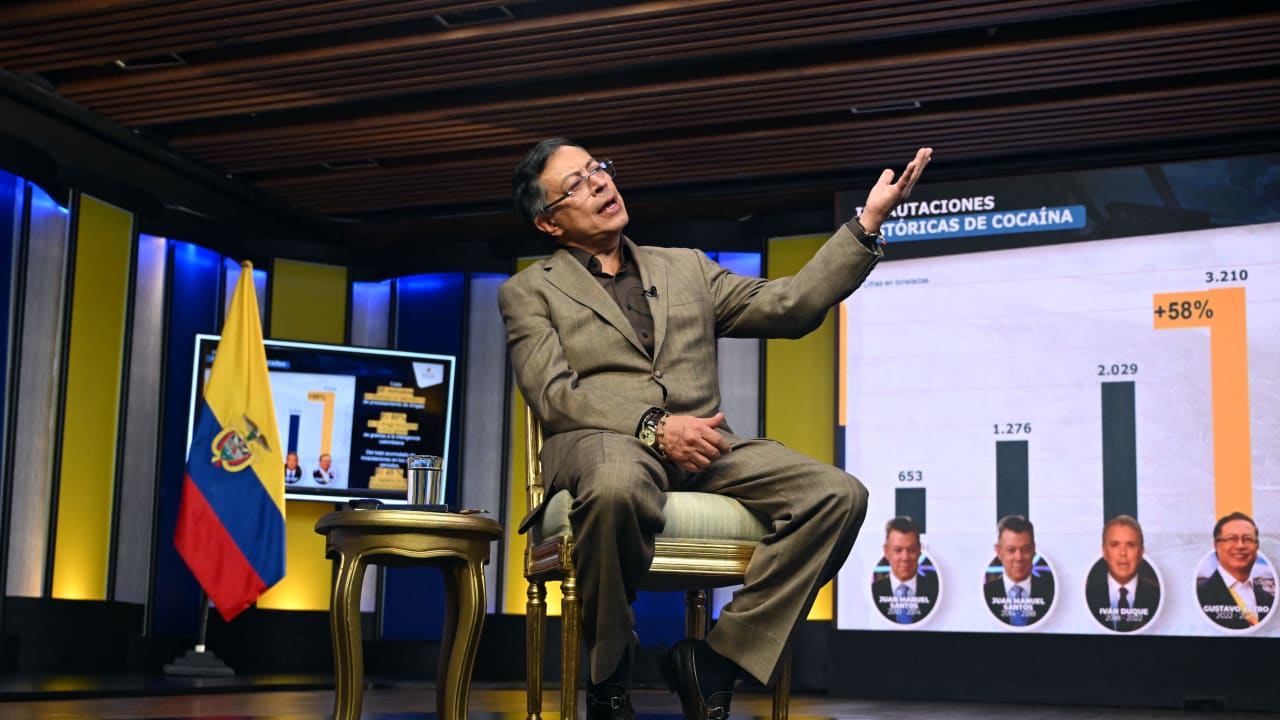
Colombian President Gustavo Petro, the country’s first left-wing president elected in 2022 on a campaign promising “Total Peace” that treated armed groups as legitimate political actors, has once again ignited major international controversy.
On June 7, 2026, Petro tweeted the Nazi slogan “Heil Hitler” in direct response to an opinion column published in the respected newspaper El Espectador.
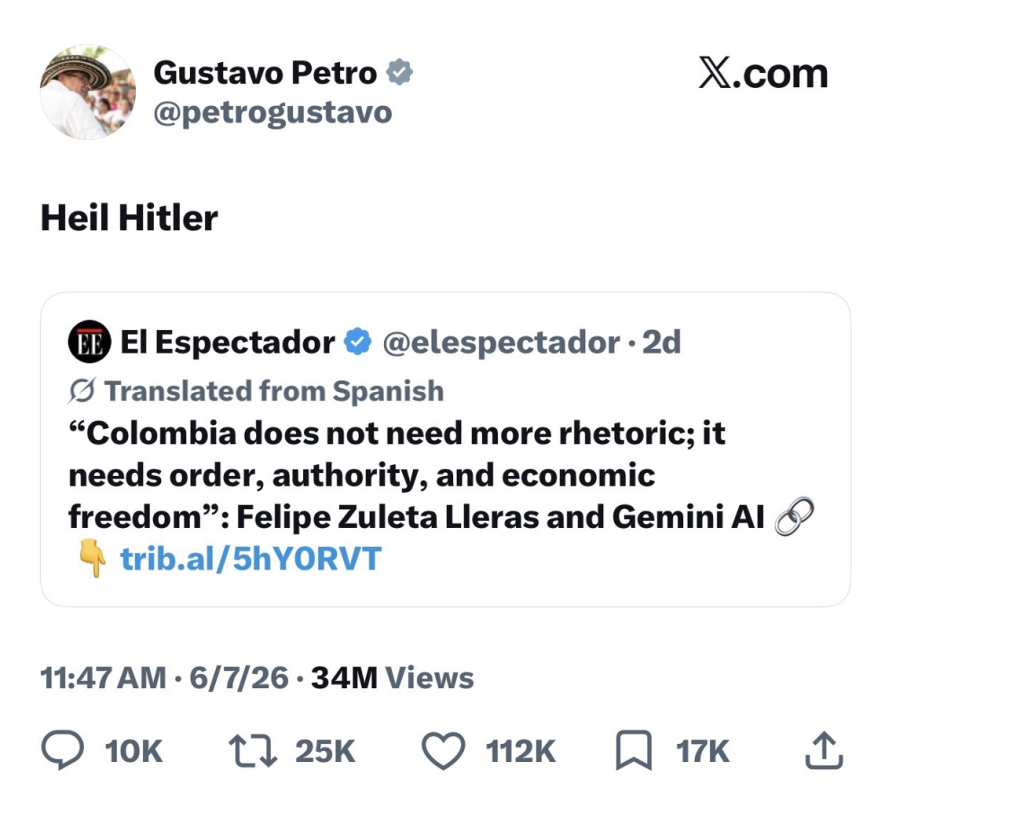
Co-authored with Google’s Gemini AI (which generated the main body of the text), the column by Felipe Zuleta Lleras made the straightforward case that Colombia desperately needs “order, authority, and economic freedom” instead of more empty political rhetoric and ideological experimentation.
Petro’s blunt two-word reply, which equated legitimate calls for stronger governance with Nazi totalitarianism, went viral almost instantly, amassing millions of views and triggering widespread condemnation from Latin American lawmakers, Jewish organizations, and international observers.
The backlash was swift and broad. The Anti-Defamation League and the World Jewish Congress condemned the post as unacceptable from a sitting head of state, describing it as part of a broader pattern of antisemitic rhetoric from President Petro.
24 lawmakers from 14 Latin American countries issued a joint statement denouncing the use of Nazi-associated language in democratic discourse. Israel’s Foreign Ministry called it an “indelible stain.”
Critics, including prominent U.S. figures, labeled the remarks monstrous and raised serious questions about Colombia’s left-leaning moral standing, especially as the country serves as president of the UN Security Council in June 2026 and holds a non-permanent seat for the 2026–2027 term.
Having only recently assumed its Council responsibilities earlier this year, Colombia’s leadership on the world stage is now under intense examination, with detractors arguing that such statements undermine its credibility on issues of human rights, peace building, and international norms.
Israeli Ambassador to the UN Danny Danon delivered a particularly sharp rebuke, calling on Petro to apologize before chairing the Security Council session and describing the use of Nazi slogans as “a disgraceful low from which there is no coming back.” No official UN condemnation has been issued so far.
President Petro has refused to apologize. Instead, he has accused opponents of fascism and alleging conspiracies involving Israeli Prime Minister Benjamin Netanyahu and other forces against his government.
The incident erupted amid heightened tensions in Colombia’s 2026 presidential election cycle.
Petro is constitutionally barred from seeking re-election, and his chosen successor, Senator Iván Cepeda, represents a continuation of his troubled progressive policies.
His soft-on-crime approach has coincided with rising violence, including higher homicide totals and a surge in massacres, as criminal groups have grown bolder during his term.
This controversy unfolded just days after the first round of voting on May 31, 2026, setting up a sharply polarized runoff on June 21. In that vote, the charismatic outsider lawyer Abelardo de la Espriella, known as El Tigre, surged to a commanding lead with approximately 43.7% of the vote, outperforming polls that had favored Cepeda (who received around 40.9%). Center-right candidate Paloma Valencia placed third and endorsed de la Espriella.
This strong showing reflects a clear desire among many Colombians for decisive right-wing leadership after four years under Petro’s administration. Public frustration has boiled over persistent insecurity, crime, economic struggles, and governance failures.
El Tigre is campaigning on bold, tough-on-crime policies inspired by leaders like El Salvador’s Nayib Bukele. He promises mega-prisons, military action against drug trafficking, and an uncompromising return to law and order.
These clear solutions are resonating powerfully with voters hungry for the stability they will get with a right-leaning president, not hate filled left leaning rhetoric.
The episode has turned the June 21 runoff into a high-stakes symbolic battle, Petro’s failing progressive legacy versus a resurgent right-wing wave sweeping Latin America.
De la Espriella, frequently compared to both Argentina’s Javier Milei and Bukele, stands as a forceful defender of traditional values, economic freedom, and uncompromising security.
His open admiration for key aspects of President Donald J. Trump’s approach underscores the growing demand for practical, results-driven leadership after years of left-wing experiments.
The Colombian people deserve real law and order, not the desperate projections of a failing leader who brands anyone calling for security as a fascist.
As the June 21 runoff approaches, this controversy has exposed deep polarization in Colombian society. Many voters have clearly had enough and are ready for a decisive rightward correction, prioritizing practical solutions to rampant violence, crime, and economic failure. Petro’s inflammatory post spotlights the strong preference for right-wing alternatives.
The outcome looks good, and Latin America, accelerating the regional shift toward policies that actually deliver security and prosperity not unstable left-wing ideology.

