

During his appearance at the globalist World Economic Forum conflab in Davos, Canadian Prime Minister Mark Carney tediously blustered through a self-aggrandizing, masturbatory speech inflaming President Donald Trump to peacock for the cabal of aggrieved globalists.
“For decades, countries like Canada prospered under what we called the rules-based international order… We knew the story of the international rules-based order was partially false,” Carney said.
“Canadians know that our old, comfortable assumptions — that our geography and alliance memberships automatically conferred prosperity and security — that assumption is no longer valid,” he continued.
“We know the old order is not coming back. We shouldn’t mourn it. Nostalgia is not a strategy. But we believe that from the fracture, we can build something better, stronger, more just. This is the task of the middle powers. The countries that have the most to lose from a world of fortresses and the most to gain from genuine co-operation,” Carney added.
Carney is certainly correct that the “old order” has been shattered. That was President Trump’s mandate, and he is fulfilling it at a breakneck pace much to the chagrin of the entrenched powers. Carney’s assumption that President Trump’s legacy is untenable is where he errs. The machinations of an ascendant leader can shape the fate of nations for generations to come, and opportunity has presented itself for President Trump to do so in our increasingly ungrateful neighbor to the north.
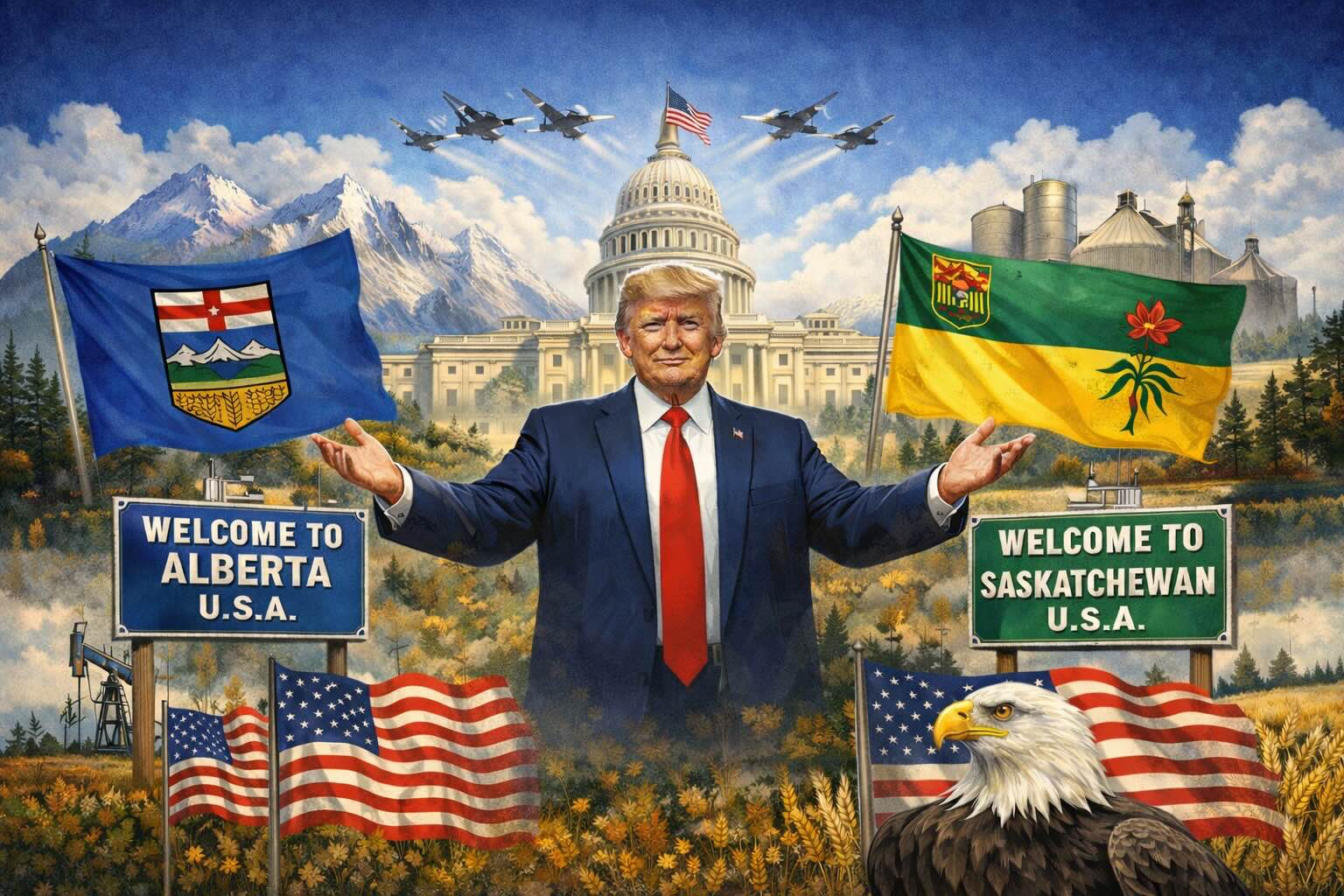
Two provinces in Canada are chronically underserved and exploited by the rest of the nation for their prosperity and wealth of natural resources. Alberta and Saskatchewan are two Canadian provinces that are sturdy, self-sufficient and overwhelmingly conservative. Both are currently pursuing nascent secession movements that are rapidly gaining in steam.
Recent reports have surfaced indicating that leaders of the Alberta Prosperity Project (APP), a pro-independence group, met with high-level officials within the Trump administration. They reportedly discussed an ongoing feasibility study regarding a $500-billion credit facility in the case of a successful referendum on independence in Alberta.
“We’re conducting a feasibility study on the availability of a sufficient credit facility to get Alberta over the hump in the hypothetical eventuality that Ottawa is going to play hardball and try to cut off our money once Alberta declares itself independent from Canada,” said Jeffrey Rath, who serves as legal counsel for the APP.
“Quite frankly, the Trump administration shows Albertans far more respect than are shown to Albertans by the government in Ottawa,” Rath added.
Saskatchewan is also exploring a secession movement, seeking freedom from the growing bureaucracy and nanny state being imposed upon them by national leaders. Led by the Saskatchewan United Party, a growing populist movement that placed third place in the previous national election, the movement for independence in Saskatchewan is overwhelmingly popular among the province’s dominant rural voting bloc.
Polling indicates that there is 79 percent support for independence among the rural areas of Saskatchewan. As the movement for independence gains traction, the ruling party is receiving an increasing amount of pressure to initiate an independence referendum, which, under established Canadian law and court precedent, is a tenable goal.
Per the Canadian Constitution, any province can become independent upon the passage of a plebiscite that is put on the ballot. The Supreme Court of Canada has ruled in favor of the legality of provinces being able to declare independence. Because of the Reference re Secession of Quebec (1998) as well as Canada’s Clarity Act of 2000, a province may hold a referendum with a clear question of independence and, if it achieves a clear majority, the federal government is legally obligated to enter into negotiations.
Once those benchmarks are met, separation becomes a political negotiation, not a legal battle. The courts cannot interfere in that process, which means the path forward is driven by democratic choice and political dialogue, not by endless litigation. As a result, Canadian political figures are growing increasingly unhinged at the momentum building behind independence movements in Alberta and Saskatchewan.
“If you are crossing a border to seek the support of a foreign government to break up our country because you don’t have the support and the resources and the ability within our own country to advance that conversation, and you’re asking the Americans or any other government, I mean that is the definition of treason… “If we can’t agree on that … then what actually are we standing for as Canadians?” said British Columbia Premier David Eby to the CBC.
It is not a surprise that the Canadian establishment would be worried about the departure of Alberta and Saskatchewan. Throughout 2007 to 2024, Alberta contributed over $285.1 billion more to the federal government than was transferred to the province from the Canadian capital of Ottawa. They contributed more than four times as much as British Colombians and Ontarians, for comparison. Additionally, Saskatchewan has vast reserves of natural resources, rare Earth elements and agricultural products that its corrupt leadership is currently selling out to China. These provinces are getting a raw deal, and the people are fed up.
Who better than President Trump to give the beleaguered Albertans and Saskatchewanians a better deal than their out-of-touch political elites could ever possibly offer? Carney spews a lot of high-minded bluster, but his own country is tearing apart at its seams. Those bought off with spoils are firmly behind the government – the welfare class and bureaucratic parasites – but the conservatives who foot the bill are growing discontented. They have an opportunity to come to greener pastures, and as President Trump remakes the maps of the Western Hemisphere, he should look North, not only to Greenland, but also to Alberta and Saskatchewan to make America stronger by offering those blue-star provinces the well-earned honor of American statehood.

