

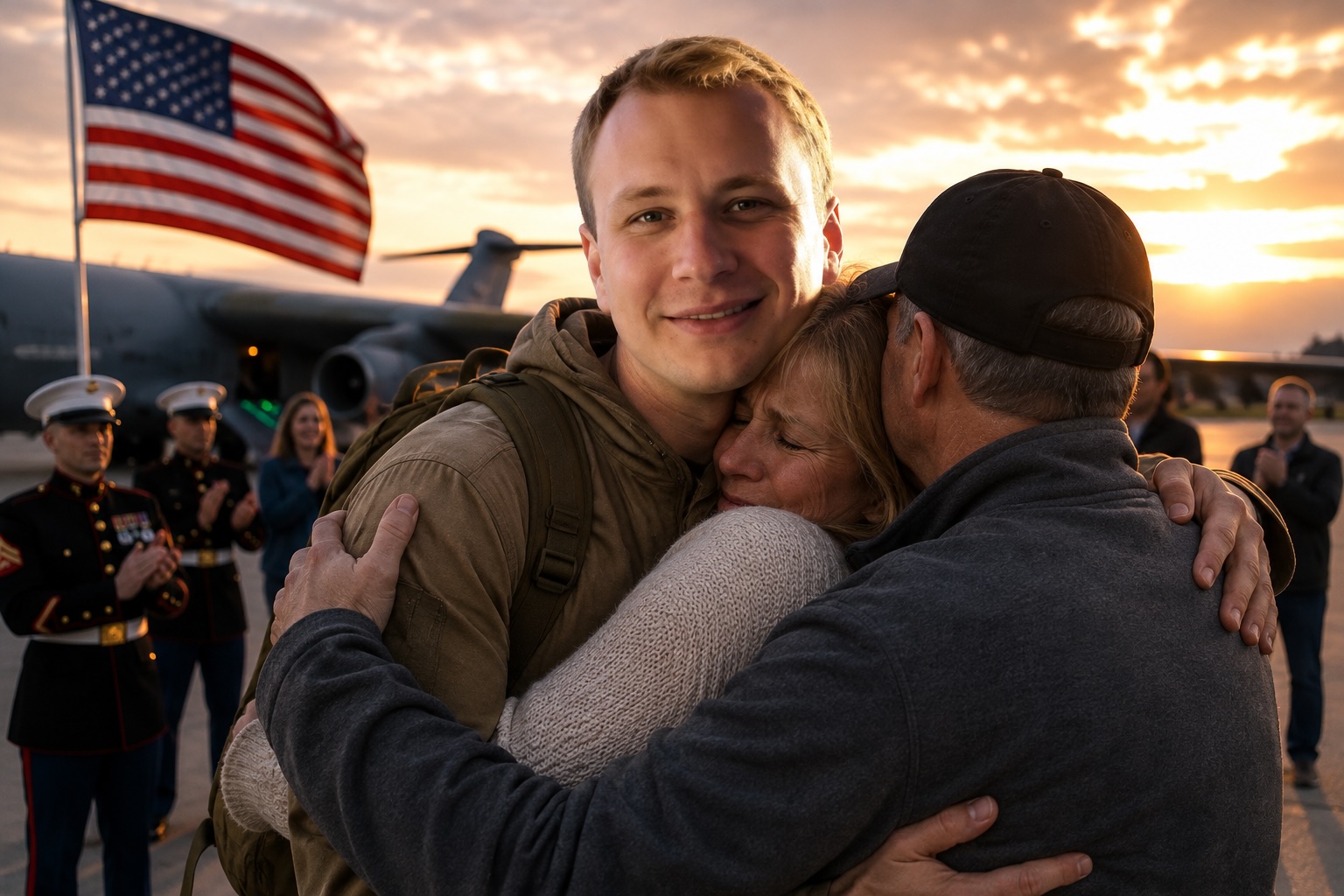
Robert Gilman, a 32-year-old United States Marine from Massachusetts, is finally home after spending 1,666 days in Russian custody. Arrested in January 2022, convicted on disputed charges, subjected to alleged physical and psychological abuse, and ultimately left gravely ill, Gilman was released after President Donald Trump personally raised his case with Russian President Vladimir Putin. No Russian prisoner was exchanged. No political concession was granted. Putin pardoned Gilman on humanitarian grounds, allowing him to return to the United States for urgent medical treatment.
Gilman served in the Marine Corps from August 2019 until August 2020. After leaving the service, he taught English in Poland and established a program to help Polish students improve their language skills. He later traveled to Moldova for another teaching opportunity and visited relatives near Moscow. His father, Vladimir Gilman, had emigrated from Russia to Massachusetts, giving Robert familial ties to the country. While traveling by train in January 2022, Gilman became ill and was removed from the train in Voronezh, approximately 340 miles south of Moscow. Russian authorities alleged that he was intoxicated, behaved disruptively, and kicked a police officer.
Gilman’s family disputes that account. His father maintains that Robert was sick, collapsed, and accidentally struck the officer with his foot. According to the family, the officer was not injured, declined to pursue the allegation, and presented no evidence at Gilman’s trial. Nonetheless, a Russian court convicted him and imposed a four-and-a-half-year prison sentence.
The timing was ominous. Gilman was arrested weeks before Russia invaded Ukraine and relations between Washington and Moscow deteriorated precipitously. An American military veteran in Russian custody had suddenly acquired political value.
The original sentence did not remain four and a half years. Russian prosecutors subsequently accused Gilman of assaulting a prison inspector, an investigator, and correctional officers. Successive convictions eventually increased his total sentence to ten years. His family and advocates contend that the additional cases were created through deliberate provocation and abuse. They allege that Gilman was forced to exercise for as long as 16 hours, deprived of adequate sleep and food, placed in solitary confinement, compelled to take psychotropic medication, and subjected to sustained psychological manipulation. He was reportedly told that his family had been beaten and that the United States had abandoned him.
These were not merely efforts to punish a prisoner. They were calculated attempts to disorient him, provoke reactions, and manufacture the conduct needed to prolong his confinement. By late June 2026, Gilman’s physical and psychological condition had collapsed. Advocates reported that he had entered a dissociative stupor, a severe stress-induced state in which a person becomes largely unresponsive to the surrounding world. He was transferred from a prison hospital to the psychiatric ward of a civilian emergency hospital in Voronezh.
For approximately seven weeks, Gilman reportedly could not eat, drink, speak, or respond normally. He was fed through a tube and, according to his advocates, handcuffed to a hospital bed under armed guard despite his near-catatonic condition. He developed pneumonia, a high fever, and dangerously elevated blood pressure. His mother traveled to Russia carrying judicial authorization to see him, but hospital officials denied her access. His attorneys also encountered restrictions. Those representing the family warned publicly that Gilman was near death.
The United States had only recently classified him as wrongfully detained. Whatever bureaucratic distinctions throughout the Biden Administration that delayed that designation, the essential facts were unmistakable. An American veteran had entered Russian custody over a disputed encounter involving an uninjured police officer. His original sentence had been expanded to a decade through charges his family considered contrived. He had then deteriorated until he was lying unresponsive and being fed through a tube. President Trump acted before Gilman became another American returned home in a coffin.
Trump discussed the case with Putin, while Special Envoy Steve Witkoff, Sebastian Gorka, Adam Boehler, Jared Kushner, and other administration officials worked through the diplomatic negotiations. Russian presidential adviser Yuri Ushakov informed the American side that Putin had agreed to pardon Gilman because of his medical condition. The result was an exceptionally rare unilateral release. Russia requested no prisoner in return, and American officials confirmed that the United States made no concessions.
President Trump announced the news personally. “Russia has released American Robert Gilman, on a humanitarian basis”, Trump wrote, explaining that he had discussed the case with Putin. “Russia asked for no one in return. No exchange took place.”
Trump then spoke directly with Gilman aboard the aircraft carrying him home. After four years of prison food, forced medication, isolation, illness, and psychological torment, Gilman made one thoroughly American request: “A GREAT cheeseburger…I will take care of that!” Trump promised.
A State Department aircraft brought Gilman to Dulles International Airport on August 11, 2026 Witkoff and Gorka met him with cheeseburgers and milkshakes. A member of the White House team presented him with a Marine Corps flag. Four physicians reportedly evaluated him during the flight, and he was subsequently transported to San Antonio, Texas, for extensive medical and psychological treatment.
Photographs showed a painfully gaunt man holding an American flag, surrounded by those who had helped secure his freedom. Despite the severity of the reports from Russia, an American official who spoke with Gilman said that he was walking and talking. His recovery, however, may be long. The consequences of prolonged isolation, malnutrition, forced medication, sleep deprivation, physical coercion, and sustained psychological abuse cannot be erased by crossing an international border.
Secretary of State Marco Rubio noted that Gilman joined more than 100 Americans whose freedom President Trump’s administration has helped secure during his second term. Rubio properly welcomed the release as a positive development while demanding freedom for other Americans unjustly imprisoned in Russia, including retired teacher Stephen Hubbard.
Gilman’s release does not absolve the Russian system that confined him or resolve the cases of the other Americans still held there. Nor should the humanitarian pardon obscure the extraordinary escalation of his case. A disputed incident involving an officer who was reportedly unharmed produced a decade-long sentence and a medical catastrophe.
Yet the manner of his release matters. The United States did not surrender a convicted Russian assassin, intelligence operative, arms dealer, or cybercriminal. It did not reward hostage diplomacy by replenishing Putin’s ranks. Direct engagement secured Gilman’s freedom without a prisoner exchange or American concession. This is what presidential diplomacy can accomplish when it is backed by strength, personal relationships, persistence, and a refusal to accept an American’s death as inevitable. Trump did not confuse negotiation with capitulation. He used his relationship with Putin to obtain a humanitarian pardon while giving Russia nothing in return.
Robert Gilman went to Eastern Europe to teach. He entered Russia to visit family and became trapped in a penal system that transformed an obscure railway incident into four and a half years of captivity. He returned emaciated, medically fragile, and bearing injuries that may not be visible for years. But he returned alive.
The Marine Corps teaches its people never to leave one of their own behind. President Trump applied that principle to the country itself. Robert Gilman is home because his government finally placed his life above bureaucratic inertia and acted before the opportunity disappeared.
His first request was not political, profound, or ceremonial. It was a cheeseburger. After 1,666 days in Russian custody, that modest meal represented something much larger: freedom, home, and the restoration of an ordinary American life that had been stolen from him.

