

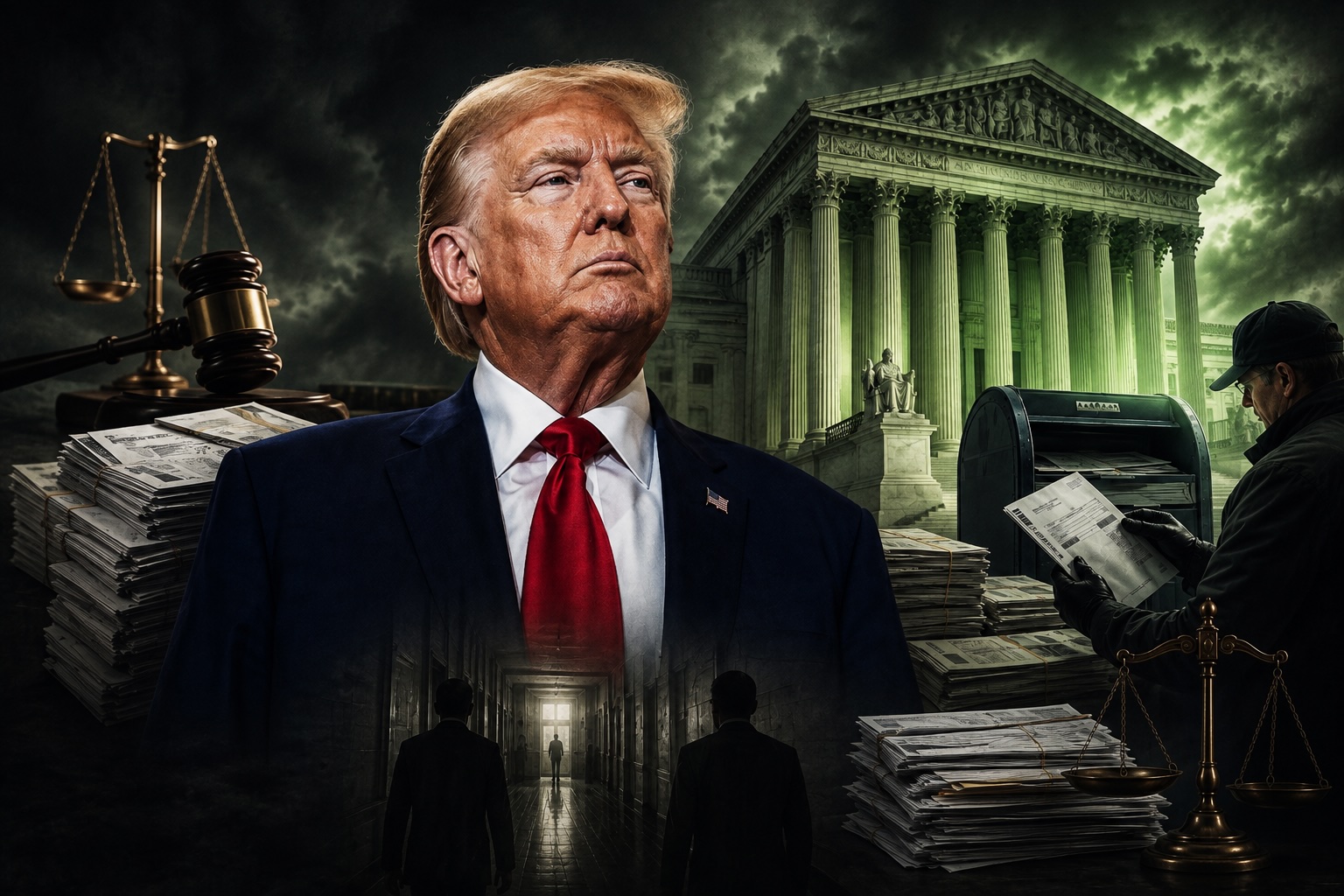
On August 24, 2026, the Supreme Court issued an unsigned emergency order allowing the Trump administration to advance key parts of an executive order restricting mail-in voting.
The ruling stayed in a lower-court injunction blocking implementation in 23 mostly Democratic-led states and the District of Columbia, clearing a path ahead of the November midterms.
This is a procedural win for the administration that lets preparatory work proceed while preserving future judicial review once concrete actions are taken.
The stay applied only to the injunction in the states’ lawsuit; a separate nationwide injunction against certain USPS rulemaking, issued by the same judge in a different case, remains in force and was not lifted.
President Donald J. Trump signed Executive Order 14399, “Ensuring Citizenship Verification and Integrity in Federal Elections,” on March 31, 2026.
The executive order directed the Department of Homeland Security to compile state-specific lists of adult U.S. citizens drawn from federal databases. It also ordered the Justice Department to prioritize the prosecution of officials who issue ballots to ineligible voters, and directed the Postal Service to play a role in verifying mail-ballot eligibility by requiring states to submit voter lists and follow new mailing rules. Non-compliant states may face the loss of federal funding.
At the signing, President Trump called the measure “foolproof,” saying it was “about voter integrity; we want to have honest voting in our country.”
Administration lawyers have described the state-specific citizenship lists as imperfect and intended only as supportive data, not binding mandates. Critics and the lower court, however, viewed the overall scheme, especially the U.S. Postal Service’s gatekeeping role, as an improper federalization of elections.
Federal district judge Indira Talwani of Boston, an Obama appointee, earlier blocked the order, finding it overreached federal authority and infringed on states’ traditional election role. The states argued it threatened chaos and improperly federalized elections so close to the midterms.
Public-opinion data cited by the administration shows consistent majority support across party lines for proof-of-citizenship requirements and measures that reduce the risk of noncitizen voting.
The administration said the suit was premature, pointing out that concrete actions had not yet harmed the states and that the order mainly directed federal agencies internally.
In its per curiam opinion the Court’s 6-3 majority agreed the challenge was brought too early. The order itself required or forbade nothing of the states, any injury remained speculative, and the government faced irreparable harm if blocked from preparing for the 2026 elections.
The Court stressed it was not deciding the ultimate legality of any implementing steps, stating the ruling “does not mean that any measure taken by the government to implement the order will necessarily be lawful. On that score, time will tell.”
The three liberal justices dissented. Justices Sotomayor and Kagan, joined in part by Jackson, argued the states had standing based on the “credible threat” of investigations and prosecutions. Jackson warned the ruling “injects additional unknowns into the already fraught pre-election period.”
Approximately 30% of 2024 presidential ballots were cast by mail.
Most Americans support stronger measures and accountability to ensure only eligible citizens vote, and many view requirements like those in the order as a necessary step to strengthen confidence in election integrity. They argue federal databases can help identify potential ineligible voters while states keep primary authority and federal agencies supply supporting data and enforcement priority.
The order rests on the long-standing principle that only U.S. citizens may vote in federal elections, a restriction already in statute and the Constitution. Americans contend the citizenship lists simply put existing law into practice rather than create new restrictions.
Administration lawyers have, understanbly, called this judicial restraint.
Several states have already tightened their own mail-ballot and voter-roll rules; the federal order is seen as reinforcing those efforts. Practical safeguards remain: the lists must draw from Privacy Act-protected federal records, and USPS rulemaking stays subject to a separate nationwide injunction.
Implementation still faces hurdles.
The Postal Service published its final rule around August 21, 2026 (with an immediate effective date once injunctions are cleared, noted in some accounts as around August 26), requiring states to supply lists of mail-ballot recipients at least 60 days before the election; non-compliant states would not have ballots mailed.
Even as legal challenges proceeded, the Department of Homeland Security has continued developing the technical infrastructure for the citizenship lists, and the administration has pressed Congress to enact the SAVE America Act to lock similar requirements into federal law.
Practical feasibility questions persist, including the completeness and accuracy of federal citizenship lists which are limited by Privacy Act constraints and data gaps, state capacity to comply on short notice, and the risk that eligible voters could be affected.
With early voting nearing and Election Day less than three months away, practical timelines may limit the order’s full effect on the 2026 midterms. In a related June 2026 ruling the Court held that states may count mail ballots arriving after Election Day if postmarked on time.
Legal hurdles remain. With the midterms approaching and a separate nationwide injunction still in place against key Postal Service rules, further litigation is expected in the weeks and months ahead.
Trump has repeatedly vowed to end widespread mail-in voting before the midterms and has consistently done everything within his power to ensure free and fair elections.

