

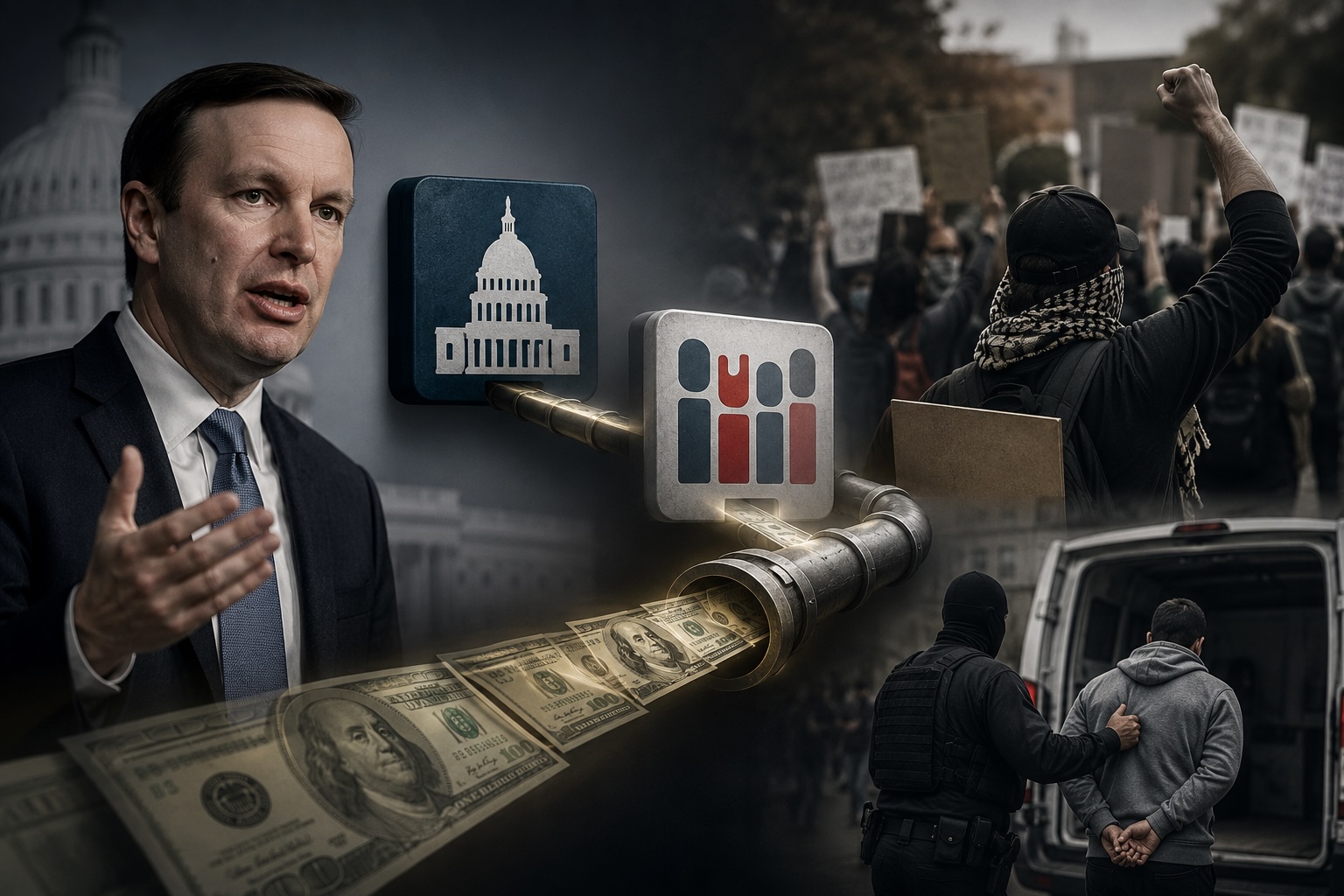
We’ve all seen the recent footage of protests, some of which amounts to subsidized interference, that have led to arrests, blockades, clashes with law enforcement, and isolated incidents of violence.
Where do we draw the line?
Sen. Chris Murphy (D-Conn.) was once viewed as a pragmatic legislator capable of crossing the aisle. He played key roles in bipartisan efforts, but that reputation has evolved sharply since President Donald Trump’s return to the White House.
Murphy has turned his leadership PAC, from a conventional vehicle for his campaign, into the American Mobilization Project, a vehicle for aggressive opposition.
Federal Election Commission records confirm that in December 2025, Murphy’s PAC directed $100,000 directly to the Indivisible Project. This $100,000 payment was part of nearly $1 million in total that the PAC had distributed to various progressive groups. The money was split between Indivisible’s political and non-contribution accounts.
It was specifically allocated to build “durable mass mobilization capacity” through staff training, volunteer recruitment, materials, permits, and logistics. Murphy has called this “on-the-ground organizing,” directing these funds into mobilization to rail against Republican policies on immigration, health care, and more.
The senator and his team describe these partnerships as efforts to strengthen democratic defense and community organizing. Many argue this creates loopholes for indirect electioneering or operational support that effectively aids partisan disruption.
Indivisible is a national progressive grassroots network launched in late 2016 to early 2017 shortly after Trump’s first election by former congressional staffers Ezra Levin and Leah Greenberg. Modeled after Tea Party tactics but from a left-leaning perspective, it began as a practical guide for local advocacy against the Trump agenda and has since grown into a nationwide movement with chapters in all 50 states.
Indivisible describes itself as resisting “authoritarian threats” and has led or partnered in major campaigns such as the “No Kings” protests and “ICE Out for Good,” which target immigration enforcement, detention centers, and related funding bills. Indivisible has organized and/or supported actions in states like Minnesota, New Jersey, and California.
These actions often involve strategic coordinated planning and direct confrontations with federal agents. The group provides activists with scripts, toolkits, call scripts for lawmakers, phone banks, and protest planning resources. This reinforces the view that many protests follow centralized templates rather than arising purely spontaneously.
Murphy has framed the current moment as an existential threat to democracy. He has said: “We may not have another election, at least a free and fair election, if we don’t stop this slide away from free speech and democracy quickly. And what we know from history is that the only way to stop a would-be tyrant from cratering, from destroying a democracy is mass mobilization.”
Many in government see a different picture. Republican lawmakers, including Sen. Josh Hawley of Missouri, have called for DOJ scrutiny of protest funding networks. They cite potential coordination, foreign influence concerns via networks like those linked to Roy Singham, and interference with federal law enforcement.
The People’s Forum has faced subpoenas and congressional demands for not registering as a foreign agent under FARA. Reports note ties to broader left-wing alliances, including Democratic Socialists of America. Transparency advocates argue such PAC-to-nonprofit flows blur lines between advocacy and disruption.
These protests are not organic; they often evolve with scripts. For example, Indivisible has designed toolkits and call scripts for paid or trained activists to contact lawmakers, coordinate rallies, and sustain pressure.
Legal experts note that these contributions comply with U.S. campaign finance rules. PACs can legally fund aligned 501(c)(4) nonprofits like Indivisible for issue advocacy, mobilization, and protests, as long as the money is not used for direct candidate contributions or illegal coordination.
These transactions will continue to fuel debates over whether elected officials should be legally allowed to finance people to act in crowds for protests.
Many of these protests are not truly spontaneous. They often rely on paid actors and organized performers to push an agenda of challenging federal operations amid intense immigration enforcement and mass deportation priorities. Some escalate to excessive force against law enforcement, clear evidence that they have become illegal and can no longer be considered peaceful protests.
Clearly there are deepening partisan rifts on immigration. Yet the organized assembly of crowds to project progressive voices reveals a manufactured approach that undermines what would otherwise appear as peaceful protests.
These orchestrated performances and funding will continue to undermine the narrative by revealing a negative view of actions that progressives consider essential resistance to perceived overreach and humanitarian failures.
As probes into protest networks continue, calls for stricter disclosure of dark money and mobilization funding grow louder.
Murphy’s shift toward activism reflects broader realignments in Washington, where former deal-makers now prioritize confrontation over compromise.
The Senator himself has acknowledged the change, stating: “This may look a little schizophrenic, having gone from spending two years writing big bipartisan deals on guns or on immigration to now being out front in trying to fight for the survival of the democracy…”
This funding and coordination, while legal at the moment, does not strengthen accountability. Instead, it reveals how elements of the opposition have transformed elected officials into funders of sustained disruption, turning legislative offices into pipelines for coordinated challenges to federal authority.
In America’s deeply divided landscape, the last thing the country needs is more engineered agitation funded by elected officials. This obfuscates critical lines between representation and mobilization, raising very serious questions about the legitimacy of these protests.
The rule of law and core constitutional safeguards are being tested. As immigration enforcement intensifies and scrutiny of these funding networks deepens, the debate over where protest ends and subsidized interference begins will only grow more urgent.

