

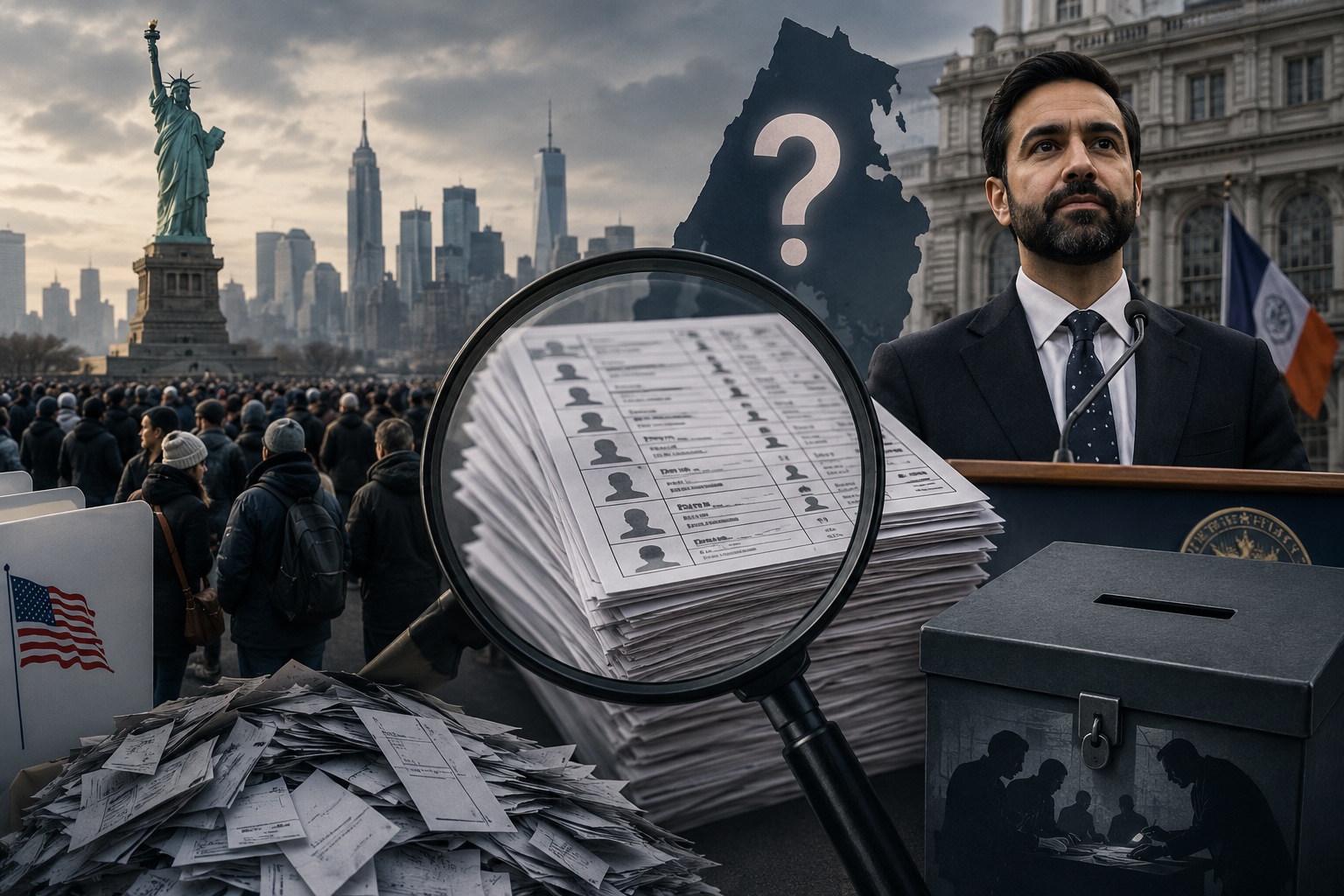
A private examination of records associated with the 2025 New York City mayoral election has raised serious questions about the accuracy of the city’s voter rolls, but it has not established that 228,000 fraudulent ballots were cast or that Zohran Mamdani was improperly installed as mayor. That distinction is important. Election officials should not be permitted to hide behind procedural jargon when confronted with substantial anomalies, but election critics should also avoid presenting disputed data as a final verdict before the underlying records have been independently examined.
Mamdani defeated former New York Governor Andrew Cuomo in the November 2025 general election. The certified results credited Mamdani with approximately 1,114,184 votes and Cuomo with 906,614, producing a margin of roughly 207,570 votes. Republican Curtis Sliwa finished a distant third. Mamdani subsequently took office in January 2026, becoming New York City’s first Muslim mayor and placing a self described democratic socialist at the helm of America’s largest city.
The controversy began with a private review conducted by election integrity activist Marly Hornik and organizations associated with NY Citizens Audit and RealAmerica.Vote. According to Hornik’s public presentation investigators examined roughly one million records from a universe of approximately 2.2 million voter records connected to the election. The inquiry concentrated heavily on recent registrants and attempted to compare names, birth dates, addresses, and Social Security information with commercial and publicly available databases.
Hornik’s team reported that approximately 68,441 records, or about seven percent of those examined, could not be verified through the databases used in the review. Another 59,104 records, representing roughly six percent, allegedly contained Social Security numbers within ranges the researchers considered invalid. Approximately 91,504 records were associated with individuals the reviewers believed did not reside within New York City, while another 9,340 reportedly contained no Social Security number. Combined, these categories produced 228,389 flagged records, a figure exceeding Mamdani’s certified margin by more than 20,000 votes.
That numerical comparison is politically explosive, but it is not dispositive. A flagged voter record is not automatically an illegal ballot, just as a discrepancy in a bank ledger does not by itself prove embezzlement. Commercial databases can contain obsolete addresses, incomplete identity information, typographical errors, name variations, and records that have not followed citizens through marriages, divorces, relocations, or other ordinary changes. Some voters may also lack conventional Social Security information for legitimate reasons. Each questionable record must therefore be investigated individually before it can be classified as unlawful.
There is also a fundamental difference between voter registration records and ballots. A defective or outdated registration entry does not necessarily establish that the person voted, that an unlawful ballot was accepted, or that the ballot was cast for Mamdani. To overturn an election, investigators would need far more than a statistical aggregation of mismatches. They would need to connect specific ineligible voters to specific ballots, establish that the votes were illegally cast and counted, and demonstrate that the number was sufficient to alter the result.
Hornik herself has stopped short of declaring that Cuomo actually won the election. Her more circumspect argument is that the available data prevents election administrators from affirmatively demonstrating the integrity of the voter rolls. That is a serious allegation, but it is narrower than the viral assertion that 228,000 fraudulent votes were discovered. The online narrative has moved faster than the evidence, turning a collection of warning lights into a declaration that the entire engine has failed.
Rudy Giuliani has embraced the broader accusation, stating that he believes Democrats cheated and describing the Democratic Party as “the most crooked enterprise in the history of the United States.” Giuliani’s skepticism is understandable. As mayor he confronted the entrenched political machinery that had governed New York for generations and he knows that the city’s bureaucracy can be opaque, obstinate, and fiercely protective of itself. His condemnation, however, remains a political judgment rather than a judicial or administrative finding.
At present, neither the New York City Board of Elections nor the New York State Board of Elections has validated Hornik’s categories as 228,389 illegal votes. No court has ruled that Mamdani’s margin was produced by fraud. No official canvass has determined that the questioned records corresponded to unlawful ballots, much less ballots cast for one particular candidate. The certified election result therefore remains legally intact.
That does not mean the findings should be discarded. The fact that a private organization could identify more than 228,000 records it considers questionable should prompt a transparent official response. Election administrators should explain the discrepancies, disclose their voter roll maintenance procedures, and permit qualified independent experts to test the competing claims. Confidence cannot be restored by demanding blind trust. It must be earned through records, procedures, and verifiable evidence.
New York’s election system is particularly vulnerable to suspicion because the state does not generally require photographic identification from voters at polling places. It also permits extensive early and absentee voting, while voter registration databases are maintained through multiple layers of state and local bureaucracy. None of these practices proves fraud, but together they create an environment in which incomplete records and administrative mistakes can accumulate like sediment in a neglected reservoir.
The appropriate remedy is not to proclaim Mamdani illegitimate before the evidence has been tested. Nor is it acceptable for election officials and their allies to dismiss every discrepancy as harmless. New York should conduct a genuine forensic review using official voter files, address histories, citizenship information where legally available, death records, duplicate registration checks, ballot participation histories, and documented chains of custody. The methodology and conclusions should be released publicly so that both critics and defenders can examine them.
The city should also adopt stronger voter identification requirements, improve residency verification, accelerate the removal of deceased and relocated voters, and establish recurring independent audits. These are not partisan demands. An honest voter should not fear accurate rolls any more than an honest accountant fears an audit. Secure procedures protect legitimate voters by ensuring that their ballots are not diluted by error, negligence, or fraud.
Mamdani’s ideology and governing agenda make the dispute even more combustible. His promises of government operated grocery stores, rent intervention, free public transportation, expanded social programs, and increased taxation have already made him a national symbol of the Democratic Party’s socialist wing. His political views deserve rigorous opposition, but ideological hostility cannot substitute for evidentiary proof that his election was stolen.
The 228,389 records identified by Hornik represent a legitimate basis for investigation, not a completed prosecution. The figures are large enough to demand answers because they exceed the certified margin, but their significance depends entirely upon whether the underlying classifications are accurate and whether the records can be connected to unlawful votes. Until that work is completed, the responsible conclusion is neither complacency nor certitude.
New Yorkers deserve to know whether their voter rolls are accurate, whether every counted ballot was lawful, and whether election administrators can document the integrity they routinely claim. The audit has not proved that Zohran Mamdani lost the 2025 election. It has proved that New York’s election bureaucracy faces questions too consequential to answer with silence.

