

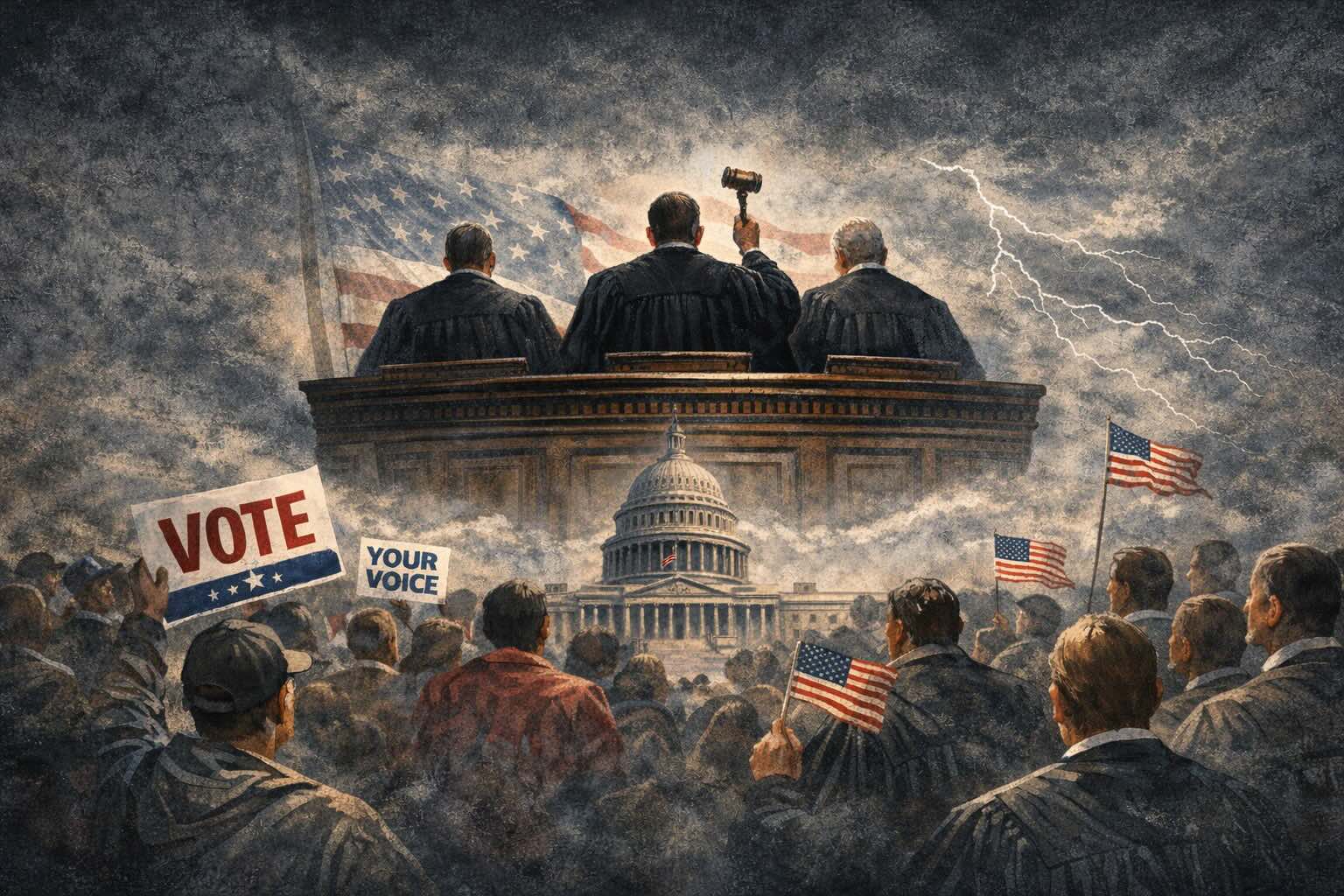
The American voter marches to the polls, casts a ballot, waits through the clamor of campaigns and the cacophony of media prognostication, and delivers a verdict. Then, in an instant, a solitary figure in a distant courtroom raises a gavel and attempts to erase the people’s command. No cavalry charges. No tanks roll through the streets. No banners are lowered. Yet power changes hands all the same. This is the modern coup by injunction, and it is corroding the very foundations of the Republic.
The Founders created three equal branches of government – Executive, Legislative, and Judicial – with each designed to check the excesses of the others. They did not create a judicial aristocracy empowered to nullify the expressed will of millions of voters whenever a single federal judge finds the prevailing political winds disagreeable. Yet that is precisely the egregious distortion now metastasizing across the nation. A handful of unelected jurists, often selected through naked forum shopping by ideological litigants, now presume the authority to suspend national policy with the flourish of a pen.
This phenomenon is commonly sanitized under the antiseptic phrase “nationwide injunction” but in truth it’s something far more pernicious. It is a black robe veto; the substitution of personal jurisprudential predilection for democratic consent and the will of the people. It is the elevation of one judge’s worldview above the mandate conferred by an electorate numbering in the tens of millions.
There was a time when judges decided the controversies before them. They interpreted statutes, adjudicated disputes, and applied the Constitution to concrete facts. They were not intended to function as a permanent supervisory board over the executive branch. They were not commissioned to operate as a roving council of philosopher kings empowered to supervise every presidential decision, every regulatory initiative, every enforcement priority, and every administrative act.
Yet modern America has drifted into precisely that absurdity. One federal judge in one courthouse can freeze immigration enforcement nationwide. Another can halt energy policy across fifty states. Another can suspend military regulations affecting thousands of service members. Another can impede election procedures in jurisdictions far beyond the parties before the court. This is not constitutional equilibrium. It is jurisprudential imperialism.
The defenders of this arrangement drape themselves in the language of law, but their true objective is transparent: when they loan election they disregard the results of the ballot box and seek sanctuary in the courthouse. When voters reject their program, they solicit judges to impose it indirectly. When elections deliver outcomes they disdain, they resort to litigation as a substitute for persuasion. The courtroom becomes the annex of defeated politics.
To be clear, the judiciary has an indispensable and honorable role. Courts must restrain unlawful action. They must protect rights. They must enforce constitutional boundaries. But there is an immense chasm between legitimate judicial review and the routine arrogation of national policymaking authority. That chasm has been crossed repeatedly.
Equally corrosive is the cynical practice of forum shopping. Activists and administrations alike scour the map for jurisdictions likely to produce ideologically congenial rulings. Cases of immense national consequence are steered not by neutral principle but by strategic geography. Litigants do not seek justice so much as they seek a favorable draw. The result is a legal carnival in which the venue often matters more than the merits. Public confidence withers under such conditions.
The consequences are severe. Elections become attenuated spectacles rather than decisive instruments of self government. Citizens cast ballots for programs that may never be implemented because an unelected judge in a distant district chooses to interpose personal doctrine between the people and their chosen representatives. Campaign promises become provisional suggestions, contingent upon the indulgence of the judiciary.
No republic can endure long under such a dispensation. Sovereignty cannot reside simultaneously in the electorate and in a scattered cadre of life tenured magistrates issuing contradictory decrees. One must prevail; either the people govern through their elected institutions or judges govern through perpetual injunction. The current drift favors the latter.
This distortion also invites escalating retaliation. Each party, once aggrieved, adopts the tactics it once denounced. The precedent established today becomes the weapon wielded tomorrow. What one faction celebrates as judicial heroism in the present it will condemn as tyranny in the future. Thus the cycle of institutional degradation accelerates. Respect for the courts declines, not because judges are too restrained, but because too many have become conspicuous political actors while pretending otherwise.
The Supreme Court of the United States (SCOTUS) must eventually confront this metastasis with clarity and vigor. Nationwide injunctions should be sharply cabined. Relief should ordinarily extend no further than the parties before the court. Sweeping national decrees should be rare, extraordinary, and justified only by the most exacting constitutional necessity. Anything less invites continued chaos.
Congress possesses remedies if it can rediscover courage. Jurisdictional reforms, venue reforms, and procedural limitations lie well within legislative competence. But courage is scarce in a city where too many legislators prefer judges to make contentious decisions for them. Judicial overreach often flourishes because elected officials welcome the abdication.
The larger issue, however, is cultural and civic. Americans must decide whether they still believe in self government. If they do, then they must reject the notion that every contested election result should be relitigated before sympathetic judges. They must reject the conceit that robes confer omniscience. They must reject the fiction that democracy is preserved when democratic outcomes are endlessly suspended by procedural fiat.
The ballot box is not meant to be subordinate to the courthouse docket. The consent of the governed is not a decorative phrase to be discarded whenever elites are displeased. The Constitution does not establish a judicial guardianship over an infantile citizenry incapable of choosing its own course. It establishes a republic of accountable institutions deriving legitimacy from the people themselves.
America neither needs, wants, or deserves a black robe regency. America does not need judicial mandarins hovering above every election, ready to annul what voters have ordained. America needs judges of restraint, judges of humility, judges who understand that the robe is not a crown.
When one judge governs the nation, self government becomes theater. When injunction replaces election, liberty becomes pretense. When courts become political citadels, the republic itself is imperiled. The time has come to restore constitutional proportion before the black robe veto becomes permanent.

