

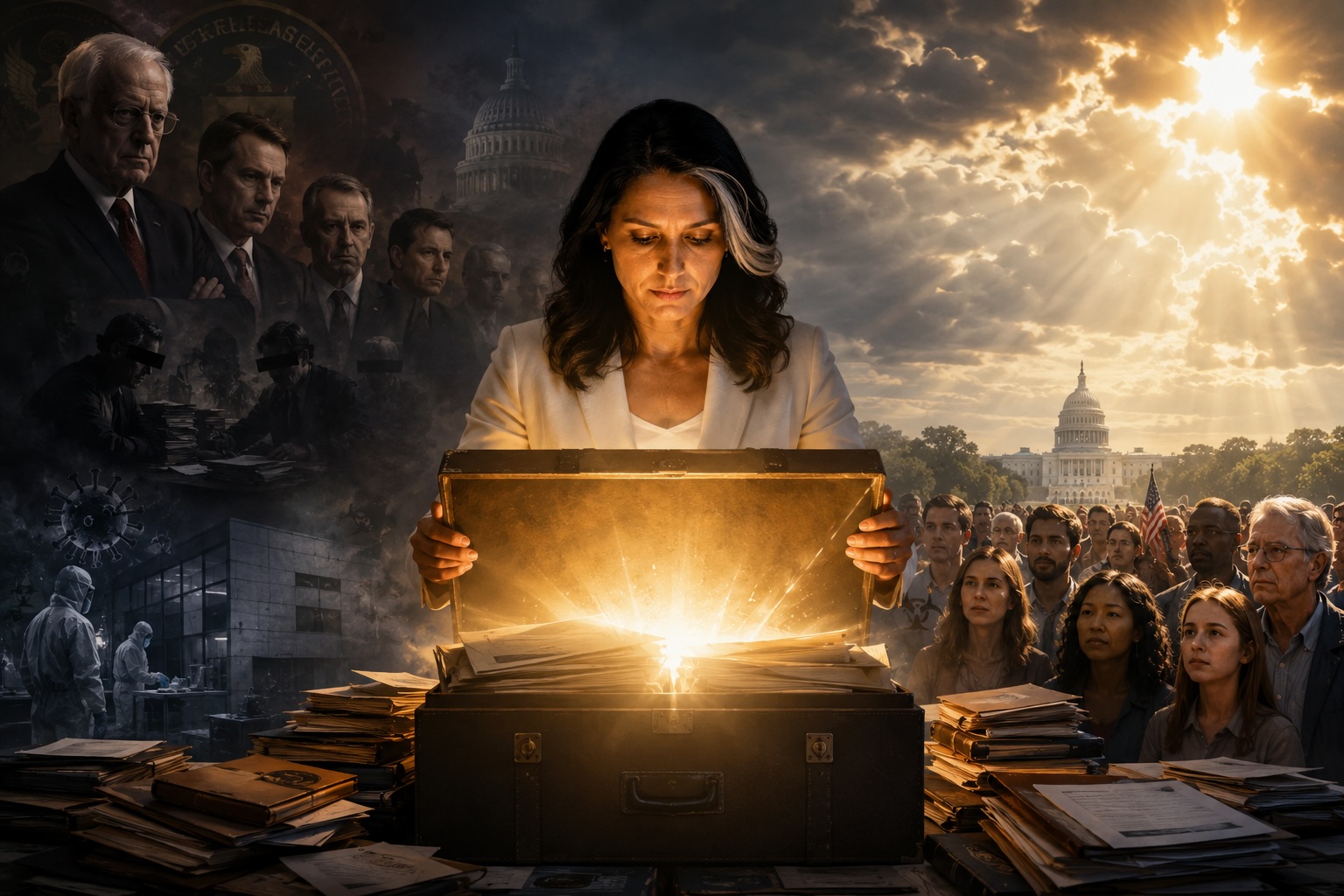
There are moments in history when the veil of official deception is suddenly torn away and the public is permitted to glimpse what powerful people worked desperately to keep hidden. The declassification of COVID-19 origin documents by Director of National Intelligence (DNI) Tulsi Gabbard on June 18, 2026, may prove to be one of those moments. Like the opening of long sealed archives after the fall of a corrupt regime, the release of these documents offers Americans an unprecedented opportunity to examine the origins of the greatest public health catastrophe of our lifetime and the actions of those entrusted with protecting the public interest.
For years Americans were told that questioning the origins of COVID-19 was irresponsible. They were told that the possibility of a laboratory leak was a fringe theory. They were censored on social media, ridiculed by corporate media outlets, and dismissed by government officials. Citizens who simply wanted answers were portrayed as dangerous conspiracy theorists. Yet today, after the release of thousands of pages of declassified records, emails, intelligence materials, and whistleblower information, many of those same questions once considered unacceptable now appear not only reasonable but essential.
The significance of this release cannot be overstated. Tulsi Gabbard’s decision to declassify these materials represents one of the most consequential acts of government transparency in modern American history. Acting under President Donald Trump’s mandate for maximum transparency, Gabbard opened a window into years of bureaucratic maneuvering, scientific controversy, intelligence community infighting, and what many Americans increasingly view as a deliberate effort to suppress uncomfortable truths. The release is not merely about COVID-19. It is about accountability. It is about whether government officials can manipulate information without consequence. Most importantly, it is about whether the American people still possess the right to know what was done in their name and with their tax dollars.
At the center of this controversy stands Dr. Anthony Fauci, who for decades occupied one of the most powerful positions in American public health as Director of the National Institute of Allergy and Infectious Diseases. According to the Office of the Director of National Intelligence (ODNI), Fauci oversaw the distribution of millions of taxpayer dollars that ultimately funded coronavirus research at the Wuhan Institute of Virology in Communist China. The newly released materials argue that this research involved dangerous manipulation of bat coronaviruses and that such work is now widely viewed by many experts as a potential source of the virus that unleashed a global pandemic.
The funding trail itself is no longer seriously disputed. Through grants administered by EcoHealth Alliance under the leadership of Peter Daszak, American taxpayer money flowed to the Wuhan laboratory for years. Public records have long established that approximately six hundred thousand dollars in NIAID funding reached Wuhan researchers between 2014 and 2019. The controversy centers on the nature of the research itself. Critics have argued for years that the experiments constituted gain of function research or closely related forms of viral enhancement. Fauci and his defenders repeatedly denied that characterization. The newly declassified documents reignite that debate with extraordinary force.
What emerges from these records is a portrait of a scientific and intelligence establishment struggling to control a narrative while facing mounting evidence that challenged its preferred conclusions. The documents allege that Fauci recommended specific scientists and experts to intelligence agencies tasked with evaluating the origins of COVID-19. Many of these individuals had direct or indirect connections to federally funded research programs. According to the declassified materials, intelligence agencies frequently incorporated Fauci’s recommendations into their assessments, creating what critics describe as a circular process in which the same small network of experts repeatedly reinforced one another’s conclusions.
One of the most controversial aspects of the release concerns the now famous “Proximal Origin” paper published in March of 2020. That paper became one of the most influential scientific documents of the pandemic. It was repeatedly cited as proof that COVID-19 emerged naturally and was not the product of laboratory activity. Yet subsequent disclosures revealed that several scientists involved in drafting the paper had privately expressed concerns about the virus’s unusual characteristics before publicly dismissing the laboratory leak hypothesis. The new declassified records suggest that Fauci actively promoted this paper as a key reference for intelligence agencies evaluating COVID-19 origins. Critics argue that this transformed what was presented as independent scientific analysis into something far more political and strategic.
The documents also shed new light on early intelligence community debates. According to summaries contained within the release, some intelligence analysts initially favored a laboratory associated origin. There were concerns regarding biosafety procedures at the Wuhan Institute of Virology. There were reports regarding illnesses among laboratory personnel in late 2019. There were questions surrounding unusual genetic features of the virus itself. Yet over time, according to whistleblower accounts cited in the release, analysts who challenged prevailing assumptions allegedly faced intimidation, professional retaliation, and pressure to conform to preferred conclusions.
The image that emerges is reminiscent of a great stone cathedral whose foundation contains hidden cracks. For years the structure appeared stable and authoritative. Citizens were expected to admire its grandeur and trust its architects. Yet beneath the surface, competing interests, conflicting evidence, and institutional self preservation were quietly at work. The declassified documents do not merely reveal isolated disagreements. They suggest the existence of a broader ecosystem dedicated to protecting reputations, preserving funding streams, and avoiding scrutiny.
Particularly troubling are allegations that Fauci’s congressional testimony failed to accurately reflect his interactions with intelligence agencies. According to the Office of the Director of National Intelligence, some newly released materials contradict statements made under oath regarding his knowledge of intelligence community involvement in COVID-19 related matters. These allegations will undoubtedly become the focus of future congressional inquiries and possible legal scrutiny. Whether such accusations ultimately withstand examination remains to be seen, but their seriousness cannot be dismissed.
President Donald Trump deserves substantial credit for insisting that these records be made public. From the earliest days of the pandemic, Trump faced extraordinary opposition when raising questions about Wuhan, Chinese transparency, and the possibility of a laboratory leak. Political opponents mocked him. Media organizations dismissed him. Bureaucrats attempted to marginalize him. Yet history has a remarkable habit of rewarding persistence and punishing arrogance. The declassification ordered under his transparency initiative represents a victory not merely for one political figure but for the principle that government information belongs to the people.
Tulsi Gabbard likewise deserves enormous recognition for her courage in releasing these records. In an era when too many public officials view information as a form of political currency to be hoarded and manipulated, Gabbard chose disclosure over concealment. She chose sunlight over shadows. She chose transparency over bureaucratic self protection. Whether one agrees with every conclusion contained within the released materials is ultimately beside the point. The American people have the right to examine the evidence and reach their own judgments.
The tragedy of COVID-19 extends far beyond infection statistics and economic losses. Millions suffered. Families lost loved ones without the comfort of final goodbyes. Businesses built over generations vanished. Children lost years of education. Entire communities endured isolation, fear, and uncertainty. The pandemic was not merely a medical event. It was a civilizational trauma whose effects continue to reverberate throughout society. Such a calamity demands answers commensurate with its scale.
The search for those answers is far from over. The newly declassified materials do not provide a single definitive document proving precisely how SARS-CoV-2 entered the human population. They do not offer a neat and tidy conclusion that resolves every scientific dispute. What they do provide is something perhaps even more important. They provide transparency. They provide context. They provide evidence that Americans were not wrong to ask difficult questions.
In the end, truth is like a river that disappears beneath the earth. For a time it may be concealed from view. Powerful interests may build structures above it and pretend it no longer exists. Yet eventually the river resurfaces. It finds daylight. It continues its journey toward the sea regardless of how many obstacles stand in its path. The declassification ordered by President Trump and carried out by Tulsi Gabbard represents another place where that river has broken through the surface. The American people now have an opportunity to follow it wherever it leads.
For a nation founded upon liberty, accountability, and the consent of the governed, there can be no higher calling than the pursuit of truth.

