

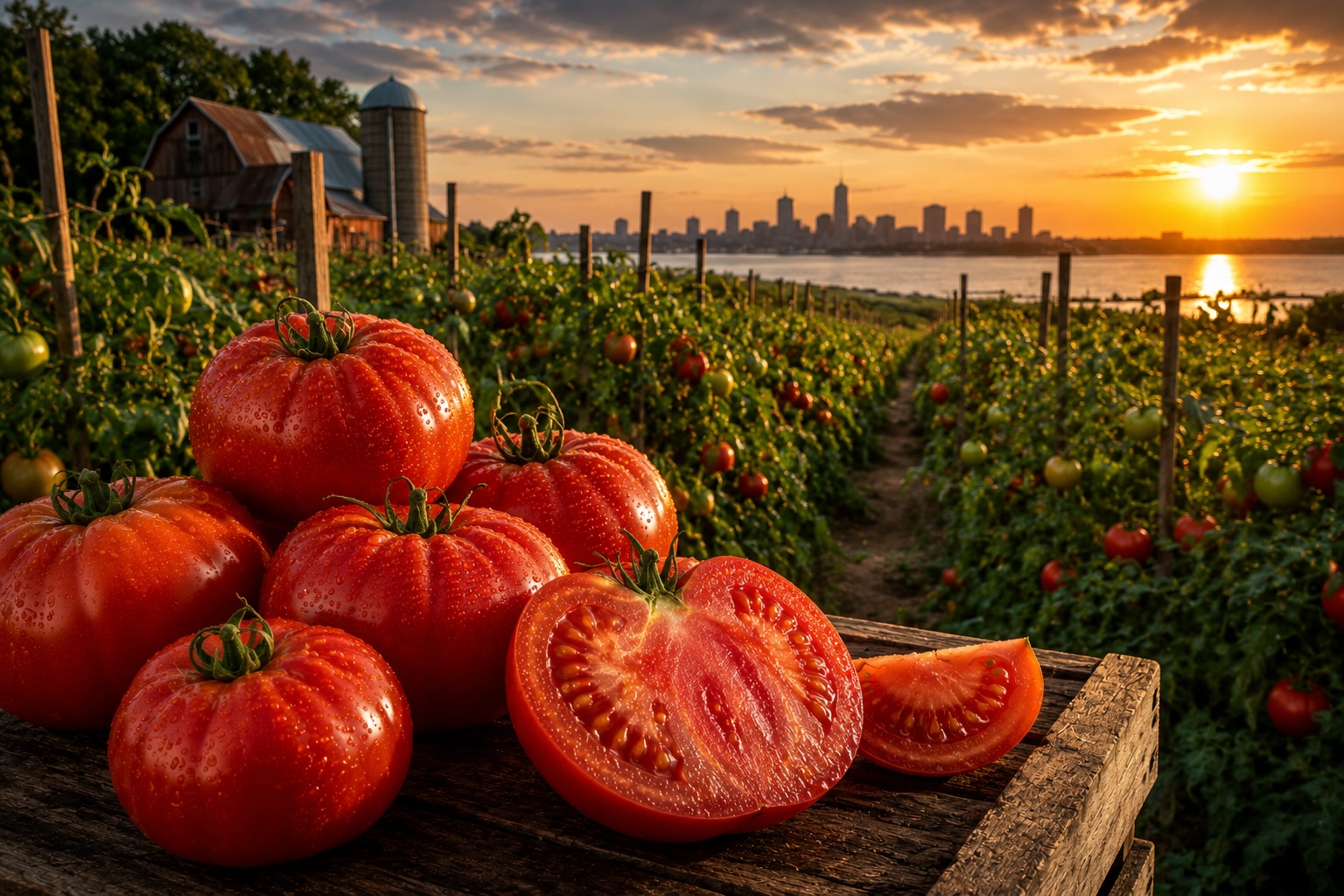
Let me be perfectly clear: there is no fresh tomato on God’s green earth that can touch a Jersey tomato at the height of summer. Not the hard specimens shipped across the continent, not the mealy impostors bred primarily to survive a truck ride, and certainly not the pallid orbs produced in industrial greenhouses where durability matters more than taste. A real Jersey tomato, picked ripe in July or August, is deep red, heavy in the hand, fragrant before the knife touches it, and bursting with that exquisite balance of sweetness and acidity that makes the average supermarket tomato seem like a botanical fraud.
New Jersey is called the Garden State for a reason. Long before the turnpikes, shopping malls, subdivisions, and industrial corridors came to dominate the popular image of the state, New Jersey was an agricultural powerhouse. Its fertile farmland and enviable position between New York and Philadelphia allowed its farmers to supply both cities with fruits, vegetables, grains, and dairy products. The “Garden State” sobriquet is commonly associated with Abraham Browning of Camden, who reportedly described New Jersey in the 19th century as an immense barrel filled with good things to eat, open at both ends, with New York and Pennsylvania reaching in from either side.
Drive through the agricultural stretches of South Jersey and that heritage remains visible. There are fields of sweet corn, peppers, peaches, blueberries, and tomatoes along with roadside farm stands selling produce that may have been harvested only hours earlier. New Jersey may be one of the most densely populated states in America, but beyond its suburban corridors lies an agricultural tradition of remarkable quality.
Its greatest contribution to the summer table is the Jersey tomato. There is no single cultivar called the Jersey tomato. The term encompasses tomatoes grown in New Jersey and several varieties with deep roots in the state’s agricultural history.
Rutgers University deserves particular credit for preserving New Jersey’s tomato tradition. Flavor mattered then, and it matters now. The famous Rutgers tomato was introduced in 1934. The Ramapo, developed at Rutgers and released in 1968, earned a devoted following for its productivity and exceptional flavor. Rutgers later developed the Rutgers 250, drawing upon the parentage of the original Rutgers tomato and selecting specifically for fruit quality and taste. These were tomatoes intended to taste magnificent, not merely to arrive intact at a warehouse.
A great Jersey tomato announces itself immediately. Pick one up and you feel its substance. Bring it close and there is the unmistakable green, earthy fragrance of the vine. Cut through the thin skin and the knife releases crimson flesh and juice. Add a little salt and watch it dissolve across the surface. The first bite delivers sweetness followed by enough acidity to provide brightness and complexity. The juice winds up on the plate and probably on your hand. That is what a tomato is supposed to taste like.
I speak from considerable personal experience. During Ronald Reagan’s 1980 presidential campaign, I was assigned as the campaign’s liaison to former President Richard Nixon, who was then living in Saddle River, New Jersey. Nixon and I subsequently became friends, a friendship that endured until the end of his life. Consequently, I spent a great deal of time in New Jersey during that period and ate more than my fair share of Jersey tomatoes. After decades of subsequent research conducted enthusiastically at the dinner table, I have reached an unshakable conclusion: the Jersey tomato is superior to any other fresh tomato grown in the United States and perhaps anywhere in the world.
There is, however, one important qualification to my tomato supremacy doctrine. As I explained in my article, “My Mother’s Sunday Gravy and the Only Acceptable Tomato” there is only one acceptable tomato for the sacred undertaking of Sunday dinner: the San Marzano. Whether your family calls it sauce or gravy, and mine calls it gravy, Sunday dinner is another matter entirely. My mother, Gloria Rose Corbo Stone, and my grandmother before her understood that a proper Sunday gravy is not something one improvises with whatever tomatoes happen to be sitting on the counter. It is slow simmered, rich, aromatic, and inseparable from the Italian American traditions of family and heritage handed down through generations. For that purpose, the San Marzano reigns supreme. Its concentrated flavor, fleshiness, sweetness, and relatively restrained acidity make it uniquely suited to a long simmer.
The Jersey tomato has a different calling. While the San Marzano owns the pot. The Jersey tomato owns the table. At its peak, a Jersey tomato requires remarkably little culinary intervention. One of the finest ways to eat it is also one of the simplest: the classic tomato sandwich. Take good white or country bread, spread it generously with mayonnaise, add thick slices of Jersey tomato, salt, and freshly ground black pepper. Nothing else is required. The bread catches the juice, the mayonnaise supplies richness, and the tomato remains the undisputed star.
Then there is the BLT. Crisp bacon, lettuce, mayonnaise, toasted bread, and thick slices of a Jersey tomato constitute one of the great achievements of American summer cuisine. For most of the year, bacon carries the sandwich. In New Jersey in August, the tomato can steal the show.
The Italians naturally know what to do with a great tomato. Caprese salad requires only thick slices of Jersey tomato, fresh mozzarella, basil, good extra virgin olive oil, salt, and pepper. Bruschetta combines diced tomatoes with basil, garlic, olive oil, and toasted Italian bread. Panzanella turns tomatoes, basil, olive oil, and day old bread into something greater than the sum of its parts. A simple salad of Jersey tomatoes, cucumbers, thinly sliced red onion, olive oil, red wine vinegar, and fresh herbs is nearly perfect on a hot summer evening.
The common denominator is restraint. When the tomato is exceptional, the cook’s principal responsibility is not to ruin it. That is precisely where the Jersey tomato separates itself from much of what passes for a tomato in the modern supermarket. Commercial agriculture must accommodate an unforgiving distribution system. A tomato traveling hundreds or thousands of miles must withstand harvesting, packing, refrigeration, transportation, warehousing, unpacking, and days on a shelf. Firmness, uniformity, and longevity are valuable commercial attributes, but none is synonymous with flavor. A locally grown Jersey tomato can be harvested much closer to its peak. It does not need the structural integrity of a tennis ball because it was meant to travel from the farm to your table, not from one coast to another.
California is an agricultural colossus, and Florida has an important tomato industry, but tonnage does not determine supremacy. Soil, climate, variety, cultivation, ripeness, and proximity to the consumer matter. Wine enthusiasts accept without argument that geography and climate leave their fingerprints on a grape. The same principle applies to tomatoes.
The Jersey tomato also serves as an edible rebuttal to the tired caricature of New Jersey itself. People whose knowledge of the state begins at Newark Airport and ends on the New Jersey Turnpike miss its beautiful small towns, beaches, horse country, orchards, farms, and agricultural communities. The same state that gave America Thomas Edison’s laboratories, Princeton University, Atlantic City, and the Jersey Shore also produces blueberries, peaches, sweet corn, peppers, strawberries, eggplant, carrots, zucchini, and of course tomatoes of the most extraordinary quality.
A Jersey tomato does not have to look perfect to be perfect. It may be irregularly shaped. It may bruise easily. Its skin may split if neglected. It may not survive three weeks in a refrigerated distribution chain looking as though it were manufactured from plastic. None of that matters because its purpose is not to be indestructible. Its purpose is to be delicious.
Some will accuse me of regional chauvinism. I plead guilty with enthusiasm. My judgment is based on many summers, many meals, and a respectable lifetime sample size. Cut open a ripe Jersey tomato in August, sprinkle it with salt, and take a bite. The evidence speaks for itself.
There is room in my culinary theology for two supreme tomatoes because they perform entirely different jobs. For my mother’s Sunday gravy there is the San Marzano, and I remain immovable on the subject. But when summer calls for a tomato sandwich, a BLT, Caprese salad, bruschetta, panzanella, or simply thick slices with salt and pepper, the Jersey tomato has no peer. The Garden State earned its name by producing exceptional things from the soil. Every July and August, its most delicious evidence ripens on the vine. The Jersey tomato is not merely the best tomato in America. I am becoming increasingly convinced it may be the best tomato in the world.

