

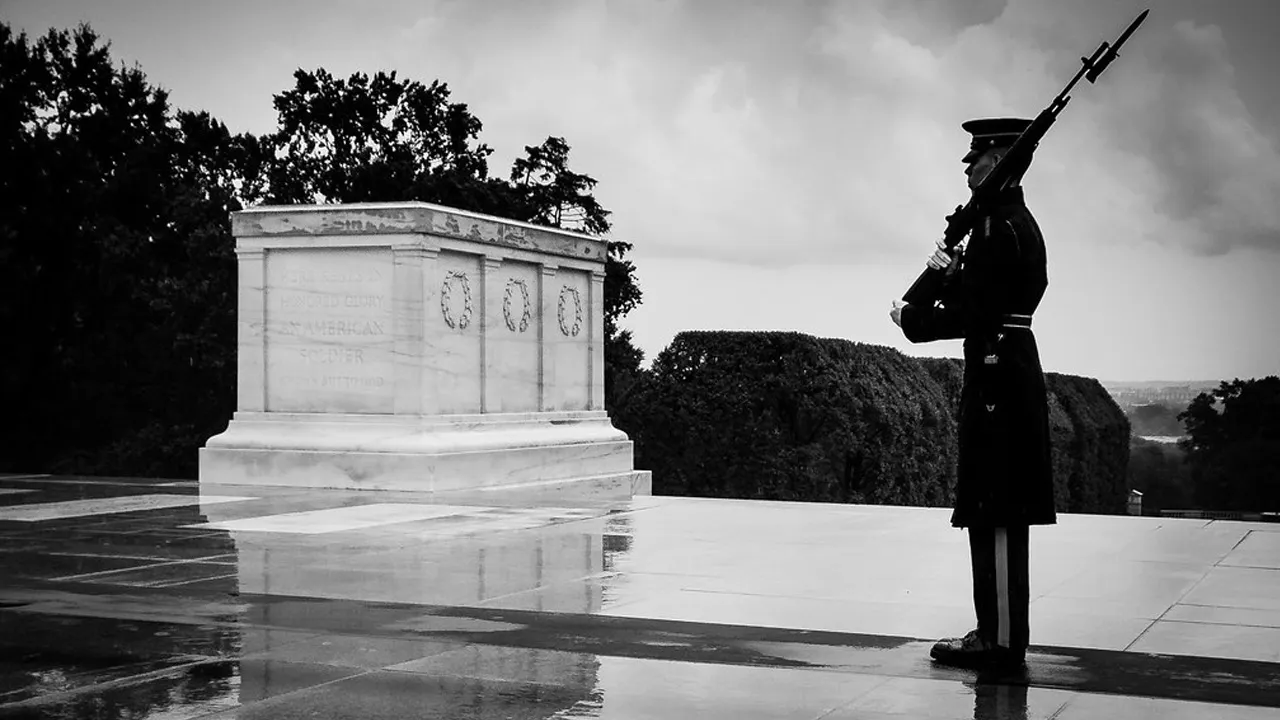
Memorial Day is not a holiday. It is not merely the unofficial beginning of summer. It is not a day for mattress sales, beach traffic, backyard cookouts, beer coolers, or retail promotions wrapped in red, white, and blue bunting.
For millions of Americans, Memorial Day is the worst day of the year. It is the day a mother stares at a folded flag inside a mahogany box. It is the day a widow runs her fingers across the cold marble of a grave at Arlington National Cemetery. It is the day a son remembers the father he barely knew except through medals, photographs, and stories whispered through tears.
Memorial Day is a sacred day of remembrance consecrated by blood, grief, sacrifice, and duty. It is a day when America must bow her head before the altar of the fallen and remember that freedom is not free.
Freedom is purchased in flesh and blood by young Americans who climbed hills under machine gun fire, stormed beaches under artillery barrages, flew burning aircraft into enemy skies, froze in foxholes, drowned in distant seas, and marched into battle knowing they may never return home again.
The story of Memorial Day begins not in comfort but in catastrophe. Its origins were born from the smoldering ashes of the American Civil War, the deadliest conflict ever fought on American soil. The first formal Memorial Day observances emerged when grieving Americans decorated the graves of Union soldiers with flowers in what became known as Decoration Day. Yet the true roots of American sacrifice stretch back even further to Lexington and Concord on April 19, 1775 when a colonial militia stood before the most powerful empire on earth, The British Empire, and answered tyranny with musket fire. Ralph Waldo Emerson later immortalized that first exchange as “the shot heard round the world,” because it was not merely the beginning of a revolution. It was the birth of an idea unlike any other in human history. America was founded upon the radical belief that our rights come from God, not kings, not governments, not bureaucracies, and not tyrants.
That idea has been defended ever since by generations of American warriors whose courage forged the republic in every era of danger and uncertainty. The first Americans to die under the flag of the United States fell during the Revolutionary War. Approximately 4,435 American soldiers were killed in combat during the Revolution, while more than 25,000 died overall from disease, exposure, imprisonment, and deprivation. The Continental Army bore the overwhelming burden, though colonial militias and early naval forces also suffered losses.
Shortly after independence, America confronted the Barbary Wars, conflicts many modern Americans barely remember but which shaped the nation’s understanding of sovereignty and military power. The Barbary Wars were fought against North African pirate states including Tripoli, Algiers, Tunis, and Morocco, whose rulers kidnapped sailors, enslaved Christians, hijacked merchant ships, and extorted tribute payments from Western nations. European powers often paid the pirates for safe passage. America refused. Thomas Jefferson understood that a republic unwilling to defend itself would soon cease to exist. During the First Barbary War from 1801 to 1805, approximately 35 Americans were killed in battle, primarily sailors and Marines. Total deaths were roughly 74. The Second Barbary War in 1815 resulted in approximately 4 battle deaths and roughly 138 total deaths. These early conflicts cemented the United States Navy and Marine Corps as guardians of American commerce and freedom abroad.
The War of 1812 followed, often called “America’s Second War for Independence”. British forces burned their way through Washington, D.C. while American soldiers and sailors fought desperately to preserve the young republic. Approximately 2,260 Americans were killed in battle and roughly 15,000 died overall, most from disease. The Army accounted for approximately 1,950 battle deaths, while the Navy lost around 265 personnel and the Marine Corps lost roughly 45.
The Mexican-American War from 1846 to 1848 expanded the United States across the continent but came at terrible cost. Approximately 1,733 Americans were killed in battle and more than 13,000 died overall. The Army suffered nearly all battle casualties while Marines and Navy personnel also perished in combat operations.
Then came the American Civil War, the great national crucible that nearly destroyed the republic entirely. Brother fought brother. Entire towns lost their young men in a single afternoon. More than 655,000 Americans died overall, including approximately 215,000 battle deaths between Union and Confederate forces. The overwhelming majority served in the Army while naval losses were significantly smaller. The Civil War remains the deadliest conflict in American history because Americans killed other Americans on an industrial scale never before seen on this continent.
After the Civil War came the Indian Wars, frontier conflicts, interventions, and overseas operations. Thousands more Americans died during campaigns against hostile tribes, during the Seminole Wars, and in smaller military expeditions that secured and expanded the nation. The Boxer Rebellion in China claimed approximately 68 American battle deaths. The Spanish American War in 1898 cost approximately 385 battle deaths and roughly 2,446 total deaths. The Philippine American War that followed claimed approximately 1,020 battle deaths and more than 4,000 total deaths.
World War I introduced America to trench warfare, mustard gas, machine guns, and industrialized death on a horrifying scale. More than 53,000 Americans were killed in battle and over 116,000 died overall. The Army and American Expeditionary Forces bore the brunt of combat losses while the Navy and Marine Corps also sustained significant casualties.
World War II transformed the entire planet into a furnace of violence. The United States lost approximately 291,557 battle dead and more than 405,000 total military personnel. The Army and Army Air Forces suffered more than 318,000 deaths. The Navy lost more than 62,000. The Marine Corps lost more than 24,000. The Coast Guard lost nearly 2,000. Young Americans crossed oceans to storm Normandy, fight through the jungles of the Pacific, liberate concentration camps, and destroy fascism and Japanese militarism. Entire cemeteries across Europe and Asia now stand as eternal monuments to American sacrifice.

