

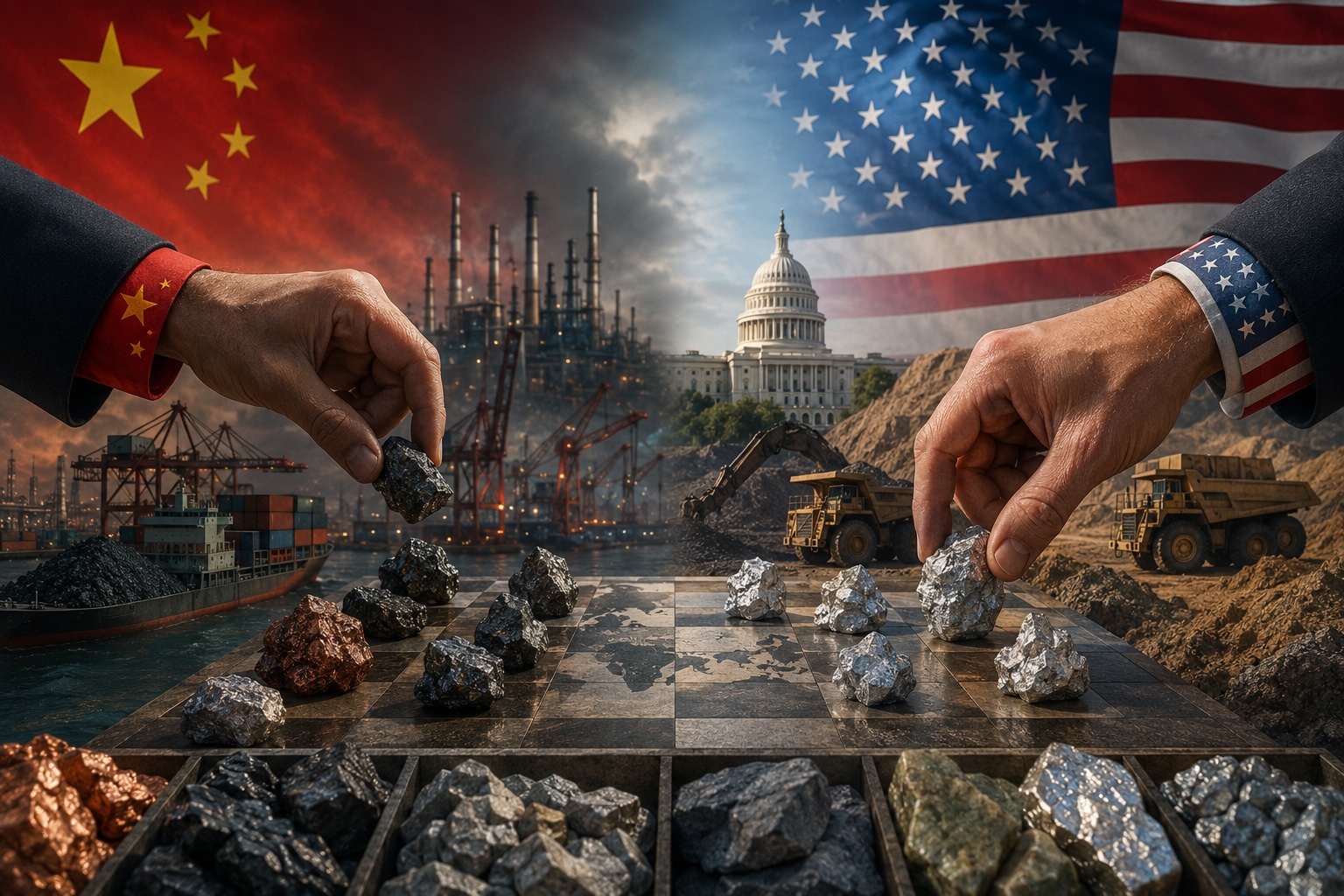
Not long ago I wrote of how China’s dominance over critical minerals has transformed these resources into a central national security priority for the United States. As dependence on adversarial supply chains now poses an urgent strategic risk that must be reduced before it can be weaponized.
Throughout history, the greatest powers have risen not simply because they possessed courageous soldiers or brilliant generals, but because they secured the resources necessary to sustain their civilizations during moments of crisis. The Roman Empire depended upon grain from Egypt. Great Britain’s maritime supremacy rested upon coal, iron, and an unrivaled merchant fleet that connected every corner of the globe. During the Second World War, President Franklin Roosevelt transformed the United States into the Arsenal of Democracy because America possessed the industrial capacity and raw materials necessary for the Allied forces to outproduce the Axis powers. Today’s battlefield extends far beyond aircraft carriers, missiles, and satellites. It reaches deep beneath the earth’s surface, where a relatively obscure collection of minerals has become every bit as strategically valuable as oil was during the 20th Century. The nation that controls these materials will enjoy an enormous advantage in military power, artificial intelligence, aerospace engineering, semiconductor manufacturing, quantum computing, and advanced industrial production.
Many Americans understandably ask why the United States cannot simply mine everything it needs within its own borders. The answer lies in a combination of geology, economics, infrastructure, and time. Although America possesses significant deposits of certain critical minerals, many of those reserves remain commercially undeveloped, are difficult to extract economically, or lack the processing infrastructure necessary to transform raw ore into materials suitable for advanced manufacturing. Opening a modern mine frequently requires years of environmental reviews, permitting, engineering, financing, and construction before a single shipment reaches an American factory. Even then, the United States often lacks sufficient domestic refining capacity, forcing raw materials to be processed overseas before they can be incorporated into military equipment or commercial products. Simply put, America currently consumes far more strategic minerals than it can produce and refine on its own. That reality demands a practical strategy rooted in diversification rather than wishful thinking.
This is precisely why recent efforts to secure access to Kazakhstan’s enormous tungsten deposits deserve careful consideration. Tungsten is not a household name, yet it is one of the most strategically indispensable metals on Earth. Derived from the Swedish phrase meaning “heavy stone,” tungsten possesses the highest melting point of any pure metal, exceeding 6,100 degrees Fahrenheit. It is extraordinarily dense, remarkably hard, and exceptionally resistant to heat, wear, and deformation. Those extraordinary physical characteristics make tungsten irreplaceable in countless military and industrial applications. It is used in armor piercing ammunition, missile guidance systems, hypersonic weapons, jet engine turbine blades, rocket nozzles, spacecraft components, advanced machine tools, semiconductor manufacturing equipment, mining machinery, and precision industrial cutting instruments. If steel formed the backbone of the Industrial Revolution, tungsten has become one of the indispensable skeletal structures supporting the technological revolution of the modern age.
The strategic importance of tungsten extends well beyond military hardware. Every sophisticated manufacturing economy relies upon tungsten to produce the machinery that builds other machinery. High precision cutting tools capable of shaping hardened steel, titanium, and aerospace alloys depend upon tungsten carbide because few other materials can withstand the tremendous friction and temperatures generated during modern manufacturing. Semiconductor fabrication facilities use tungsten in integrated circuits and advanced chip production. Energy exploration, medical imaging equipment, aviation, telecommunications, and countless other industries rely upon tungsten’s unique physical properties. Remove tungsten from the global economy, and the intricate machinery of advanced civilization begins to seize like an engine deprived of lubricating oil. It is one of those rare materials whose importance far exceeds public awareness.
Unfortunately, Communist China recognized tungsten’s strategic value decades before much of the Western world awakened to the danger. Through patient planning, state subsidies, acquisitions, and relentless industrial expansion, Beijing now controls roughly 80% of global tungsten production while simultaneously dominating large portions of the processing infrastructure necessary to convert raw ore into finished products. This strategy was neither accidental nor purely commercial. It reflected a sophisticated understanding that controlling indispensable resources creates leverage over nations whose industries cannot function without them. A country need not fire a missile if it can instead interrupt the supply of materials required to manufacture missiles in the first place. Economic coercion, carefully applied, can often achieve objectives that conventional warfare cannot.
Tungsten represents only one piece of a much larger strategic mosaic. Rare earth elements such as neodymium, dysprosium, terbium, praseodymium, yttrium, and gadolinium enable the powerful permanent magnets found in advanced fighter aircraft, submarines, guided missiles, radar systems, robotics, and artificial intelligence hardware. Gallium and germanium remain indispensable for semiconductors, infrared sensors, fiber optic communications, and sophisticated military electronics. Antimony strengthens specialized ammunition and military alloys. Niobium enhances aerospace components capable of withstanding extraordinary stress. Tantalum permits advanced electronic systems to function under extreme conditions. Lithium, cobalt, graphite, nickel, and manganese form the backbone of modern battery technology that powers everything from military drones to energy storage systems. Individually, these names may seem esoteric. Collectively, they constitute the periodic table upon which America’s military superiority and technological leadership increasingly depend.
Lithium deserves particular emphasis because it has become the petroleum of the electrified era. Every serious discussion involving electric vehicles, grid scale battery storage, portable electronics, artificial intelligence infrastructure, autonomous systems, and military energy resilience inevitably returns to lithium. Yet the United States remains heavily dependent upon imports because domestic production cannot presently satisfy projected demand. Argentina, Chile, and Australia possess some of the world’s richest lithium reserves, while Canada and Brazil continue expanding their own production. Developing America’s own deposits remains essential, but even optimistic projections acknowledge that domestic mining alone cannot satisfy near term requirements. Until additional American production becomes operational, partnerships with trusted allies remain indispensable.
The emerging partnerships with nations such as Kazakhstan, Canada, Australia, Chile, Argentina, and Brazil should therefore be understood not as evidence of weakness but as examples of strategic realism. During the Second World War, the Allied victory depended upon an intricate international network supplying aluminum, chromium, manganese, rubber, copper, and countless other strategic materials. No serious historian argues that America should have attempted complete economic isolation while fighting a global war. The same principle applies today. Diversifying supply chains among trusted allies reduces the risk that any hostile power can strangle America’s industrial base through economic coercion. Strategic partnerships strengthen national sovereignty because they reduce dependence upon adversaries rather than increasing it.
The Chinese Communist Party (CCP) has already demonstrated its willingness to employ export controls as instruments of geopolitical leverage. Restrictions involving rare earth elements and other strategic materials have disrupted manufacturing, delayed production schedules, increased costs, and reminded policymakers that economic warfare has become an integral component of modern statecraft. America’s military cannot remain dependent upon supply chains controlled by a geopolitical rival whose long term ambitions increasingly conflict with the interests of the United States and the broader free world. National security in the 21st Century requires more than aircraft carriers, fighter squadrons, and missile defense systems. It requires secure access to the elemental building blocks from which those weapons are manufactured.
The path forward is neither isolationism nor blind globalization. America must aggressively develop its own mines, modernize domestic processing facilities, encourage scientific innovation, strengthen strategic stockpiles, expand recycling technologies, and reduce unnecessary regulatory barriers that delay responsible mineral development. At the same time, the United States must continue forging long term partnerships with friendly nations possessing the resources that America presently lacks in sufficient quantity. This dual strategy combines self reliance with strategic diversification, ensuring that no hostile nation can ever again hold America’s industrial future hostage.
The New Cold War will not be won solely by the nation possessing the largest military budget or the most sophisticated weapons. It will be won by the nation capable of securing the indispensable resources that make those weapons possible in the first place. The minerals buried beneath the soil of Kazakhstan, Australia, Canada, Chile, Argentina, Brazil, and other friendly nations are far more than commercial commodities. They are the raw ingredients of American sovereignty, industrial resilience, technological leadership, and military preparedness. Recognizing that reality today will spare the United States from confronting a far more dangerous reality tomorrow, when rebuilding broken supply chains may prove infinitely more difficult than preserving them now.

