

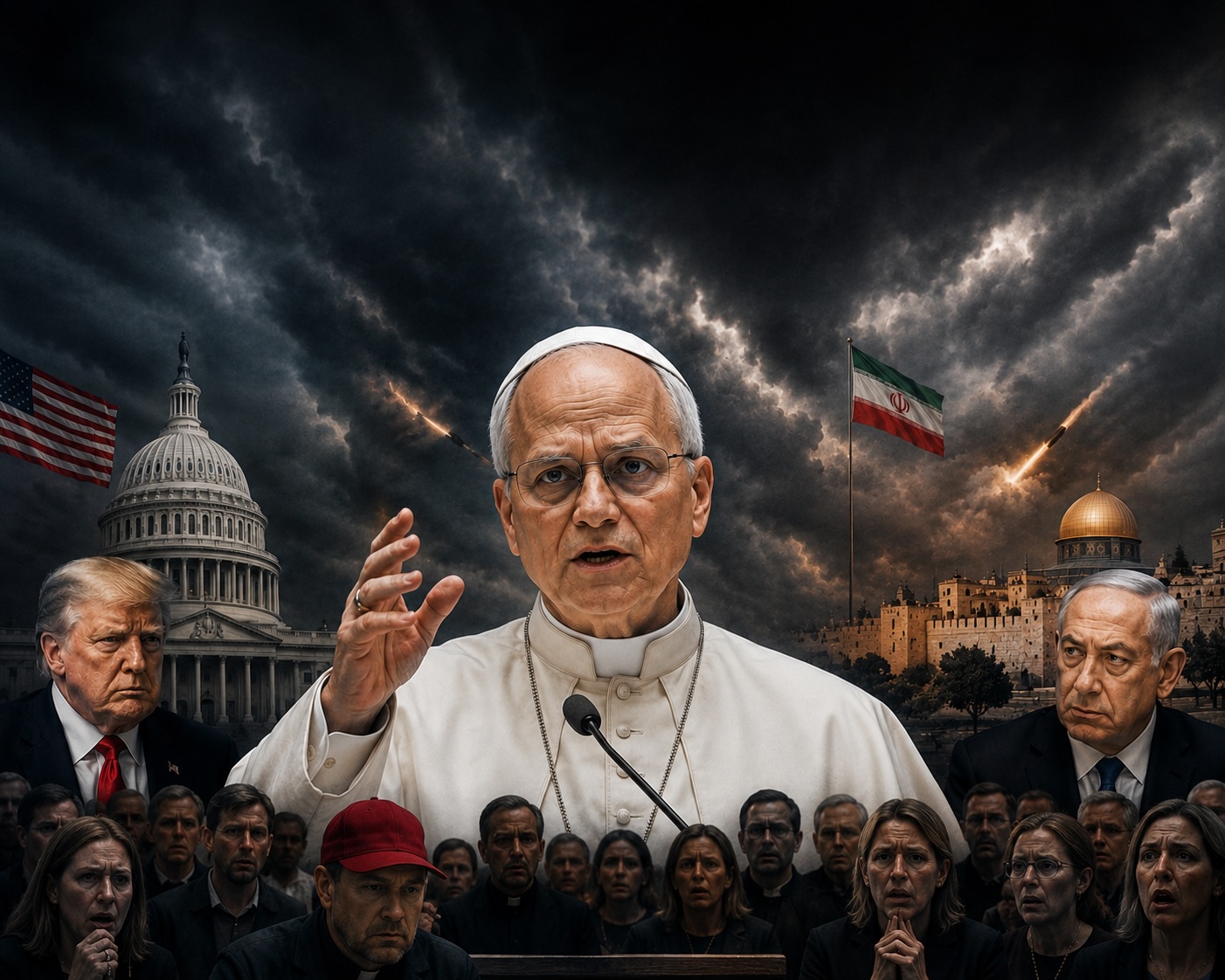
When the white smoke rose above the Sistine Chapel on May 8, 2026 and Robert Prevost emerged as Pope Leo XIV, the world expected continuity, ritual, and the careful cadence of Vatican diplomacy. Instead, the world received a pontiff who stepped directly into one of the most combustible geopolitical infernos of the modern age. As missiles streak across the Middle East, as Iran rattles the saber of regional war, and as Western civilization stands at the precipice of another epoch defining conflict, Pope Leo has become an increasingly controversial figure in the moral and political struggle surrounding Iran, Israel, and the future of Christendom itself.
The Vatican has long portrayed itself as the custodian of conscience amidst the barbarity of war. Yet in recent months Pope Leo XIV has inserted himself into the Iran crisis with rhetoric that has sent shockwaves through Washington, Jerusalem, and among millions of conservative Catholics across the world. While President Donald Trump has pursued a doctrine of overwhelming strength against the Iranian regime, Pope Leo has repeatedly emphasized ceasefires, negotiations, restraint, and what he calls the moral catastrophe of escalation.
This ideological collision between temporal power and spiritual authority has erupted into one of the most extraordinary confrontations between an American president and a sitting pope in modern history.
President Trump, who has always viewed the Iranian regime as a malignant revolutionary empire masquerading as a nation state, has made clear that the world cannot permit Tehran to obtain nuclear capability. His position is not merely political. It is civilizational. The Islamic Republic of Iran has spent decades funding terrorism, destabilizing governments, financing proxy militias, threatening Christians throughout the Middle East, and chanting for the destruction of both Israel and America. The ayatollahs are not misunderstood diplomats in flowing robes. They are ideological fanatics presiding over a theocratic fortress built upon repression, bloodshed, and anti Western hatred.
Pope Leo, however, has increasingly framed the conflict through the language of humanitarian catastrophe and spiritual suffering. In March he publicly pleaded for a ceasefire and declared that “violence can never lead to justice.” He warned that the Middle East was descending into “an irreparable abyss” and called for renewed dialogue with Tehran and other actors in the region.
Those statements ignited immediate backlash from supporters of President Trump, who viewed the Vatican’s rhetoric as dangerously detached from geopolitical reality. The President himself reportedly exploded after Leo condemned what he called the “delusion of omnipotence” fueling the war against Iran.
Trump responded with the blunt force vocabulary that has defined his political career. According to multiple reports, the President accused Pope Leo of being “weak on crime” and “terrible for foreign policy,” while rejecting any insinuation that confronting Iran represented reckless militarism.
The clash escalated even further after Trump accused the pontiff of effectively enabling Iran’s nuclear ambitions, a claim the Vatican angrily denied. Pope Leo publicly reaffirmed that the Catholic Church opposes nuclear weapons entirely and insisted that dialogue is preferable to war.
Yet many conservatives across Europe and the United States are asking an uncomfortable question. What exactly does diplomacy with Tehran accomplish after decades of deception, proxy warfare, hostage taking, and terrorism?
History teaches painful lessons about regimes animated by ideological absolutism. Neville Chamberlain believed signatures and smiles could restrain Hitler. Countless Western leaders convinced themselves that tyrannies could be managed through process, concession, and accommodation. The twentieth century became a graveyard for those illusions. Strength preserved freedom. Weakness invited catastrophe. That reality hangs over the Iran crisis like a thundercloud.
Iran is not Switzerland with minarets. It is a violent revolutionary state governed by clerics who have spent generations constructing a regional network of militancy stretching from Lebanon to Yemen. The regime survives through fear, surveillance, executions, censorship, and the manipulation of religious fervor. Even inside Iran itself, the regime has repeatedly shut down communications, crushed dissent, and brutalized protesters desperate for liberty.
President Trump understands that reality instinctively. He views deterrence not as cruelty but as necessity. The Trump Doctrine has always operated on one central premise. Peace comes through unmistakable strength. Civilization survives when its enemies know there are consequences for aggression.
Pope Leo views the matter differently. His critics argue that his language too often resembles the abstract moralism of European elites who enjoy the luxury of geographic distance from the regimes they condemn only softly. His defenders counter that the mission of the papacy is not military strategy but the preservation of human dignity amid chaos.
But therein lies the deeper conflict. The Vatican speaks the language of universal mercy. Donald Trump speaks the language of strategic realism. One believes peace can emerge through dialogue. The other believes evil advances when strength hesitates. Neither side lacks conviction. Neither side lacks influence.
This confrontation has now spilled openly into international diplomacy. Secretary of State Marco Rubio traveled to the Vatican in an effort to repair relations between Washington and the Holy See after weeks of increasingly bitter exchanges. Vatican officials described the meetings as cordial but noticeably restrained, an extraordinary departure from the carefully polished language that usually governs Vatican diplomacy. Yet beneath the diplomatic choreography lies a deeper truth.
The world is entering an era where moral authority and political authority are colliding with increasing ferocity. The old post Cold War assumptions have collapsed. The age of polite globalism is dying. Nations are rearming. Religious identity is resurging. Civilizations are hardening into rival blocs. And somewhere in the center of this geopolitical earthquake stands an American pope confronting an American president over the future of war and peace.
For faithful Catholics, the moment is agonizing. Millions revere the papacy while simultaneously believing the Iranian regime represents one of the greatest threats to global security in the modern era. They hear Pope Leo’s calls for peace and admire the spiritual sincerity behind them. But they also understand that tyrannies are not dismantled through sentimentality.
History is rarely kind to civilizations that lose the will to defend themselves. The tragedy of this moment is that both Pope Leo and President Trump believe they are acting in defense of humanity itself. One fears the apocalypse of endless war. The other fears the apocalypse of unchecked evil.
The stakes could not be higher because if Iran ever succeeds in obtaining nuclear weapons, the world will not remember diplomatic communiqués, Vatican appeals, or carefully crafted statements from international summits. It will remember whether the West possessed the courage to stop a revolutionary regime before the balance of civilization itself tipped into darkness.

